Jack Stands

Reliability Analysis of Jack Stands’ Locking and Adjustment Mechanisms: Pawls, Threads, and Hydraulic Structures

Reliability Analysis of Jack Stands' Locking and Adjustment Mechanisms: Pawls, Threads, and Hydraulic Structures

The garage is usually quiet at night.
The faint clicking of metal is amplified in this silence. It’s at this moment that many people first seriously consider: Is Jack Stand really “locked up”?

The risks associated with support structures often don’t occur at the moment of lifting but rather are hidden in the stage where the structure “appears stable.” The locking and adjustment mechanisms are the core factors determining whether this stability truly exists.

Today we’ll break down three common jack stand structures—pawl, threaded, and hydraulic—and their respective engineering logic, potential failure paths, and reliability differences exposed in real-world usage environments.

Why is the “locking mechanism” more worthy of discussion than load-bearing parameters?

In the accident review materials, a recurring commonality is that
The support did not fail due to overload but rather because “the locking was not truly completed” or “the adjustment structure shifted after being subjected to force.”

This is why simply discussing the rated load capacity of a jack stand cannot explain most accidents.

From an engineering perspective, the locking and adjusting mechanisms perform two tasks:

  • Transform the “height adjustment action” into a static load-bearing state.
  • When the force path changes, prevent the structure from retreating or collapsing.

If any link in the chain is uncertain, the support will no longer be predictable.

A pawl-type jack stand: a structure that relies on meshing rather than friction.

The ratchet-type structure is the most common type of jack stand.
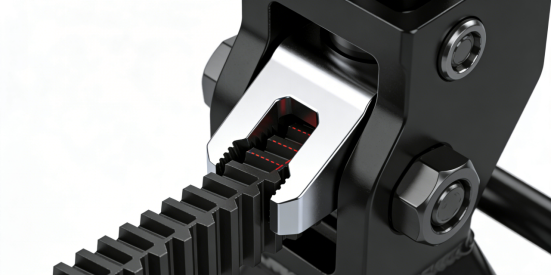
It achieves segmented height adjustment through the mechanical engagement of a rack and pinion with a ratchet.

The advantages of this project are clear:

  • The force path is clear, and the vertical load is directly transmitted to the tooth surface.
  • Locking relies on geometric engagement, not surface friction.
  • The structure is simple, and the failure modes are relatively predictable.

However, the problems are also concentrated.

In practical use, the risks of a ratchet-type jack stand mainly come from three aspects:

  • Incomplete engagement of tooth surfaces (common during rapid descent)
  • Foreign objects or rust can cause insufficient pawl rebound.
  • The lateral force caused by the change in the vehicle’s center of gravity results in an off-center load on the tooth surface.

In these cases, the surface may appear to be “stuck,” but the effective stress-bearing area may only be a portion of the design value.

Pawl ratchet Jack Stand locking mechanism diagram

Key judgment point:
A truly reliable pawl lock must meet the requirements of “full tooth contact + reconfirmation after weight-based return.” Without secondary confirmation, the lock is merely psychological.

Threaded adjustment mechanism: high precision, but extremely sensitive to user habits.

Threaded jack stands are often considered more “precise.”
Continuous adjustment and finely divided height lead many users to mistakenly believe that they are inherently safer.

From an engineering perspective, the load-bearing capacity of a threaded structure depends on:

  • Thread engagement length
  • Material shear strength
  • Reverse torque control in use

The problem is that threads are not naturally self-locking structures.

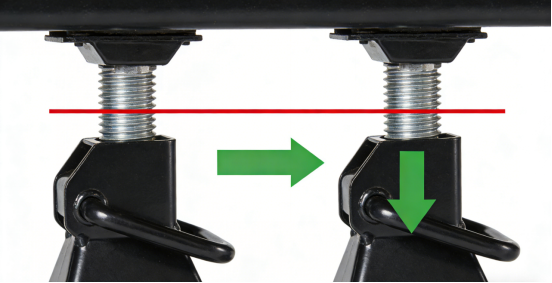
In many structural failure analyses I’ve participated in, the typical risk of threaded jack stands is not fracture but slow backlash. This backlash is almost imperceptible to the naked eye, but it gradually amplifies over long periods of operation.

Common triggers include:

  • The vehicle’s weight shifted forward and backward during the repair process.
  • Temperature changes cause micro-expansion of metal
  • Insufficient initial locking force or lack of mechanical limit switch
Threaded Jack Stand backlash and wear failure example

The conclusion is not complicated:
A threaded structure does not mean it is not dangerous; it simply changes the risk from “instantaneous failure” to “gradual shift.”

Hydraulic structure: easy to adjust, but should not be used for long-term support.

Hydraulic adjustment is common in lifting tools, but when it appears on a jack stand, it requires extra caution.

The essence of a hydraulic system is sealing and pressure balance.
This means:

  • Even the smallest leak can translate into a highly variable situation.
  • Seal aging is a matter of time, not probability.

In reality, the most common misconception about hydraulic Jack Stands is
using “short-time operation” as a safety justification.

However, from an engineering reliability perspective, hydraulic structures are not suitable for static, long-term, and unmonitorable support tasks. They are better suited as “adjustment aids” rather than “final lock-in.”

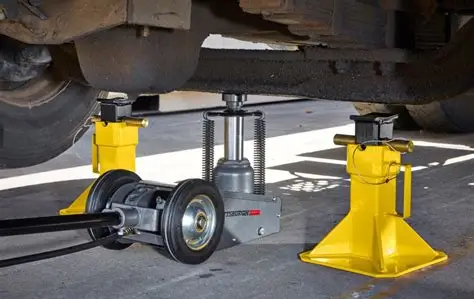
Hydraulic Jack Stand pressure loss reliability warning

A principle that has been repeatedly proven is that
If the support height is maintained entirely by hydraulic pressure, then the risk is only postponed, not eliminated.

Reliability comparison of three structures

Structure typeLocking logicMain risksPredictability
ratchetGeometric meshingIncomplete meshinghigh
ThreadedThread friction + meshingSlow rollbackmiddle
HydraulicPressure maintenancePressure relief and agingLow

This table is not a “ranking of superiority and inferiority,” but rather helps to understand how the risks are distributed behind different jack stand designs.

[Not sure how to choose? Check out our carefully selected high-quality jack stands ]

What do you really rely on: structure or luck?

Many jack stand incidents are not due to design failures, but because users interpret “locking” as an action rather than a state.

The next time you hear that “click,” perhaps pause for an extra second to reconfirm whether the force path is clear and whether the locking is truly complete. If you want to minimize this uncertainty, you can return to the Jack Stand anchor text and systematically outline the error-proofing logic for different risk scenarios.

True security does not come from a particular structure, but from whether you can foresee how it will fail.

>>> The Ultimate Guide to Choosing a Jack Stand: In-Depth Analysis of Safety and Applicability

author-avatar

About Gavin Reid

Gavin Reid has been obsessively analyzing garage safety protocols and vehicle support systems for over a decade. After transitioning from a professional service bay to independent safety consulting in 2020, Gavin realized the market was flooded with confusing weight ratings and compromised designs that offered a false sense of security. His Mission: To help DIY mechanics—especially home hobbyists—identify critical failure points in vehicle lifting and ensure every project ends safely. Why Trust Gavin: Engineering Obsessive: He dissects load paths and weld integrity. From metallurgy to geometric stability, he understands the physics that keep two tons of steel from crushing a human chest. Data-Driven Testing: Gavin has stress-tested 40+ models, evaluating lateral stability and locking redundancy rather than just "marketing tonnage." In the Garage: He’s a fixture in local DIY communities, frequently inspecting frame rails for pinch weld placement and documenting metal fatigue on aging gear. Gavin believes that "a lapse in physics is a permanent mistake." He is dedicated to teaching mechanics how to maintain a "zero-trust" relationship with their equipment. Would you like me to provide Gavin’s specific checklist for identifying structural fatigue in used jack stands?