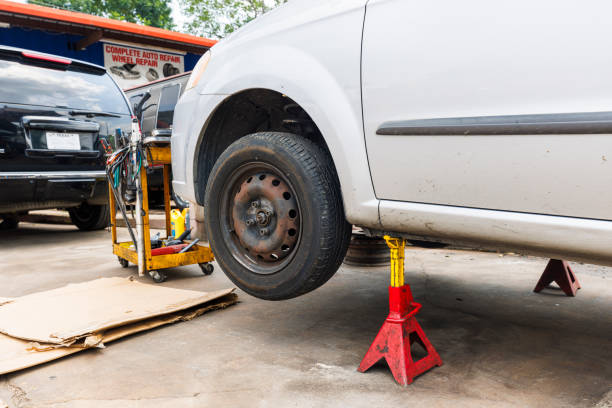
Jack Stands

The Real Cost of the Jack Stands Accident: How Much Money Can Be Lost from a Single Support Failure?

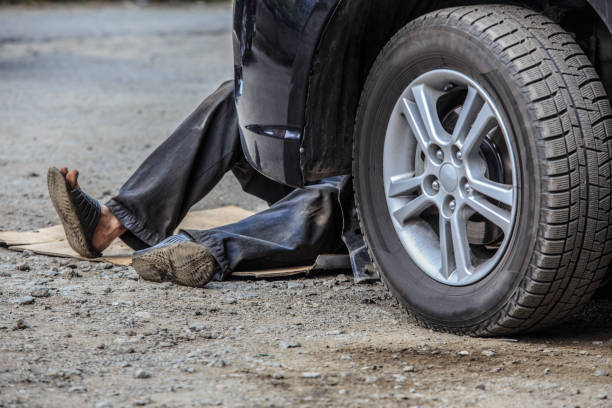
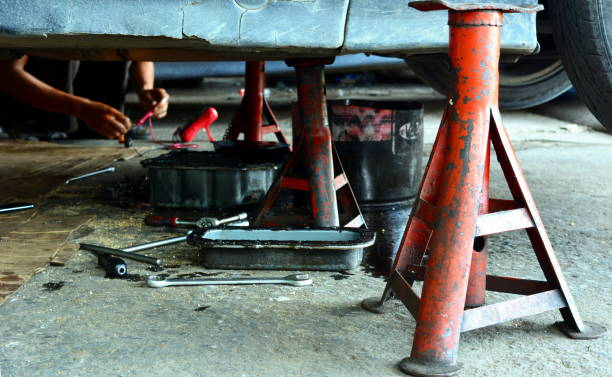
Person working unsafely under a car, highlighting the need for proper Jack Stands for safety.

In the pursuit of efficiency and cost savings, one detail is often overlooked: the seemingly insignificant jack stands. You might think it’s just a simple support tool to hold the car up securely.

But I want to tell you that the cost of a jack stand failure accident goes far beyond the visible vehicle damage; it can uncover a bottomless, hidden abyss. Today, let’s calmly and rationally dissect this risk.

Beneath the surface: The hidden costs of accidents far exceed expectations.

When a vehicle accidentally falls from a jack stand, the impact of that instant results in far more than just a few scratches or a dent.

Direct property damage: Bill for vehicle damage

First and foremost, the most direct impact is damage to the vehicle itself. If the vehicle becomes unstable or overturns on jack stands, the chassis and body structural components will be the first to be affected.

  • Damage to vehicle body structural components: For example, the pinch welds (welds below the door sills), chassis beams, subframe, and even the suspension system can deform or break due to impact. Repairing these damaged components is extremely complex, often requiring cutting and welding, which is not only costly in terms of labor but can also affect the vehicle’s overall rigidity and safety. I have seen cases where improper selection of support points led to permanent deformation of the pinch welds, which not only affected the vehicle’s resale value but also created potential problems for future repairs.
  • Potential damage to core components: The violent shock from a sudden vehicle drop can impact core components such as the engine, transmission, and exhaust system. While these damages may not be visible on the surface, internal sensors, pipes, connectors, and even the gearbox can develop tiny cracks or shifts. For example, if the oil pan is impacted, it can lead to oil leaks, potentially causing more serious engine failure. Diagnosing and repairing these hidden damages often costs far more than you expect, sometimes even reaching the level considered the most expensive part of a car to damage.
  • Damage to the residual value of an accident vehicle: Even after repairs, a serious car accident record will significantly reduce its value in the used car market. Buyers are generally cautious about accident-damaged vehicles, and even the most perfect repairs may not fully restore their original value.
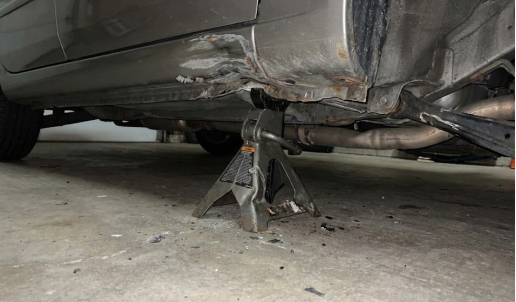
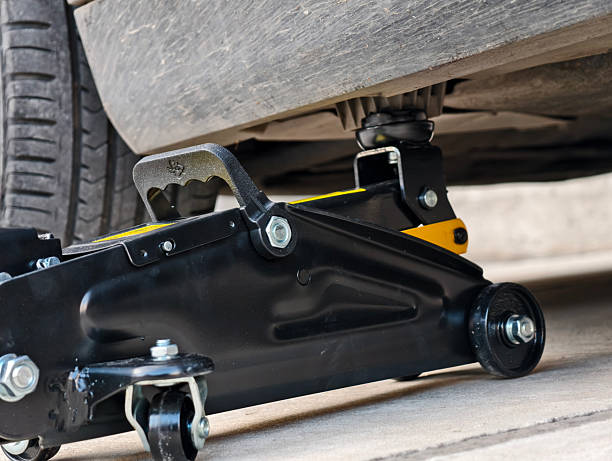
A single jack stand supports a car's undercarriage on a concrete floor.

Personal injury: The most expensive “tuition fee”

Compared to vehicle damage, the cost of personal injury is often far greater and more difficult to quantify in monetary terms.

  • From minor scrapes to severe consequences: A jack stand failure accident can result in injuries of varying degrees. Minor injuries include abrasions and sprains, while more serious injuries can include fractures, spinal cord injuries, internal organ damage, and even amputation or more serious, fatal consequences. Imagine working under a vehicle weighing several tons suddenly falling – the consequences would be unimaginable.
  • Medical expenses: emergency room visits, surgery, hospitalization, medication, rehabilitation treatment… these costs can snowball, quickly depleting your savings. In China, a major surgery can easily cost over ten thousand yuan, and if long-term rehabilitation is required, the figure can be astronomical.
  • Lost wages and income loss: Being unable to work due to injury means an interruption of income. For the breadwinner, this not only affects the individual but can also plunge the entire family into financial hardship.
  • Psychological damage: The psychological shadow and trauma from the accident can last a lifetime. Fear of garage repairs and loss of confidence in life are losses that money cannot compensate for.

The “blind spot” of insurance: the difficulties in claiming compensation for DIY accidents.

You might think, “I have car insurance, so the insurance company will cover me if I have an accident.” But for DIY accidents, the situation may not be so simple.

Insurance companies’ attitude towards DIY accidents

Insurance policies are rigorous legal documents that often include disclaimers for “non-professional operation” or “unauthorized modification”.

  • Explanation of the disclaimer: If you attempt to repair your vehicle without proper qualifications and cause an accident due to improper operation, the insurance company has sufficient grounds to determine that your actions constitute “unauthorized” or “unprofessional” operation. When an insurance claim for a DIY car repair accident occurs, they will initiate an investigation to verify the cause of the accident.
  • Investigation and Claim Denial Process: Once the insurance company suspects the accident is related to DIY repairs, they may send experts to conduct an on-site investigation and collect evidence. If it is proven that your operational error caused the vehicle to fall, then according to the terms of the policy, the insurance company may refuse to pay for vehicle damage, and may even refuse to cover your personal injury medical expenses. This means that you will not only have to bear the cost of vehicle repairs, but also pay for your medical treatment out of pocket.
Features/ScenariosDIY repair accidents (such as jack stands errors)Accidents at professional repair shops
Vehicle damage claimsClaims may be rejected, and you will have to pay out of pocket.This is usually covered by the repair shop’s liability insurance or the vehicle owner’s car insurance.
Personal injury compensationClaims may be denied; you may need to pay out of pocket or use your personal accident insurance.This is usually covered by the repair shop’s liability insurance, and the car owner can claim compensation.
Accident Cause DeterminationIt must be proven that the operation complies with safety regulations; otherwise, it is easily deemed as improper operation.The institution bears the burden of proof and usually has detailed procedural records.
Legal liabilityThey shall assume primary responsibility.The repair organization bears primary responsibility.
Repair qualityRisk at your own riskThe organization provides quality assurance and has a traceability mechanism.

Liability determination and legal risks

If the accident happens in your own garage, it may seem like a private matter.

But if it involves family members (such as those assisting or being accidentally injured), or if you are repairing a friend’s vehicle, then determining liability becomes complicated.

  • Family liability: Although legal responsibility is not usually pursued between family members, you will face enormous moral and financial pressure if a family member is seriously injured as a result.
  • Repairing for others: If you repair something for a friend without a license and cause an accident, you may be liable for civil damages, and in extreme cases, even criminal charges if serious injury or death results. This legal risk is something many DIY mechanics don’t anticipate.

An Engineering Perspective: Why “Good Enough” Is Often Not Safe

Understanding the load-bearing limits and safety factors of jack stands

  • Misconceptions about load-bearing limits: First, let’s clarify a common misconception: the rated load of a “2-ton” jack stand usually refers to the load of a pair of jack stands. The weight capacity of a jack stand is the total load-bearing capacity, not the weight of a single jack stand. In other words, a single jack stand has an actual load-bearing capacity of only 1 ton. If you use two jack stands to support one end of a vehicle, they would be supporting half the vehicle’s weight. Even so, this is only the static load-bearing capacity.
  • Static load and dynamic impact: Vehicles are not completely stationary on jack stands. When you disassemble parts, tighten screws forcefully, or even just accidentally bump into the vehicle, vibrations and dynamic impacts can occur. These impacts instantly amplify the forces borne by the jack stands, far exceeding the static load. A poorly designed or low-quality jack stand is highly susceptible to jack stand failure under such dynamic stress.
  • Introducing the concept of “safety redundancy”: This is precisely why we need “safety redundancy.” If your car weighs 4,000 pounds (approximately 1.8 tons), you’ll need at least a pair of 3-ton (6,000-pound) jack stands, and even more recommended is a pair of 6-ton (12,000-pound) jack stands. This means each jack stand can withstand 3 tons of weight, far exceeding the static load required for a single support point on the vehicle. This extra load-bearing capacity is the “safety redundancy” against dynamic impacts and unexpected situations, significantly reducing the risk of the car falling off the jack stands and causing damage.

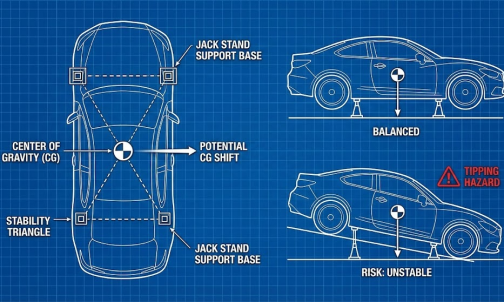
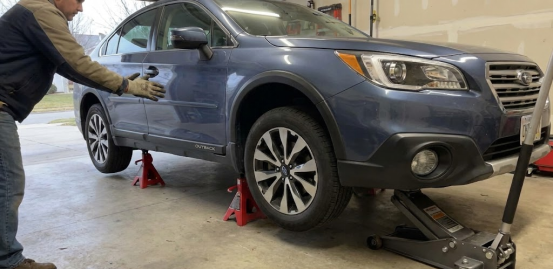
[Engineering/Mechanics/Usage Logic]: A vehicle’s center of gravity shifts slightly during maintenance operations (such as removing the engine or wheels). When the center of gravity moves outside the stable range of the jack stands’ support base, even jack stands with sufficient rated load-bearing capacity may tip over. Therefore, selecting jack stands with wide, stable bases and ensuring the support points are as close as possible to the vehicle’s center of gravity can effectively improve safety.

Diagram illustrating safe and unstable placement of Jack Stands for vehicle maintenance.

Key details: From the selection of pinch welds to support points

Choosing the right support points and taking additional safety measures are equally important.

  • Properly identify the jack points: Every vehicle has manufacturer-designated jack points and pin welds. These are typically the strongest parts of the vehicle’s structure and can withstand the vehicle’s weight. Never place jack stands on vulnerable or non-load-bearing areas such as the exhaust pipe, oil pan, or suspension arms; this is almost certainly suicidal.
  • The correct way to use jack stands on pinch welds: Pinch welds are common support points on many cars and SUVs. However, placing jack stands directly on pinch welds can not only damage the vehicle’s paint finish but may also cause uneven stress or even slippage due to the mismatch in the shape of the jack stand’s support surface. Therefore, I strongly recommend using jack pads. Jack pads are rubber or polyurethane pads specifically designed to protect pinch welds and fit the support surface of jack stands. They distribute pressure, increase friction, and prevent direct metal-to-metal contact.
    • Can jack pads help improve safety when using jack stands? The answer is yes. They provide a buffer layer, reducing the likelihood of the jack stand slipping or damaging the vehicle’s structure.
    • How do jack pads protect my car during lifting? They distribute pressure by providing a wider, softer contact surface, while preventing the sharp edges of the metal jack stand from directly contacting and scratching or flattening the pinch welds.
    • What should I consider when choosing jack pads for my vehicle? Consider the material of the jack pads (wear-resistant, non-slip), shape (whether it fits the shape of your jack stands and vehicle pin welds), and hardness (it needs to provide cushioning but not be too soft to cause instability).
  • The Indispensability of Wheel Chocks: Even if your vehicle is securely placed on jack stands, always use wheel chocks to hold in place any tires that are not raised. This prevents the vehicle from rolling due to unexpected vibrations or minor incline adjustments. “Do I need wheel chocks with jack stands?” is a no-brainer; the answer is: absolutely. They are your last line of defense.

Investment security: Is this “risk cost ROI” worth it?

The value of high-quality jack stands

Choosing the right jack stands involves more than just looking at the tonnage; you also need to consider their design, materials, and stability.

  • How to select based on vehicle type and operational requirements:
    • For small cars, a pair of 3-ton jack stands are usually sufficient.
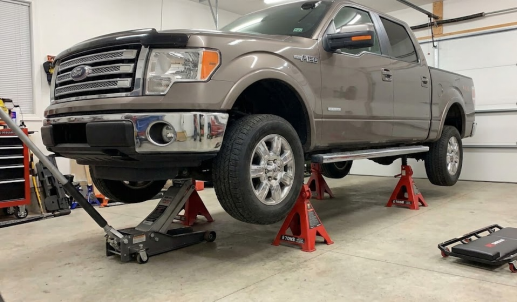
    • For SUV jack stands or light trucks, a pair of 6-ton jack stands offers a wider base and a higher safety factor; for example, 6-ton jack stands are often recommended for the F150.
    • If you have a sports car with a low chassis, you may need low jack stands or low height jack stands to ensure it can be placed smoothly.
  • Emphasizing the importance of brand and certification: The market is flooded with jack stands of varying quality. Don’t risk your safety to save a few dollars. Choose well-known brands and check if the product has passed certifications from authoritative organizations (such as ASME PALD). Remember industry incidents like the Harbor Freight recalls, which warn us that even well-known brands have had quality issues; therefore, regularly checking the condition of your jack stands is crucial. Researching reviews like “Who makes the best jack stand?” often reveals that brands like Daytona (Harbor Freight), Big Red, ESCO, Husky, and Torin are popular choices among DIY enthusiasts and professionals.
  • Key considerations when choosing high-quality jack stands:
    1. Load-bearing capacity: far exceeds the actual weight of the vehicle, at least twice the weight of half the vehicle.
    2. Base design: The wide and stable base effectively prevents tipping, especially on uneven ground.
    3. Locking mechanism: Dual locking mechanisms (such as ratchet plus safety pin) are more reliable than single locking.
    4. Materials and workmanship: Heavy steel and good welding process are the guarantee of quality.
    5. Height adjustment: Sufficient adjustment range to adapt to different vehicles and maintenance needs.
    6. Certification Standards: Certified by ASME PALD or other national safety standards.

Preventative investment: far lower than the cost of an accident.

Consider purchasing safety tools, learning the correct knowledge, and allocating sufficient time as the best insurance against future risks. The investment in a high-quality jack stand may only be a few hundred dollars, while the cost of a jack stand failure accident can reach tens or even hundreds of thousands of dollars, not to mention irreparable personal injury. This “risk cost ROI” is obvious.

Before starting any undercarriage work, spend 10 minutes carefully checking the condition of the jack stands, whether the support points are correct, and whether the wheel chocks are in place. These 10 minutes could be the guarantee of your and your family’s well-being.

Conclusion: Safety First, Take Control of Your Repair Journey

Jack stand accidents far exceeds our imagination; it’s not just about financial loss, but also a threat to health, family, and even life. As a garage safety consultant, I want you to realize that safety isn’t a cost, but the wisest investment in life and property. Before every DIY repair, please cultivate a meticulous repair attitude, starting with details such as choosing the right jack stands, correctly placing support points, and using jack pads and wheel chocks to ensure every undercarriage operation is safe and controllable. Take control of your repair journey, starting with taking control of safety.


FAQ

Q1: What aspects are typically included in the cost of a jack stand failure accident?
A1: This mainly includes vehicle repair costs (damage to the body, chassis, and core components), high medical expenses (personal injury), potential lost wages, and the risk of insurance claim denial and vehicle residual value depreciation due to the insurance claim for a DIY car repair accident.
Q2: Why might an insurance company refuse to pay for an accident caused by a DIY jack stands support failure?
A2: Insurance companies typically exclude liability for losses caused by “unprofessional operation” or “unauthorized modifications” according to their terms and conditions. DIY repairs that fail to follow the manufacturer’s safety specifications may be considered improper operation, resulting in no compensation for a DIY car repair accident claim.
Q3: Besides choosing high-tonnage jack stands, what other methods can be used to improve support safety and prevent damage from car falling off jack stands?
A3: In addition to choosing the right jack stands, be sure to operate on a solid, flat surface, correctly identify and use the vehicle’s jack points and pinch welds, use jack pads to protect the vehicle body, and always use wheel chocks to secure any wheels that are not lifted.
author-avatar

About Gavin Reid

Gavin Reid has been obsessively analyzing garage safety protocols and vehicle support systems for over a decade. After transitioning from a professional service bay to independent safety consulting in 2020, Gavin realized the market was flooded with confusing weight ratings and compromised designs that offered a false sense of security. His Mission: To help DIY mechanics—especially home hobbyists—identify critical failure points in vehicle lifting and ensure every project ends safely. Why Trust Gavin: Engineering Obsessive: He dissects load paths and weld integrity. From metallurgy to geometric stability, he understands the physics that keep two tons of steel from crushing a human chest. Data-Driven Testing: Gavin has stress-tested 40+ models, evaluating lateral stability and locking redundancy rather than just "marketing tonnage." In the Garage: He’s a fixture in local DIY communities, frequently inspecting frame rails for pinch weld placement and documenting metal fatigue on aging gear. Gavin believes that "a lapse in physics is a permanent mistake." He is dedicated to teaching mechanics how to maintain a "zero-trust" relationship with their equipment. Would you like me to provide Gavin’s specific checklist for identifying structural fatigue in used jack stands?