Jack Stands

Is it safe to disassemble the engine in a Jack Stands? Hidden risks of weight transfer.

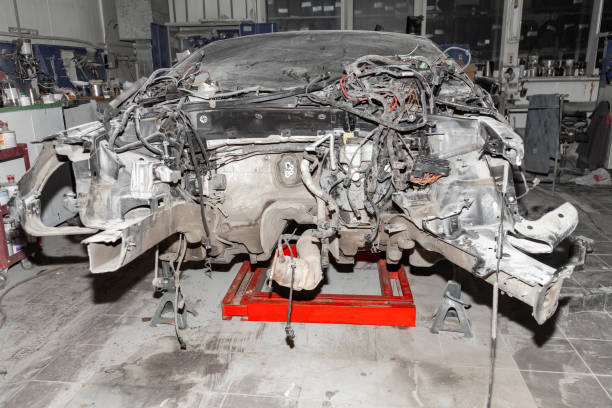
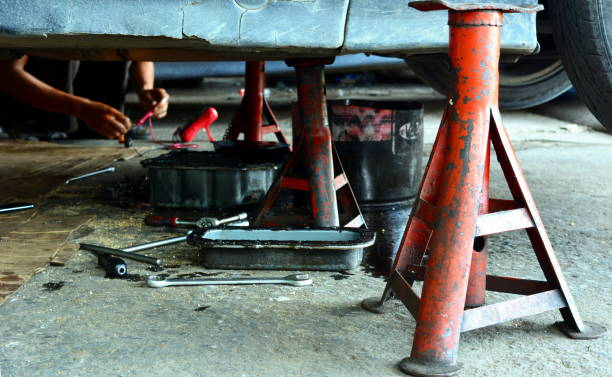
Stripped car chassis resting on jack stands for repair in a workshop.

You’re engrossed in an ambitious DIY project in your garage—disassembling a vehicle’s engine. You’ve carefully propped up the car body with jack stands, feeling confident in your work.

However, you might not realize that when a several-hundred-kilogram engine is “suddenly removed,” the vehicle’s center of gravity shifts drastically, potentially posing hidden risks that are difficult to detect with the naked eye.

Many people underestimate the challenges of engine removal on jack stands, often focusing only on load-bearing capacity while ignoring deeper mechanical issues.

This article will delve into how weight distribution during engine removal challenges vehicle stability and provide robust safety strategies to help you avoid potentially fatal errors.


Engine disassembly supported by a bracket: an overlooked “weight management” issue.

The initial balance: Why do you feel it is “as stable as Mount Tai”?

In routine maintenance, we are accustomed to placing jack stands under designated support points on the vehicle, trusting that they provide sufficient stability.

This is because vehicles are designed with weight distribution in mind, so that in a normal stationary state, the center of gravity is usually located within the rectangular support surface formed by the four wheels.

When the vehicle is lifted and placed on jack stands, as long as the support points are correctly selected, the ground is flat, and the load is within the rated range of the jack stands, the vehicle can usually maintain good “static balance.”

However, this sense of balance often creates a misconception, leading people to believe that the vehicle can remain stable under all circumstances. But what we are about to face is far more than simple static support; it involves a “dynamic” process involving complex mechanical changes.

The “Sudden Departure” of Heavyweight Components: The Real Weight of the Engine and Transmission

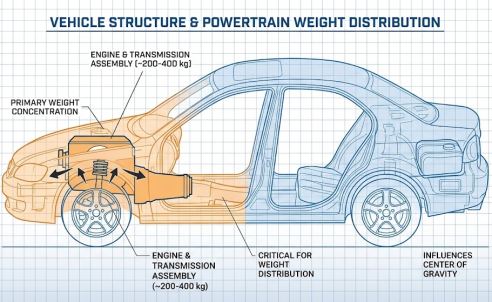
The engine and transmission are among the heaviest and most concentrated components of a vehicle.

A typical four-cylinder engine usually weighs between 100 and 200 kilograms, while a V6 or V8 engine can reach 200-300 kilograms or even more. If the transmission is included, the entire powertrain can easily weigh over 300-500 kilograms.

Understanding vehicle weight distribution for safe lifting with jack stands.

What happens to the overall weight distribution of a vehicle when these heavy components are removed from the front or middle? Clearly, it creates a significant mass deficit, causing the vehicle’s center of gravity to shift sharply in the opposite direction.

For example, removing the front-mounted engine will shift the center of gravity rearward, while removing the rear-mounted transmission will shift it forward. This instantaneous or gradual transfer of weight is the most easily overlooked aspect of car balance after engine out process and a key factor contributing to potential dangers.


Hidden Danger: How a Shift in the Center of Gravity Can “Disrupt” Vehicle Stability

Unveiling the Principles of Mechanics: The Game Between the Supporting Triangle and the Center of Gravity

A vehicle on jack stands can be simplified into a mechanical model: the virtual plane enclosed by all the support points constitutes the vehicle’s “support surface.”

Theoretically, the vehicle is stable as long as its center of gravity projection always falls within this support surface. However, when heavy components such as the engine or transmission are removed, the vehicle’s center of gravity position changes significantly.

Removing the front-mounted engine shifts the center of gravity rearward; removing the rear-mounted transmission shifts it forward.

If the projected center of gravity moves off the support surface, the vehicle loses balance, generating an overturning moment. Once this moment exceeds the friction and shear resistance of the jack stands themselves or their contact points with the vehicle body, the vehicle will overturn. The “tip angle” will also decrease, making the vehicle more prone to instability.

Often, after removing the engine, DIY enthusiasts will habitually push the car body to check its stability, only to find that the car body suddenly tilts or even slides off the jack stands. This is a typical manifestation of the center of gravity exceeding the boundary of the support surface.

Jack Stands’ “Limits” and “Misconceptions”: They are not a panacea.

Jack stands are to withstand vertical compressive loads and safely transfer the weight of a vehicle to the ground.

They are typically made of robust steel and have high load-bearing capacity ratings (such as 3-ton jack stands, 6-ton jack stands, or even 12-ton jack stands).

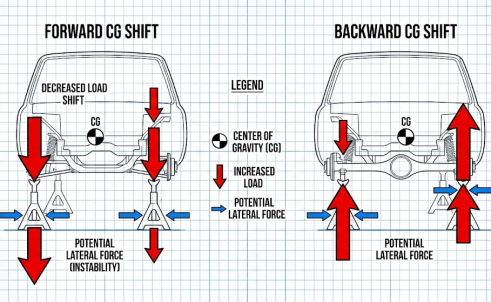
However, when the vehicle’s center of gravity shifts, the jack stands are no longer subjected to only vertical loads, but also lateral shear forces or torques.

These forces are beyond the primary design scope of the jack stands. For example, if the center of gravity shifts to one side, the jack stand on the other side may experience a greater lateral thrust, which could cause its base to slip or even the pins to fall off, leading to jack stand failures.

Diagram: Center of gravity shifts on car supported by jack stands, showing instability.

Some common jack stand failures, such as pins not locking completely, base deformation or slippage on uneven surfaces, are often related to improper stress, especially lateral forces.

Therefore, even if your jack stands are rated to carry a load far exceeding the vehicle’s total weight, they should never be considered a foolproof solution, especially in special scenarios like engine removal on jack stands.


Safe operating and adjustment strategies when disassembling the engine/transmission

Assessment and Planning: A “Safety Simulation” Before Taking Action

Careful planning is essential before carrying out engine removal on jack stands.

  1. Consult the repair manual: Carefully read the vehicle’s repair manual to understand the manufacturer-specified lifting and support points, as well as the specific procedures for removing the engine/transmission. The manual usually provides precautions after weight removal.
  2. Predict changes in center of gravity: Based on the vehicle’s drive type (front-wheel drive, rear-wheel drive, four-wheel drive) and powertrain location, predict the direction and magnitude of weight transfer.
    1. Front-wheel drive vehicles: The engine and transmission are usually located at the front of the vehicle, and removing them will significantly shift the center of gravity to the rear.
    2. Rear-wheel drive vehicles: The engine is in the front, and the transmission is in the center or rear. Removing the engine shifts the center of gravity to the rear, while removing the transmission may slightly shift the center of gravity to the front or change little.
    3. Four-wheel drive vehicles: The situation is more complicated, and the weight distribution between the front and rear axles needs to be considered comprehensively.
  3. Prepare additional support: Prepare extra jack stands in advance to cope with changes in the center of gravity.

Adjusting key support points: It’s not as simple as just “adding a bracket”.

When disassembling heavy components such as engines or transmissions, simply using the standard number of jack stands is far from sufficient.

You will need to add additional jack stands in areas where weight is being removed (such as under the engine compartment). Jack stands serve as redundant supports to expand the support surface and create a more stable support structure.

More importantly, after removing the engine/transmission, you may need to readjust the position of the existing jack stands or add new support points to rebalance the vehicle and prevent car balance loss after engine removal.

For example, if the front engine is removed, the pressure on the rear jack stands will increase, and you may need to add extra support in the middle or rear of the vehicle, or even consider placing a jack under the front of the vehicle, but not fully raised, as an extra safety redundancy.

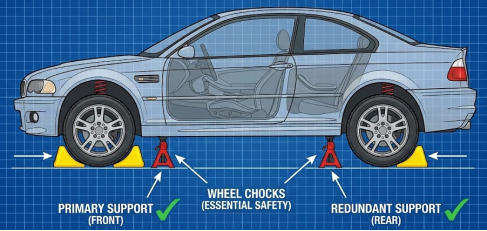
Always make sure to wedge the wheels that are not lifted with wheel chocks. This is the first line of defense against any accidental rolling, thus preventing the center of gravity from shifting and causing danger.

Jack stands redeployment strategies for different vehicle drive types during engine/transmission removal:

Vehicle drive typeMain components to be removedCenter of gravity change predictionRecommended Jack Stands redeployment strategy
front-wheel driveEngine/TransmissionNoticeably shifted backwardAdd extra support to the front of the vehicle, or adjust the existing front support points backward while strengthening the rear support.
Rear-wheel driveengineNoticeably shifted backwardSimilar to front-wheel drive vehicles, the front has added support, and the rear has reinforced support.
Rear-wheel drivegearboxSlight forward shiftAdd extra support in the middle or rear of the vehicle, or adjust the existing middle support point forward to strengthen the front support.
Four-wheel drive vehicleEngine/TransmissionComplex, requires specific analysisAdd redundant support in the opposite direction of the removed component and closely monitor the vehicle’s balance.

Preventative Measures: Essential Recommendations for Improving Jack Stand Engine Swap Safety

To maximize jack stands engine swap safety, here are some hardcore tips:

  • Prioritize jack stands with higher load-bearing capacity: even if your vehicle is a small car, choose 3-ton jack stands. For most sedans and mid-size SUVs, 6-ton jack stands offer greater safety margins. For heavy-duty trucks or large SUVs, 12-ton jack stands or dedicated support equipment are better options. It’s better to overload than underload.
  • Ensure you are working on a flat, solid surface: Always work on a flat, solid concrete surface. Avoid working on slopes, soft mud, grass, or cracked asphalt, as these surfaces may cause jack stands to sink or slip.
  • Protect your car body with Jack Pads: Place jack pads between the jack stands and the car body. They not only protect pinch welds on the underside of the car body (such as car pinch welds and pinch welds on car) from metal deformation or paint damage, but also increase friction and reduce the possibility of slippage at the jack stands on pinch welds.
  • Redundant support principle: When removing heavy components such as engines or transmissions, in addition to the main support points, always add extra jack stands in the nearby area as auxiliary support to form multiple layers of protection.
  • Using a jack as a safety backup: During disassembly, consider keeping a hydraulic jack (such as a low floor jack) underneath to gently support the vehicle body, but not to fully bear its weight, as an additional safety backup in case of emergency.
  • Regularly inspect your jack stands: your lifeline is at stake. Regularly check your jack stands for cracks, warping, rust, or the integrity of the locking mechanism. Avoid using defective or recalled products (such as certain Harbor Freight recall models).

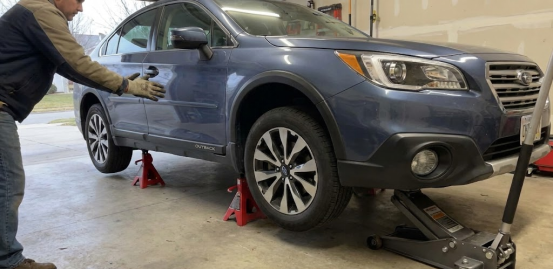
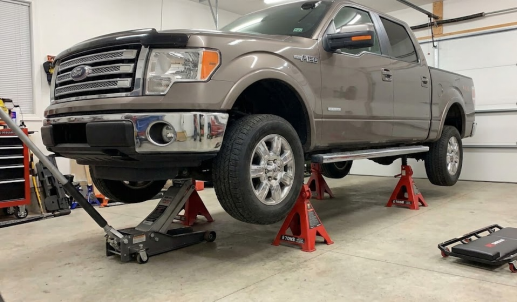
Diagram: Car safely supported by front and rear jack stands with wheel chocks.

Not all Jack Stands are created equal: Choice and defense

Load-bearing capacity and stability: Beyond the “good enough” mentality

When selecting jack stands, we often only focus on their nominal load-bearing capacity, such as 2-ton jack stands. However, this is only the tip of the iceberg.

In extreme scenarios such as engine removal, the vehicle’s center of gravity may shift, subjecting a jack stand to an unexpected localized load.

Therefore, choosing jack stands with a wide base, stronger welds, and double-locking mechanisms is crucial.

A wide base provides a larger contact area, reducing the risk of sinking and tipping over; the double-locking mechanism provides extra safety, preventing the pins from accidentally coming loose.

Models like Harbor Freight‘s Daytona series or some models from the Husky brand are favored by many DIY enthusiasts for their robust construction and excellent stability. Don’t try to save money by buying inferior products; your life is more valuable than any cheap, low-quality jack stand.

Avoid common jack stand failures: Your lifeline cannot be lost.

Jack stands are not indestructible. They can fail due to improper use, aging, or manufacturing defects. Common jack stand failures include:

  • Wear/deformation of pins or ratchet teeth: leading to failure of the locking mechanism.
  • Weld cracking: Structural failure under heavy pressure or lateral force.
  • Deformed or rusted base: affects stability or load-bearing capacity.

Regularly inspecting your jack stands is crucial. If any signs of damage are found, stop using them immediately and replace them.

Additionally, always be aware of manufacturer recalls, such as those involving specific models in past Harbor Freight recalls, to ensure your tool is safe.

When using the jack stand, ensure proper protection at the pinch weld to prevent damage or slippage, and ensure the pinch welds themselves are not severely rusted or deformed.


in conclusion

Disassembling an engine or transmission is no ordinary repair; it poses a significant challenge to the vehicle’s balance. Understanding and anticipating changes in weight distribution during engine removal is crucial to ensuring the safe support of the jack stands.

Safety isn’t about luck; it stems from meticulous planning, the right tool selection, and rigorous operation. DIY is fine; loss of control is.

Before undertaking any heavy-duty repairs involving changes in the vehicle’s center of gravity, always invest time and effort in thorough preparation and assessment.

If you want to minimize this risk and ensure every DIY operation is flawless, then a thorough understanding and correct use of support tools is absolutely essential. Users with higher safety redundancy requirements typically focus on equipment that provides more comprehensive support solutions.


FAQ

1. How does the vehicle’s center of gravity change when the engine is disassembled?
Answer: Disassembling heavy components such as the engine can cause the vehicle’s center of gravity to shift significantly forward or backward, altering the vehicle’s force balance on the jacks and potentially increasing the risk of rollover.
2. Is it safe to disassemble the engine using only jack stands for support?
Answer: Relying solely on the standard number of jack stands to support engine removal carries risks, as changes in the center of gravity can cause uneven stress on the support points or exceed their design limits. It is recommended to add redundant supports and reassess car balance after engine removal.
3. Besides adding jack stands, what other methods can improve the support safety during engine disassembly?
Answer: In addition to adding high-load-bearing jack stands, you should also ensure that you are operating on a flat surface, use wheel chocks, adjust the support points according to the maintenance manual, and consider using jack pads to protect the pin inch welds.
author-avatar

About Gavin Reid

Gavin Reid has been obsessively analyzing garage safety protocols and vehicle support systems for over a decade. After transitioning from a professional service bay to independent safety consulting in 2020, Gavin realized the market was flooded with confusing weight ratings and compromised designs that offered a false sense of security. His Mission: To help DIY mechanics—especially home hobbyists—identify critical failure points in vehicle lifting and ensure every project ends safely. Why Trust Gavin: Engineering Obsessive: He dissects load paths and weld integrity. From metallurgy to geometric stability, he understands the physics that keep two tons of steel from crushing a human chest. Data-Driven Testing: Gavin has stress-tested 40+ models, evaluating lateral stability and locking redundancy rather than just "marketing tonnage." In the Garage: He’s a fixture in local DIY communities, frequently inspecting frame rails for pinch weld placement and documenting metal fatigue on aging gear. Gavin believes that "a lapse in physics is a permanent mistake." He is dedicated to teaching mechanics how to maintain a "zero-trust" relationship with their equipment. Would you like me to provide Gavin’s specific checklist for identifying structural fatigue in used jack stands?