Jack Stands

The truth behind Jack Stand support failure: Don’t just look at the load-bearing capacity; the key is that your force path is wrong!

The truth behind Jack Stand support failure

Hello fellow car enthusiasts! I’m your old friend. Today, we’re going to talk about a serious topic that’s often misunderstood—the “failure” of Jack Stand brackets.

You might think that if a jack support malfunctions, it’s simply because it’s poor quality and has broken. But based on my years of experience reviewing accidents and countless bloody cases, I can tell you that what you perceive as a “support failure” might just be the tip of the iceberg.

The real culprit is often not a “breakage” in the product itself, but rather an incorrect force path that causes the vehicle to “slip” off the support. Believe it or not, load-bearing parameters ≠ actual safety in use. A support rated for three tons might not even be able to support one ton if used incorrectly. It’s like buying the most secure safe but leaving the key lying around outside the door—it’s anything but safe.

Behind the shocking figures: A warning from the NHTSA

Data from the National Highway Traffic Safety Administration (NHTSA) shows that thousands of people are injured each year in accidents involving motor vehicle jacks, and up to 74% of these accidents are not caused by the jack “collapsing” but by the vehicle “slipping” off the jack.

I was involved in a case where a mid-size SUV was having its brake pads replaced in its own garage, with only two jack stands supporting the front wheels. Because the stands were positioned slightly off-center, the vehicle slid off course after a minor wobbling, resulting in a broken arm and spinal injury for the driver. The accident happened very quickly, reminding us that our understanding of jack stands must be upgraded.

Unveiling the core: The interplay between force path and stability

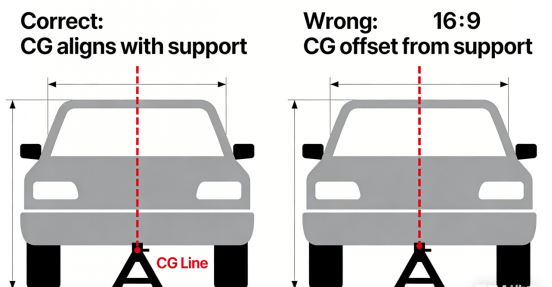
Imagine your car is like a giant building block. When it’s lifted, all the weight is concentrated on a few support points. If these support points don’t properly support and transfer the vehicle’s weight, then even the strongest support structure won’t help.

The physical basis of stent “slippage”: center of gravity, point of force, and contact surface

When a vehicle is lifted, its center of gravity changes. If the support frame is not positioned to effectively transfer the vehicle’s weight vertically downwards to the ground, the vehicle can easily shift laterally with slight swaying, eventually leading to slippage.

Real-world example: A car owner placed the oil pan support bracket on the metal plate next to the oil pan while changing the engine oil. The bracket appeared stable, but after the car wobbled slightly, the oil pan bent, causing the bracket to slip off. The car then landed directly on the floor, damaging the oil pan and partially deforming the bracket.

Chart comparing vehicle weight vs recommended Jack Stand load

Ground conditions: Silent accomplices

Where do you choose to have the repairs done? On the smooth concrete floor of your garage? Or on the slightly sloping asphalt driveway in front of your house? Or perhaps on dirt ground?

Real-world example: A driver used a jack stand to lift his vehicle on a hot asphalt road in the summer heat to replace brake pads. The stand slowly sank into the softened asphalt, causing the vehicle to tilt slightly. Fortunately, it was noticed in time; otherwise, the consequences could have been disastrous.

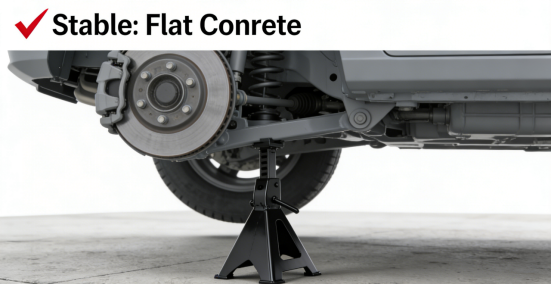
  • Smooth, solid concrete: the ideal choice, providing maximum friction and uniform load-bearing capacity.
  • Asphalt lanes: High temperatures can soften the asphalt, causing the supports to sag and resulting in uneven stress on vehicles.
  • Muddy/grassland areas: These are high-risk areas for accidents, as the supports are prone to tilting or sinking.
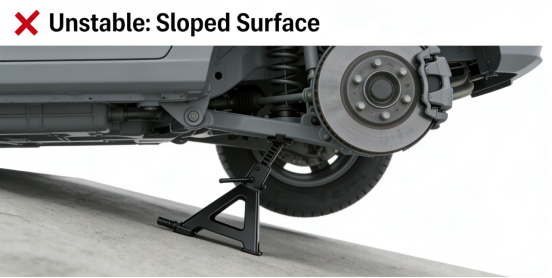
  • Sloping ground: Any slope will increase lateral forces, significantly increasing the risk of slippage.
The vehicle slipped off the jack stand due to poor ground contact.

The battle over placement: finding the vehicle’s “skeleton”

The vehicle chassis is not solid in every way. It has a “skeleton” specially designed for lifting and support—such as frame longitudinal beams and special jack support points (usually with grooves or rubber pads).

Jack stand. Real-world example: A car owner placed a stand near the exhaust pipe to support his SUV for convenience. The stand quickly slipped off, causing damage to the exhaust pipe and deformation of the bottom of the jack stand.

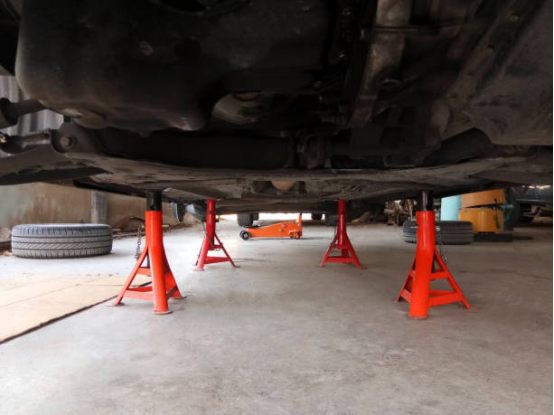
Correct Jack Stand placement on chassis support point

Avoiding Misconceptions: Parameter Worship and Wishful Thinking

a Jack Stand, many people  HYPERLINK “https://buyjackstands.com/shop” only look at its “weight capacity in tons” at first glance. While weight capacity is important, it’s only a theoretical value and doesn’t guarantee safety in actual use.

Jack stand. Real-world example: A 2-ton SUV was supported by only one 3-ton jack stand. When the ground slightly dented, the vehicle tilted, and the stand was “insufficient to bear the weight,” almost causing an accident.

I always recommend choosing a load-bearing capacity that is twice the actual requirement, such as using a 6-ton support for a 2-ton vehicle, to provide greater safety redundancy.

Vehicle typeApproximate vehicle weight (kg)Recommended load capacity (tons) for a single jack support.
small cars1000-15002-3
Mid-size sedan1500-20003-4
SUV/Light Truck2000-30004-6
Heavy trucks>30006+

Fine; fine; DIY is fine; the problem is getting out of control.

Fellow car enthusiasts, mastering this knowledge will allow you to avoid most jackstand accidents, making every DIY repair more relaxed and safer. True safety doesn’t rely on load-bearing parameters but on understanding and respecting force paths and predictability.

To minimize the risks of DIY garage modifications and provide comprehensive protection for your car and family, it’s wise to learn more about professional safety equipment and operating guidelines. Safety should always come first.

>>> The Ultimate Guide to Choosing a Jack Stand: In-Depth Analysis of Safety and Applicability

author-avatar

About Gavin Reid

Gavin Reid has been obsessively analyzing garage safety protocols and vehicle support systems for over a decade. After transitioning from a professional service bay to independent safety consulting in 2020, Gavin realized the market was flooded with confusing weight ratings and compromised designs that offered a false sense of security. His Mission: To help DIY mechanics—especially home hobbyists—identify critical failure points in vehicle lifting and ensure every project ends safely. Why Trust Gavin: Engineering Obsessive: He dissects load paths and weld integrity. From metallurgy to geometric stability, he understands the physics that keep two tons of steel from crushing a human chest. Data-Driven Testing: Gavin has stress-tested 40+ models, evaluating lateral stability and locking redundancy rather than just "marketing tonnage." In the Garage: He’s a fixture in local DIY communities, frequently inspecting frame rails for pinch weld placement and documenting metal fatigue on aging gear. Gavin believes that "a lapse in physics is a permanent mistake." He is dedicated to teaching mechanics how to maintain a "zero-trust" relationship with their equipment. Would you like me to provide Gavin’s specific checklist for identifying structural fatigue in used jack stands?