Jack Stands

The Truth About the “Lifespan” of Jack Supports: In-Depth Analysis of Material Fatigue and Safety Hazards

The Truth About the "Lifespan" of Jack Supports

together; you might think a jack stand is just a few steel plates welded together. How complicated could it be? But this seemingly simple tool, supporting your multi-ton vehicle, can have disastrous consequences if anything goes wrong. In the accident debriefings I’ve participated in, I’ve seen far too many cases where this detail caused problems, some with irreversible consequences.

errors but Today, we won’t discuss those obvious operational errors but rather delve into a more hidden “problem”—material fatigue and lifespan. This is a “hidden risk” that cannot be fully covered by numerical parameters.

Jack Stand metal fatigue micro-crack inspection close-up

The “potential dangers” of stents: Why are the dangers you can’t see more deadly?

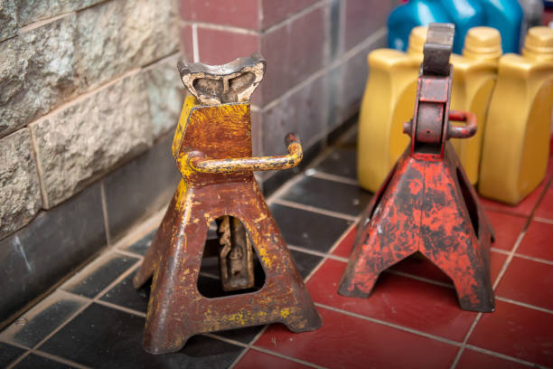
Jack stand. Many car owners focus only on rated load capacity and price when choosing and using a jack stand. However, behind these figures lie many dangers that are difficult to detect with the naked eye.

Metal fatigue: The “gentle knife” of time and stress.

impact but Have you ever wondered why a metal component that has never been overloaded would suddenly break? This is due to metal fatigue. It’s not a one-time impact but a cumulative damage.

From an engineering perspective, when a metallic material is repeatedly subjected to loads below its yield strength, its internal microstructure gradually changes. Initially, tiny cracks initiate within the material or at surface defects. With each application and removal of the load (this is known as “alternating load”), these microcracks propagate until the material’s effective load-bearing area decreases drastically, ultimately leading to sudden, brittle failure of the structure. This process can be very slow, but once it reaches a critical point, it occurs almost without warning.

jacket stand Metal structures are susceptible to fatigue and aging issues, which is not simply a matter of getting old. It means that even if you never overload your equipment, your jacket stand is not “immortal.” Stress concentration areas (such as welds and sharp edges) are breeding grounds for fatigue cracks.

Environment and usage habits: accomplices in accelerating stent aging.

Jack stands: Besides the inherent fatigue properties of metals, our usage and storage habits are also significant factors that accelerate the aging of jack stands:

  • Overloading: This is the most direct and brutal form of damage. Once the rated weight is exceeded, the support components will immediately be subjected to excessive pressure, leading to bending, cracking, or even instantaneous failure.
  • Corrosion: Rust is the number one enemy of steel. Once the paint peels off, moisture and oxygen in the humid air react with the steel to form rust. Rust reduces the effective load-bearing area of the steel, especially at welds and critical stress points, making fatigue cracks more likely to propagate.
  • Manufacturing defects: Especially in some budget brands, weak welding and substandard metal materials are common problems. These inherent defects are natural initiation points for fatigue cracks, greatly shortening the lifespan of the support structure.
  • Environmental factors: Humidity, high salinity (such as in coastal areas), extreme temperature fluctuations, and contact with corrosive chemicals (such as brake fluid and acidic cleaners) can all accelerate the decomposition and corrosion of materials, eroding the structural integrity of the support.
Rust and corrosion on Jack Stand weld affecting safety

How long is the “lifecycle” of your Jack Stand? Identifying signs of failure.

Having understood the risks, the next step is to identify them. How long will your jack stand last? There’s no absolute answer, but we can judge from some signs.

Economic vs. Professional: The Logic Behind Lifespan Differences

Inexpensive jack stands may only last 1-3 years before problems arise, while high-quality products, if properly maintained, can last 5-10 years or even longer. The difference lies in:

  • Material selection: High-quality brackets are usually made of higher-quality and stronger steel or aluminum alloy, which have better fatigue resistance.
  • Manufacturing process: A professional welding process and more precise machining can effectively reduce stress concentration points and internal defects.
  • Design redundancy: Good designs take safety redundancy into account, providing a certain level of protection even in extreme situations.

Failures are more valuable lessons than successes. From those incidents where small losses led to bigger ones, we can better understand the importance of choosing reliable tools.

Visible warning signs: What signs indicate danger?

Before each use, always perform a thorough visual inspection. These warning signs may be subtle, but they are external indications of damage to the internal structure of the stent:

  • Cracks, bending, deformation: Any cracks, obvious bending, or deformation found in the support legs, base, support saddle, or ratchet mechanism indicates that the structural integrity has been severely compromised and the device must be scrapped immediately and never used!
  • Holes, peeling paint, and obvious rust: Large areas of peeling paint and rust, especially at welds, adjustment holes, or critical stress points, indicate that corrosion may have penetrated deep and weakened the metal’s strength.
  • :Weld abnormalities: Check all welds for cracks, detachment, uneven weld points, or uneven surfaces, which may be signs of manufacturing defects or fatigue damage.
  • :Ratchet mechanism jamming or loosening: If the ratchet cannot be adjusted smoothly, or the locking pin is loose or cannot be firmly locked, this will directly affect the stability and locking ability of the bracket.

The following table can help you make a quick judgment:

Observation signsPotential problemsRecommended Actions
Surface cracks/bending deformationMaterial fatigue/overload damageDispose of immediately and do not use.
Extensive paint peeling/rustRisk of structural strength damageThorough cleaning and rust prevention treatment, or consider replacement.
Weld cracking/abnormalityStructural integrity damagedDispose of immediately and do not use.
Ratchet stuck/Cannot lockSupport stability riskInspect and clean; replace immediately if repair is not possible.
Uneven legs or baseLong-term uneven stress/deformationCheck load-bearing stability and consider replacement.
Maintenance steps extending Jack Stand lifespan and safety

Routine inspection and maintenance: Extending lifespan and, more importantly, extending safety.

  • Pre-use check: Make it a habit to perform a thorough check of the stent before each use, following the “visible warning” checklist mentioned earlier.
  • Cleaning and Storage: After use, clean off any oil or dirt from the rack and store it in a dry, clean environment away from direct sunlight and humidity. This will effectively slow down corrosion and material aging.
  • Rust prevention: If paint peeling is found, promptly sand off the rust and apply rust-preventive paint. Keeping the paint surface smooth is an effective way to prevent the spread of rust.

“Shorter duration operation” does not mean greater safety. Fatigue damage is cumulative, and no use should be taken lightly.

Take control of your safety

The seemingly simple tool, the jack stand, actually involves material fatigue and lifespan issues that are far more complex and dangerous than we imagine. But because we now understand the principles and identification methods of these “hidden flaws,” we can better manage the risks instead of relying on luck.

Now you have a better understanding of how to do things safely. Remember, respect for your tools and attention to detail are key to ensuring safety during DIY repairs.

>>> The Ultimate Guide to Choosing a Jack Stand: In-Depth Analysis of Safety and Applicability

author-avatar

About Gavin Reid

Gavin Reid has been obsessively analyzing garage safety protocols and vehicle support systems for over a decade. After transitioning from a professional service bay to independent safety consulting in 2020, Gavin realized the market was flooded with confusing weight ratings and compromised designs that offered a false sense of security. His Mission: To help DIY mechanics—especially home hobbyists—identify critical failure points in vehicle lifting and ensure every project ends safely. Why Trust Gavin: Engineering Obsessive: He dissects load paths and weld integrity. From metallurgy to geometric stability, he understands the physics that keep two tons of steel from crushing a human chest. Data-Driven Testing: Gavin has stress-tested 40+ models, evaluating lateral stability and locking redundancy rather than just "marketing tonnage." In the Garage: He’s a fixture in local DIY communities, frequently inspecting frame rails for pinch weld placement and documenting metal fatigue on aging gear. Gavin believes that "a lapse in physics is a permanent mistake." He is dedicated to teaching mechanics how to maintain a "zero-trust" relationship with their equipment. Would you like me to provide Gavin’s specific checklist for identifying structural fatigue in used jack stands?