Jack Stands

The “ground secrets” of jack stands: How do different ground surfaces affect your car repair safety?

The "ground secrets" of jack stands: How different ground surfaces affect your car repair safety?

often-overlooked yet Every time we lift a vehicle, we want everything to go perfectly. You carefully place the jack stand, confirm the support points, and even check the support’s load-bearing parameters. But have you ever considered that, besides the strength of the stand itself, the ground beneath your feet is the often-overlooked yet crucial “invisible killer” that can determine everything?

Today, I’ll take you through a deep dive into how different ground surfaces mechanically affect the performance of the jack stand and how we can completely eliminate these potential hazards. True safety comes from predictability, not luck.

modes and We will break down the ground type, mechanical principles, and potential failure modes and provide a set of effective safety strategies so that you can be confident in every DIY repair.

‘Why are ground conditions Jack Stand’s “lifeline”?

jack stand, When we talk about the safety of a jack stand, most people’s first reaction is to check its load-bearing capacity, materials, and structure. These are certainly important, but they only tell half the story. The other half, and the most crucial half, lies in its “interaction” with the ground.

More than just load-bearing parameters: the misunderstood “safety factor”

Many car owners believe that as long as the bracket’s rated load capacity is far higher than the vehicle’s weight, there’s no problem. But the reality is far more complex than the numbers suggest.

For example, I once witnessed a car owner repairing his garage. The support frame was rated to bear 3 tons, while the vehicle weighed only 1.5 tons. However, the frame base was placed on old, cracked concrete in the garage, and even a slight wobbling caused the frame to tilt, nearly causing the vehicle to overturn. This tells us that rated load-bearing capacity ≠ actual safety. The impact of ground conditions on safety is often severely underestimated.

Jack Stand ‘s “foundation”: the principle of stability

angle), but the stability of the support depends not only on its geometry (such as base area and leg opening angle) but also on ground conditions.

In a roadside tire-changing incident, a driver placed a tire stand on slightly damp soil. The weight of the vehicle caused one leg of the stand to sink into the mud, shifting the vehicle’s center of gravity. Fortunately, the driver quickly moved away, avoiding serious injury. This clearly illustrates that even the sturdiest tire stand cannot guarantee safety if the ground cannot provide a uniform reaction force.

Disassembling different surfaces: How do they quietly “steal” your safety?

. Different ground types have a significant impact on the mechanical performance of the jack stand. Understanding these differences is the first step in building a secure defense system.

Solid, level ground (concrete/asphalt)

Concrete or asphalt surfaces are often considered ideal environments because they offer high load-bearing capacity and reduce scaffolding subsidence. However, this does not mean they are completely safe.

  • Minor unevenness: I once discovered during garage repairs that the bracket was placed on a slightly uneven concrete floor, and the four legs were not evenly stressed. You could feel the bracket wobbling slightly when you gently pushed the vehicle.
  • :Debris and cracks: During a road trip camping trip, the support frame was placed on the edge of asphalt gravel. A small stone caused the frame to tilt slightly. Fortunately, no accident occurred, but the potential danger was obvious.
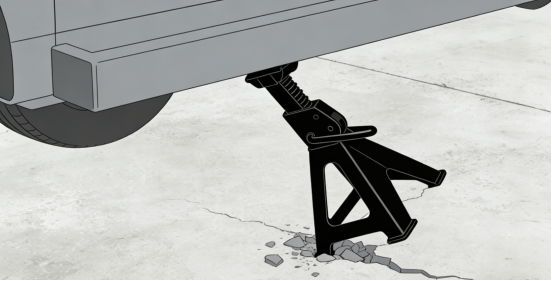
The jack was placed on the cracked concrete surface.

Soft ground (soil/gravel/grass)

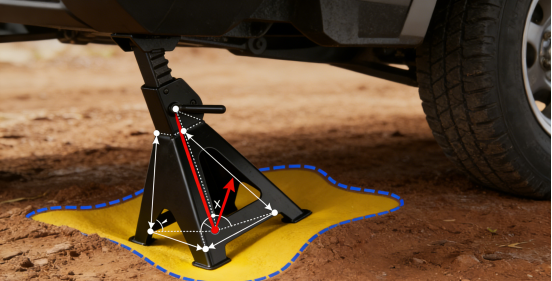
This is the most dangerous type of ground. Soft ground can easily cause the support structure to sink, thus changing the vehicle’s center of gravity.

  • otherwise, Sinking and tilting: During a car repair experience in the countryside, the support frame stepped on the wet mud, and the vehicle sank and tilted slightly. Fortunately, the operator noticed in time and added wooden blocks; otherwise, it could have easily overturned.
  • jack stand Stress concentration and structural failure: In a case shared by a car owner, a car owner placed the jack stand directly on gravel. The vehicle’s weight was concentrated in one corner of the base, causing the bracket weld to crack and nearly collapse.
Jack Stand sinking in soft soil showing ground risk

Uneven ground (ramp/unpaved road surface)

Uneven ground can cause uneven stress on the support structure, resulting in additional bending moments and torques.

  • : Additional: Additional bending moment and torque: I once participated in a vehicle repair and chassis repair. The bracket was placed on a lane with a slope of about 5 degrees. The uneven force on the bracket legs caused slight twisting. If the car owner had not made quick adjustments, the consequences could have been serious.
  • : Lateral slippage or overturning: Even on hard surfaces, the support may slip laterally if there are potholes or unevenness. Multiple incidents have shown that this type of overturning often occurs when operators fail to notice minor unevenness in the ground.

Why it’s dangerous from a mechanical perspective: Deep failure mechanisms

Effective contact area: an overlooked key factor

The larger the support base, the better the stability in theory. However, on soft ground, this advantage may be completely negated.

During the repair of an off-road vehicle, although the support base was large, only half of it was in contact with the ground when placed on wet mud, which caused a sudden increase in pressure per unit area and the support to sink slightly.

Shear force and bending moment: the invisible killer of supports

joints, When the support structure tilts or sinks, the vertical load is converted into shear force and bending moment, which act on the welds, joints, and legs, increasing the risk of failure.

For example, when a car owner was changing a tire on a gravel road, one leg of the support frame got stuck in the gravel, causing the weld to suddenly open due to shear force. The vehicle’s center of gravity shifted rapidly, but fortunately someone was there to help support it, preventing it from falling.

The gambling mentality of “short-time assignments”

Many people think that “short-term repairs are fine,” but ground deformation and support stress are cumulative.

jack stand In one accident recap, a driver lifted the chassis for only a few minutes, but the soft ground slightly subsided, causing the jack stand to tilt and nearly causing the vehicle to fall. This illustrates that even short-term operations can be fatal.

Building an impregnable “security fortress”

Ground Pre-inspection: The First Step in the Safety Process

  • :Visual inspection: Check for cracks, pits, debris, oil stains, or signs of looseness.
  • : Foot feel test: Step on the ground and feel the elasticity and sinking sensation.
  • Inclination assessment: Ensure the surface is flat and without slope, as even a slight inclination may be magnified.

The Art of a Stable Base: Using Pads

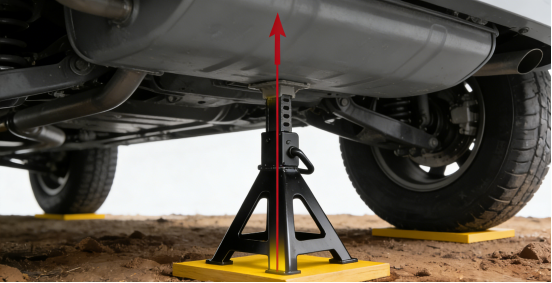
  • : Material selection: sturdy hardwood blocks (such as 2×10, at least 2 inches thick) or thick steel plates.
  • Principle: Increase the effective contact area with the ground, reduce unit pressure, and enhance stability.
  • Placement method: The pad should completely cover the base of the bracket, slightly exceeding it, and ensure that it is stable and does not slip.
Jack Stand positioned with wooden pads for secure base

Security Confirmation Checklist

  • reinspect Gently shake the vehicle: if there is any shaking, sinking, or unusual noise, immediately reinspect it.
  • :Visual inspection: Confirm that the bracket is vertical and stable, without tilting or sliding.
  • Check the contact points: Ensure that the bracket is firmly in contact with the vehicle chassis and there is no risk of it coming loose.

Take safety into your own hands

Ground conditions have a decisive impact on the mechanical performance of a jack stand. Accident cases show that ignoring ground factors is often more dangerous than using a low-quality support structure.

True safety comes from “predictability,” not luck. By understanding ground action, mastering the right preventative strategies, and adopting the concept of safety redundancy, you will firmly grasp the initiative in ensuring safety.

DIY repairs are not inherently problematic, but loss of control is. Choosing a bracket designed with ground adaptability in mind and multiple safety redundancy schemes not only provides load-bearing capacity but also brings genuine peace of mind.

>>> The Ultimate Guide to Choosing a Jack Stand: In-Depth Analysis of Safety and Applicability

author-avatar

About Gavin Reid

Gavin Reid has been obsessively analyzing garage safety protocols and vehicle support systems for over a decade. After transitioning from a professional service bay to independent safety consulting in 2020, Gavin realized the market was flooded with confusing weight ratings and compromised designs that offered a false sense of security. His Mission: To help DIY mechanics—especially home hobbyists—identify critical failure points in vehicle lifting and ensure every project ends safely. Why Trust Gavin: Engineering Obsessive: He dissects load paths and weld integrity. From metallurgy to geometric stability, he understands the physics that keep two tons of steel from crushing a human chest. Data-Driven Testing: Gavin has stress-tested 40+ models, evaluating lateral stability and locking redundancy rather than just "marketing tonnage." In the Garage: He’s a fixture in local DIY communities, frequently inspecting frame rails for pinch weld placement and documenting metal fatigue on aging gear. Gavin believes that "a lapse in physics is a permanent mistake." He is dedicated to teaching mechanics how to maintain a "zero-trust" relationship with their equipment. Would you like me to provide Gavin’s specific checklist for identifying structural fatigue in used jack stands?