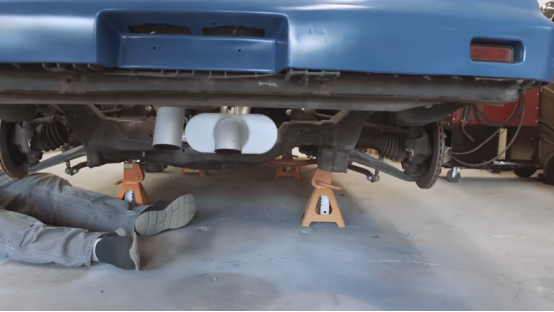
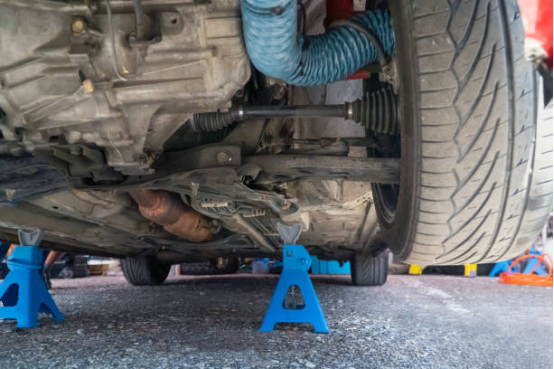
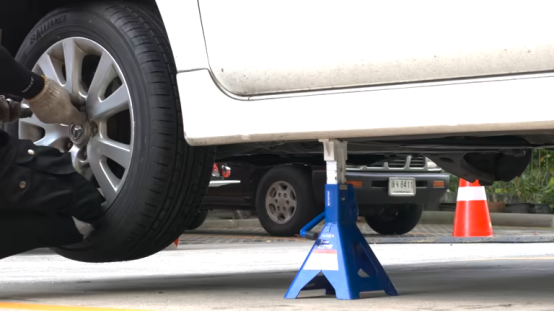
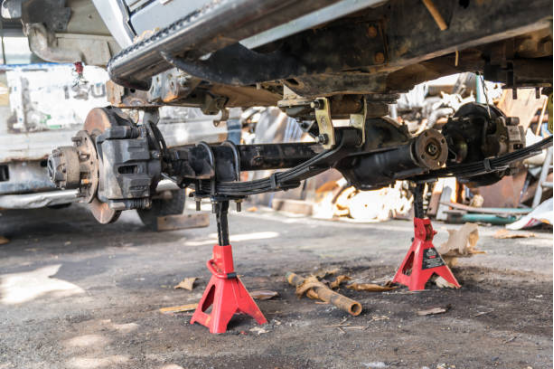
Jack Stands

Vehicle Maintenance: The Overlooked “Center of Gravity” Trap—An In-Depth Analysis of the Safety Dimensions of Jack Supports

The Overlooked "Center of Gravity" Trap – An In-Depth Analysis of the Safety Dimensions of Jack Supports

What you perceive as “safety” is just the tip of the iceberg.

In your garage, you’ve probably used a jack stand countless times to prop up your car for routine maintenance like oil changes and tire changes. You carefully checked the stand’s weight capacity, making sure it far exceeds the weight of your vehicle, and the ground looks perfectly level. Everything seems “perfect,” right?

But in fact, you may be standing on the edge of an overlooked “center of gravity” trap.

The “illusion” of jack supports: Why does high load-bearing capacity not equal absolute stability?

of the jack stand they buy is high enough, it’s absolutely safe. This is like buying a supercar that’s supposed to be able to go 300 km/h but then speeding it on a bumpy dirt road. While load-bearing capacity is important, it doesn’t equate to actual safety. The jack stand’s load-bearing capacity only indicates the maximum vertical pressure it can withstand. During vehicle maintenance, the center of gravity dynamically changes, generating lateral forces and overturning moments that far exceed what a simple load-bearing number can cover.

Real-world case study: A security consultant’s warning

An experienced DIY car enthusiast was disassembling the front brake discs when he failed to realize the vehicle’s center of gravity was shifting to the opposite side. Although he was using a jacket stand with a rated load capacity exceeding the vehicle’s total weight, the right-side stand became unbalanced the moment the heavy load was removed, causing the vehicle to tilt slightly. Fortunately, his companion managed to pull him back, preventing a serious accident. Similar cases demonstrate that even experienced individuals can be caught off guard by shifts in the center of gravity.

DIY is fine; the problem is getting out of control.

Our core belief is: DIY is fine; losing control is the problem. Our goal isn’t to eliminate DIY, but to help you fully understand the potential factors that could lead to “loss of control” before you start and to master preventative measures. Today, we’ll delve into the “invisible hand” of the vehicle’s center of gravity, how it affects your jack stand during repairs, and how to truly take safety into your own hands.

car lifted on jack stands showing correct support points for Jack Stand safety

What exactly is the center of gravity (COG)? Why is it so important in maintenance?

More than just a physical concept: the role of a vehicle’s center of gravity in static and dynamic states

The center of gravity (COG) is the point where all the weight of a vehicle is concentrated. Imagine if you could support this point with one finger; the vehicle would be perfectly balanced. When the vehicle is stationary, the center of gravity is relatively fixed, but it begins to shift when the vehicle is lifted or parts are removed during maintenance.

The lower the center of gravity, the more stable the vehicle; the higher the center of gravity, the more likely the vehicle is to overturn.

The “Invisible Hand” in Maintenance: How the Center of Gravity Silently Affects the Stability of the Bracket

When a vehicle is supported by a jack stand, its stability depends entirely on the contact between the stand and the ground and the fixation between the vehicle and the stand. If the vehicle’s center of gravity shifts, a tipping moment is generated, like an invisible hand trying to push the vehicle over and cause the stand to become unbalanced.

A real-life example: When a car owner was changing the left front wheel, the vehicle’s center of gravity shifted to the right, significantly increasing the pressure on the right-side support and causing the left-side support to become slightly unsupported. Fortunately, he noticed the vehicle swaying in time and readjusted the support points, thus preventing a rollover accident.

diagram explaining vehicle center of gravity shift on stands

A Shift in Focus During Vehicle Repair: Analysis of Risk Scenarios

Disassembling heavy objects: tires, gearbox, engine

This is the most common scenario involving a shift in the center of gravity. Removing one side of the tires or braking system will shift the center of gravity to the other side. The shift is even more pronounced if the transmission or engine is removed.

Real-life example: A DIY enthusiast was disassembling the lower engine mount when his center of gravity shifted slightly towards the rear of the car, causing the front mount to tilt slightly. Fortunately, he had added spare wooden blocks on both sides beforehand, thus preventing an accident.

Suspension system operation: compression and release

When replacing shock absorbers or springs, the change in vehicle suspension height will slightly adjust the center of gravity. In one operation I observed, after a technician removed a compression spring, the front of the vehicle vibrated slightly, and the center of gravity height increased by about 5 centimeters. However, because the support bracket was placed with proper width, it did not overturn, demonstrating the importance of support bracket placement and center of gravity management.

Vehicle body posture adjustment: lifting height and bracket placement point

The higher a vehicle is lifted, the further its center of gravity is from the ground, and the less stable it becomes. A real-world example: a car owner, while lifting his vehicle to 50 centimeters for a chassis inspection, used only two jack stands to support the front. The vehicle swayed instantly, causing the stands to shift. This incident made him realize the extremely high risk of using single-point support.

Considerations for “safety redundancy” beyond load-bearing capacity

Load-bearing parameters ≠ Actual safety in use

Load-bearing parameters are typically vertical static loads tested under ideal laboratory conditions. In actual maintenance, vehicle weight may be unevenly distributed, and the vehicle will also be subject to pushing and pulling vibrations during operation; these dynamic loads are far more complex than the rated parameters.

Implications of Static Stability Factor (SSF)

SSF = Wheelbase / (2 × Center of Gravity Height).
A wider wheelbase and a lower center of gravity result in greater vehicle stability. When supported by a jack stand, it simulates the extreme case of “narrow wheelbase and high center of gravity.” Choosing a jack stand with a wide and stable base and minimizing the lifting height are intuitive ways to improve stability.

Real-world examples: overlooked “small details”

I once witnessed a mechanic remove a tire on a surface with fine sand. The vehicle wobbled slightly in its support; the support slipped by 1 centimeter, causing the tire to shift. Although no serious accident occurred, this example perfectly illustrates how small details can accumulate into significant risks.

mechanic using multi-point Jack Stand setup for stable maintenance

Preventing Loss of Balance: A Practical Guide to Safe Operation

Double Confirmation Method: Pre-Lift Assessment and Planning

  • Ground inspection: Ensure it is hard, flat, and free of debris; use thick wooden or steel plates as pads if necessary.
  • Vehicle assessment: Consult the manual to find the officially designated lifting and support points.
  • Operational planning: Plan the disassembly sequence in advance and predict the direction of the center of gravity shift.

Multi-point support principle

  • At least two jack stands: Even if only one corner is being raised, two supports must be used. Four-point support is recommended.
  • Backup support: Place wooden blocks or spare hydraulic jacks next to the support and lower it slightly so that the weight of the vehicle mainly falls on the support.

Ground pretreatment

  • Cleaning and leveling: Remove debris and gravel, and check with a level.
  • Anti-slip mats/support mats: Use rubber mats on smooth surfaces and thick wooden boards to distribute pressure on soft surfaces.

Step-by-step operation and real-time monitoring

  • Slowly lift, place the support, and gently lower the hydraulic jack.
  • Each time a heavy object is disassembled, the stability is reassessed, and the supports are adjusted or safety redundancy is increased if necessary.

Take safety into your own hands

Today’s sharing aims to give you a more comprehensive understanding of Jack Stand security. DIY is fine, but getting out of control is the problem.

Key points to review:

  • Understand the principles of center of gravity shift, and pay attention to ground conditions and support placement.
  • Employing multiple safety redundancies
  • Regularly inspect and maintain tools
  • Relying on predictability rather than luck for security

To minimize risk, consider support products that are scientifically designed, made of reliable materials, and take into account off-center loading and dynamic stability. These supports provide stronger error-proofing and certainty for operation.

>>> The Ultimate Guide to Choosing a Jack Stand: In-Depth Analysis of Safety and Applicability

author-avatar

About Gavin Reid

Gavin Reid has been obsessively analyzing garage safety protocols and vehicle support systems for over a decade. After transitioning from a professional service bay to independent safety consulting in 2020, Gavin realized the market was flooded with confusing weight ratings and compromised designs that offered a false sense of security. His Mission: To help DIY mechanics—especially home hobbyists—identify critical failure points in vehicle lifting and ensure every project ends safely. Why Trust Gavin: Engineering Obsessive: He dissects load paths and weld integrity. From metallurgy to geometric stability, he understands the physics that keep two tons of steel from crushing a human chest. Data-Driven Testing: Gavin has stress-tested 40+ models, evaluating lateral stability and locking redundancy rather than just "marketing tonnage." In the Garage: He’s a fixture in local DIY communities, frequently inspecting frame rails for pinch weld placement and documenting metal fatigue on aging gear. Gavin believes that "a lapse in physics is a permanent mistake." He is dedicated to teaching mechanics how to maintain a "zero-trust" relationship with their equipment. Would you like me to provide Gavin’s specific checklist for identifying structural fatigue in used jack stands?