Jack Stands

Jack Stands Safety Guide: In-depth Analysis of Vehicle Structure

Jack Stands Safety Guide

Hello, friends who want to do things right!

standsI am well aware of everyone’s enthusiasm for DIY. The sense of accomplishment from repairing and maintaining your car yourself is unparalleled. However, I must also seriously remind everyone that I have seen too many serious consequences caused by a seemingly simple detail— improper selection of the jack stand support point. Many accidents are not due to poor quality jack stand, but rather to the user’s lack of basic understanding of vehicle structure and force principles, or a sense of complacency.

Vehicle Structure Overview: Understanding Your “Skeleton” and Stress Zones

Before discussing Jack Stands support points, we need to understand the “skeleton” of your car. Different car body structures have vastly different areas of stress that require sturdiness.

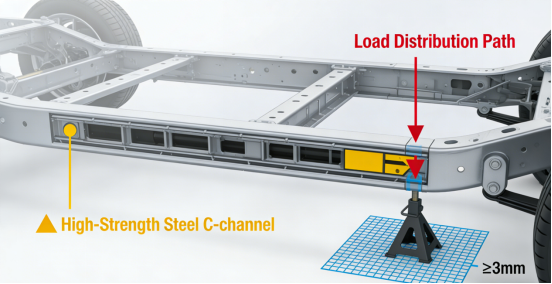
Body-on-frame chassis: robust chassis beams

What is a frame chassis? As the name suggests, the body and chassis are manufactured separately and then assembled together. The chassis has a separate, robust trapezoidal or rectangular frame (commonly known as a “beam”) on which major components such as the engine, transmission, and suspension system are mounted. These vehicles are typically pickup trucks, rugged off-road vehicles, or certain large SUVs.

Where are the support points? — Understanding the longitudinal and transverse beams of the chassis. For a frame-type chassis, the ideal support points are the longitudinal and transverse beams of the chassis. These are the strongest and most capable of withstanding vertical loads in the vehicle structure. They are like the foundation and load-bearing walls of a house, distributing the vehicle’s weight evenly.

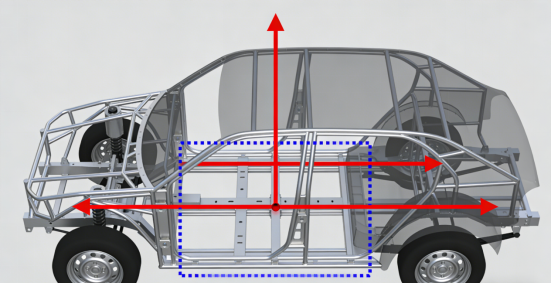
Unibody chassis lift point and reinforced area diagram

Unibody construction: a one-piece structure

What is a unibody construction? — How to understand its stress distribution? This is the mainstream structure for modern sedans, urban SUVs, and most crossovers. The body and chassis are integrated, without a separate “frame.” The vehicle’s weight and stress are borne and distributed by the body structure itself. Its design philosophy is to pursue lightweighting and space utilization while ensuring strength.

Reinforced areas and hidden support points: Welds, stiffeners, and subframe connection points. Although the monocoque body does not have a main frame, it is reinforced in specific areas during design, such as:

  • Reinforcing ribs and welds under the rockers : This is one of the strongest areas on the side of the vehicle, and there are usually special lift point markings or a visible weld.
  • Subframe connection points : The subframe is an auxiliary frame that connects the engine, transmission, and suspension system to the main body of the vehicle. Its connection points are usually reinforced to serve as reliable support points.
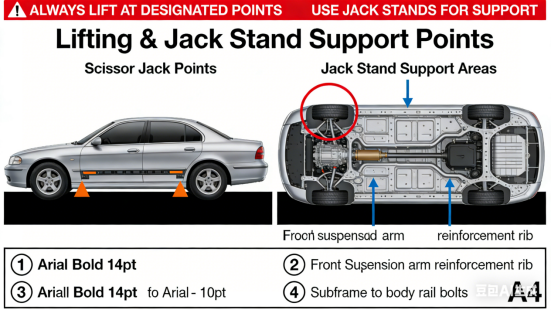
Axle tube Jack Stand placement for rear-wheel drive safety

Subframe and suspension system: Not a “universal support point”

The role of the subframe and its considerations as a support point: Although the subframe is robust, its primary function is to connect the powertrain and suspension system and absorb energy during a collision. When choosing it as a support point for the Jack Stands, it is essential to ensure that it is a strong part that connects to the vehicle body, rather than a weak point in the subframe itself or a suspension connection point .

Why are suspension components generally unsuitable as support points? — A conflict between dynamic design and static load-bearing principles. I’ve seen far too many people try to use Jack Stands to support control arms, shock absorbers, or steering knuckles. This is extremely dangerous! Suspension components are designed to withstand dynamic loads and shocks while the vehicle is in motion; they have various bushings and ball joints that allow for a certain degree of movement. When Jack Stands are used to support these components:

  1. Poor stability : The suspension components are not designed to withstand static vertical pressure, and their shape and connection method may cause Jack Stands to slip.
  2. Easily damaged : The sharp support surfaces of Jack Stands may crush rubber bushings, ball joint dust covers, or even cause component deformation.
  3. Safety hazard : Even if temporarily stable, the mobility of these components greatly increases the risk of Jack Stands slipping off when the vehicle shakes or experiences uneven stress.

How to Choose a Safe Jack Stand: Principles and Practices

Now that we have a basic understanding of the vehicle’s structure, the next step is to determine how to select the support points. Please remember, there are no shortcuts to safety; only strict adherence to procedures and careful operation.

Consult the owner’s manual: the first and most important rule

Why is the owner’s manual your “bible”? — Manufacturer-designated safe areas. This is a golden rule I always emphasize: Before you start, consult your owner’s manual! When designing vehicles, car manufacturers conduct rigorous calculations and tests to designate the safest lift and support points that will not damage the vehicle. These points are usually specially reinforced areas capable of supporting the entire weight of the vehicle.

  • Locate the officially designated lift points (lift blocks or reinforcing ribs) : The manual will clearly indicate the location of these points, and some may even include illustrations. They may be rubber pads on the underside of the vehicle or reinforced areas next to welds.
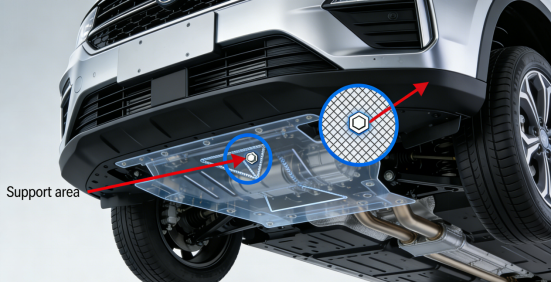
Jack Stand correct support point on vehicle frame

Identifying the “hard bones” of a vehicle: robust structural areas

If the owner’s manual does not explicitly specify the Jack Stand support points, or if you wish to find more universal and secure points, you can refer to the following principles:

  • Frame longitudinal and crossbeams : This is ideal for a frame-type chassis. Ensure that the Jack Stands are supported on flat, sturdy beams, not at edges or welds.
  • Axles and Differentials : For rear-wheel drive vehicles, the area near the end of the rear axle tube is a common support point. However, it is crucial to avoid this: avoid using the weakest point of the differential, never lift a loaded vehicle using the differential, and never use a single central Jack Stand to support both ends of the axle, as this is considered single-point support and is a high-risk practice . The correct approach is to support the axle on both sides.
  • Rocker arm weld points or reinforcements : For monocoque chassis, look for rocker arm reinforcements or visible welds on the inside of the side skirts at the bottom of the vehicle, where they connect to the chassis. These areas are typically designed for lifting.
  • Robust subframe connection points : If the subframe has a large, flat area that is tightly connected to the main body, it can be considered as a support point. However, ensure that the Jack Stands are pressed against solid metal, not against wiring, piping, or weak stamped parts.

Avoid fatal weaknesses: areas that cannot be sustained.

The following areas are absolutely prohibited from being supported by Jack Stands, as they are the vehicle’s “Achilles’ heel,” and damage to them could have disastrous consequences:

  • Suspension components (control arms, shock absorbers, ball joints) : As previously emphasized, these components are dynamic and their structures are not suitable for withstanding static pressure, making them extremely prone to slippage or damage.
  • Oil pan, transmission housing, exhaust pipe : These components are typically made of thin metal or aluminum alloy and contain oil or precision parts. If they are deformed or ruptured under pressure, they can cause oil leaks or even render the engine or transmission unusable.
  • Body panels, plastic parts, mudguards : these are all decorative or protective components with no load-bearing capacity. Using them for support is tantamount to suicide.
  • Brake lines, fuel lines, and wiring harnesses : these are the lifelines of a vehicle. Jack Stands running over these lines or harnesses can cause brake failure, fuel leaks, or even short circuits, potentially leading to a fire. I’ve personally witnessed far too many serious accidents caused by problems with this seemingly minor detail.
Safety support pointDangerous support pointsCause Analysis
Frame longitudinal beams/crossbeams (frame type)Suspension components (control arms, shock absorbers, ball joints)Dynamic design, prone to slippage, structurally fragile
Official designated lift point/reinforcing ribOil pan, gearbox housing, exhaust pipeThe material is thin and the internal structure is delicate, making it prone to damage that could lead to serious consequences.
End of axle tube (rear drive)Body panels, plastic parts, mudguardsIt has no load-bearing capacity and is only for decoration or protection.
Bogie rocker arm weld/reinforcing ribBrake lines, fuel lines, wiring harnessVehicles are lifelines; crushing them is a disaster, leading to safety accidents.
Robust subframe and body connection pointsWeak or moving parts outside the vehicle’s center of gravityThis leads to instability and increases the risk of Jack Stands slipping.

Summarize

Friends, that concludes today’s sharing. I hope that after reading this article, you will feel, “I realized how many risks I had overlooked before,” and “Now I understand better how to do things safely.”

DIY vehicle repair is both a pleasure and a skill. However, this pleasure and skill must be built on a foundation of absolute safety. Put safety first, and treat every operation as if it were the first time. Don’t rely on luck; trust science, engineering, your judgment, and meticulous inspection.

True safety isn’t about how many tons your jack stands can support but about how deeply you understand them and how correctly you operate them. If you want to minimize this risk and ensure flawless operation every time, we welcome you to learn more about professional vehicle support solutions, making your DIY journey always safe and controllable.

>>> The Ultimate Guide to Choosing a Jack Stand: In-Depth Analysis of Safety and Applicability

author-avatar

About Gavin Reid

Gavin Reid has been obsessively analyzing garage safety protocols and vehicle support systems for over a decade. After transitioning from a professional service bay to independent safety consulting in 2020, Gavin realized the market was flooded with confusing weight ratings and compromised designs that offered a false sense of security. His Mission: To help DIY mechanics—especially home hobbyists—identify critical failure points in vehicle lifting and ensure every project ends safely. Why Trust Gavin: Engineering Obsessive: He dissects load paths and weld integrity. From metallurgy to geometric stability, he understands the physics that keep two tons of steel from crushing a human chest. Data-Driven Testing: Gavin has stress-tested 40+ models, evaluating lateral stability and locking redundancy rather than just "marketing tonnage." In the Garage: He’s a fixture in local DIY communities, frequently inspecting frame rails for pinch weld placement and documenting metal fatigue on aging gear. Gavin believes that "a lapse in physics is a permanent mistake." He is dedicated to teaching mechanics how to maintain a "zero-trust" relationship with their equipment. Would you like me to provide Gavin’s specific checklist for identifying structural fatigue in used jack stands?