Jack Stands

Jack Stands’ Application Guide for Boats and General Trailers

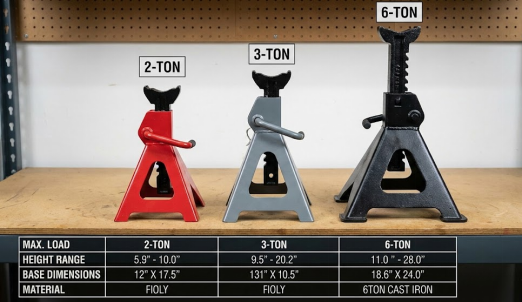
Various 2, 3, and 6-ton automotive jack stands displayed with specifications.

Hello everyone, I’m your old friend. Today, let’s talk about a topic that is both tempting and risky for many outdoor enthusiasts: how to safely change or maintain wheel bearings for your boats or utility trailers using jack stands.

Every summer, I see countless families setting off in their trailers and RVs to enjoy their holidays. Few people consider whether the most crucial connecting component of these trailers, carrying joy and anticipation—the wheel bearings—receives the attention and maintenance they deserve. Bearing maintenance may sound trivial, but improper operation, especially if the support structure malfunctions, can lead to more than just replacing a part; it concerns your property safety and, more importantly, the safety of you and your family.

There are many articles on car supports, but very few specifically address trailers, especially boat trailers and utility trailers. These trailers have unique structures and center of gravity characteristics, and cannot be treated the same as ordinary cars. Today, I’ll share my experience to guide you through understanding how to use jack stands to provide rock-solid support for your trailer.


I. The “Sweet Trap” of Towing Maintenance – Safety Starts with Support

Imagine a sunny weekend, and you decide to lubricate the trailer bearings yourself. Tools at your fingertips, enthusiasm high, you skillfully jack up one corner of the trailer, and prepare to crawl underneath… Stop! Behind this seemingly simple action lie many risks you may never have realized.

Trailers, especially boat and general-purpose trailers, are fundamentally different from passenger cars. They typically use a ladder frame structure with a high chassis, and their center of gravity is often higher when unloaded or partially loaded. This means that even a slight sway or an unstable support can cause the entire trailer to lose balance instantly and overturn.

Ensuring the trailer is absolutely safe the moment it’s lifted is paramount. Jack stands are the core tool for achieving this.


II. The Physics of Trailer Support: Why We Can’t Just Take Things for Granted

Understanding the physical characteristics of trailers is the first step in ensuring safety.

High center of gravity and rollover risk: In-depth understanding of the essential differences between trailer structure and passenger car/truck structure

Cars typically have a low center of gravity, wide wheelbase, and good stability. Trailers, especially general-purpose trailers used for transporting boats or heavy loads, generally have a higher center of gravity. Furthermore, when towed, part of the weight is borne by the towing vehicle. Once detached from the towing vehicle and lifted independently, their stability faces a severe test. Imagine a wine glass versus a flat-bottomed bowl—which is easier to tip over? The trailer is that wine glass.

When we use only one jack to lift a trailer, the entire weight of the trailer is concentrated on a narrow support point. This not only easily leads to uneven force on the jack and tilting, but also makes the trailer prone to tipping over under even a small external force.

This is a typical state of instability, and once it occurs, there is almost no chance of recovery.


III. Core Security Pillars: The Golden Rules for Correctly Using Jack Stands

Now, let’s build your trailer safety support system step by step.

Preparation: Absolute safety is the prerequisite

Flat, solid ground: Asphalt vs. Concrete, why is there a difference?

  • Always operate on flat, solid concrete surfaces. Asphalt surfaces soften at high temperatures, and the base of the jack stands may sink into it, causing instability. Grass and mud are even worse, as they cannot provide stable support.
  • If you must work on a non-concrete surface, be sure to place a sufficiently large, thick wooden board (e.g., a 2×12 inch board) under the jack stands base to distribute the pressure.

Wheel Chocks: The “stabilizing force” against rolling

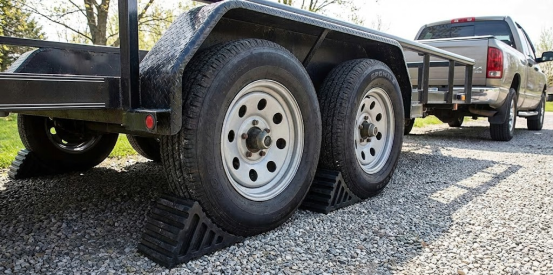
  • Place wheel chocks on both the front and rear wheels of the trailer before it is lifted. For example, if you are lifting the front of the trailer, place wheel chocks on both sides of the rear wheels. This effectively prevents the trailer from rolling accidentally during lifting or after being supported.
Dual axle trailer securely chocked on gravel, often supported by jack stands for maintenance.

Check your equipment: Are your Jack Stands and jacks “healthy”?

  • Before use, always carefully inspect your jacks and jack stands. Make sure they are free from visible damage, deformation, or cracks.
  • For jack stands, check that the locking mechanism is intact and that the pins can be fully inserted. A special reminder: if your jack stands are from a Harbor Freight recall batch (such as Pittsburgh Automotive 3-ton and 6-ton, specific batch numbers), please stop using them immediately and contact the retailer for a replacement. Safety is paramount; don’t gamble with your life.

Find the best support point: the main beam is king, keep it away from the axle.

This is the most crucial step in trailer support.

Why Axles Aren’t Ideal Choices: Stress Analysis and Damage Risk

  • Although axles appear sturdy, in some trailer designs, placing jack stands directly on the axle can cause unnecessary stress concentration on the axle tube, even leading to deformation. More importantly, axles are typically cylindrical or square in shape, resulting in a relatively small contact area with the jack stands’ saddles, making them prone to slippage.

The “Lifeline” of Boats & Utility Trailers: Identification and Importance of the Frame Rail

  • The main frame rail of boats and utility trailers is typically the strongest and most load-bearing part of the structure. When lifting the trailer, the ideal jack stands should be placed near the main frame rail section, close to the wheels. These areas are usually box-shaped structures or thick C-shaped steel sections that distribute the load evenly.
  • Consult the manufacturer’s manual to confirm the recommended lift point. If not explicitly stated, choose the section of the frame closest to the wheels that is structurally the strongest and flattest.

How to accurately place Jack Stands: Ensure the contact surfaces are secure to prevent slippage.

  1. Place the jack under a solid point on the main beam of the trailer and slowly lift the trailer until the wheels are just off the ground.
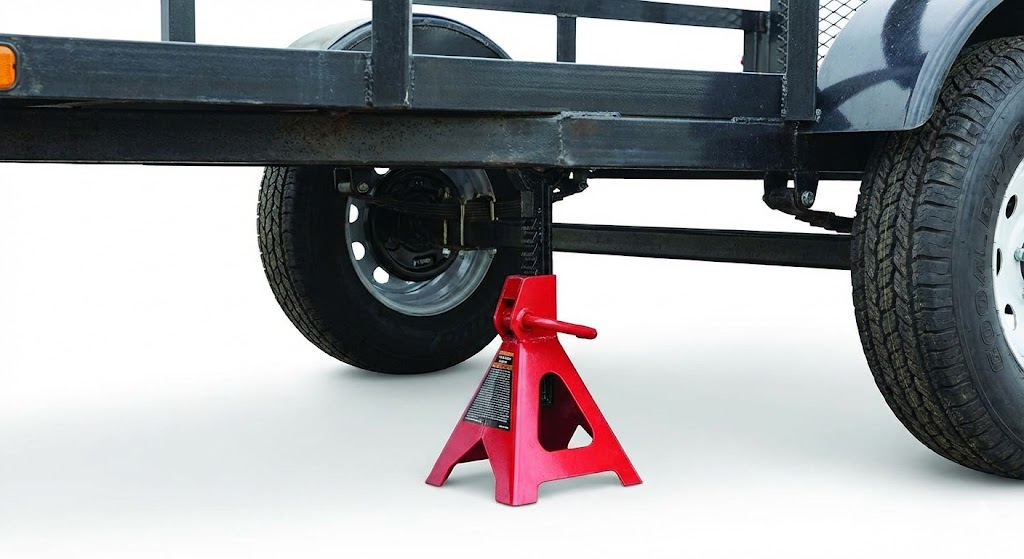
  2. Place the jack stands below another sturdy beam point near the jack. Ensure that the jack stand saddles are fully and securely in contact with the beam without any wobbling.
  3. Slowly lower the jacks until the weight of the trailer is completely transferred to the jack stands. At this point, the jacks can be slightly loosened, but it’s best not to remove them completely, keeping them as an extra backup support.
Red 2-ton jack stand supporting a trailer frame, essential for safe repairs.

Triangle Support: The Hidden Power of the Tongue Jack

This is a safety strategy unique to trailers, determined by their high center of gravity.

Constructing a three-point stable system: Tongue Jack + two Jack Stands

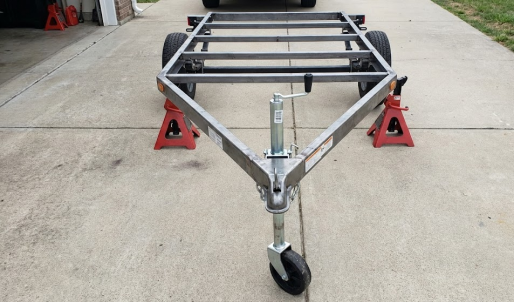
  • Because trailers have only one or two axles and a high center of gravity, lifting only one side of the wheels creates an unstable two-point support for the entire trailer. Therefore, the trailer tongue jack plays a crucial role as a third support point in this situation.
  • When lifting the trailer, first use the Tongue Jack to adjust the height of the front of the trailer, then use a jack to lift the wheel that needs maintenance, and finally place two jack stands. This creates a stable three-point support system with the Tongue Jack and the two jack stands placed on the trailer’s frame. This geometry is mechanically the most stable.

How to adjust the height to distribute the load evenly?

  • After transferring the trailer weight to the jack stands, you can fine-tune the height of the Tongue Jack to ensure even weight distribution across the three support points. Gently shake the trailer to check its stability. If you feel instability on any side, readjust.

IV. Detailed Procedure for Safely Replacing Wheel Bearings

Once the trailer is safely lifted and supported, bearing maintenance can begin.

  1. Lift and place them one by one: proceed gradually and do not rush.

    If you need to lift both wheels at the same time, always lift one side first, place the jack stands securely, and only lift the other side after confirming it is stable.

    I’ve seen far too many accidents caused by trying to lift the entire axle at once.

    During lifting, always ensure that the jack is perpendicular to the lifting point to avoid oblique force.

  2. “Shaking test”: the last line of defense before formal operation.

    Before you begin working under the trailer, shake it vigorously with both hands, trying it from different directions: front, back, left, and right. If the trailer shows any signs of instability, immediately lower it and re-inspect the support points and jack stands. This step is crucial; it helps you identify potential support issues.

  3. Disassemble wheels and bearings for maintenance: Follow the manufacturer’s manual.

    Refer to your trailer or bearing manufacturer’s maintenance manual to perform steps such as wheel removal, old bearing removal, cleaning, inspection, adding new grease, and installing new bearings. We will not go into the specific steps here, as the focus is on support safety.

  4. Pullback and Inspection: Reverse the trend, proceed step by step.

    1. After the bearing maintenance is completed, the wheel will be reinstalled.
    2. Use a jack to slightly lift the trailer to relieve the weight on the jack stands, then remove the jack stands.
    3. Lower the trailer slowly and smoothly until the tires are fully in contact with the ground.
    4. Remove wheel chocks.
    5. Finally, before driving, be sure to double-check that all bolts are tightened, especially the wheel nuts and bearing caps.
Empty trailer frame safely supported by two red jack stands on a concrete driveway.

V. Advanced Security Considerations and Clarification of Misconceptions

Jack Stands capacity options: 2-ton, 3-ton, and even 6-ton. How do you choose the right one for your trailer?

Jack stands are available in various tonnage options, such as 2-ton, 3-ton, 6-ton, and even 12-ton. Here, “tonnage” usually refers to a pair of jack stands’ total load-bearing capacity, not just a single one.

  • Understanding Trailer GVWR (Gross Vehicle Weight Rating): Before selecting jack stands, be sure to check your trailer’s GVWR (Gross Vehicle Weight Rating). This value can usually be found on the trailer’s nameplate or in the owner’s manual.
  • Safety margins are crucial: For example, with a trailer with a GVWR of 5000 lbs (approximately 2.5 tons), even if you only lift one side, theoretically you only need to support half or less of the weight, but I strongly recommend choosing jack stands with a capacity of at least 6 tons. Why?
    • Distributed load: Even if only one side is lifted, the weight on the other side remains. We aim for maximum safety redundancy.
    • Stability: Generally, the larger the tonnage of the jack stands, the wider the base and the more robust the structure, resulting in better stability. This is especially important for trailers with a high center of gravity.
    • Future compatibility: Investing in larger capacity jack stands can handle heavier trailers or more complex maintenance work in the future.

Long-term support: Can Jack Stands provide support for an extended period of time?

Yes, high-quality jack stands can support a vehicle indefinitely, provided they are placed correctly on a firm, level surface. They are mechanical structures and will not leak pressure due to seal failure, unlike hydraulic jacks.

However, some factors also need to be considered for long-term support:

  • Tires: If a trailer is left on jack stands for months or even years, flat spots may appear on the tires. It is recommended to slightly increase the tire pressure before long-term storage, or to rotate the wheels periodically, or even consider using dedicated wheel cribs to support the tires.
  • Suspension/Seals: Prolonged suspension may put some stress on the seals of shock absorbers or struts, but the impact is usually minimal.
  • Rust prevention: The areas where jack stands contact the trailer chassis can rust due to prolonged friction or moisture. Regular inspection and application of rust inhibitors can effectively mitigate this.

When to consider alternatives: Scenarios where Car Ramps or Wheel Cribs are appropriate

  • Car Ramps: For tasks requiring simple inspections under the vehicle, such as oil changes, that don’t require wheel removal, car ramps are a quick and relatively safe option. They offer a larger contact area and good stability. However, the downsides are that the wheels cannot be removed, and for low-chassis vehicles, there is a potential risk of scraping the bumper.
  • Wheel cribs: These are wider and more stable support tools than jack stands, usually made of high-density foam or solid wood. They can lift the entire tire, providing very stable support, and are especially suitable for long-term storage or display of vehicles. However, their lifting height is fixed and they are not as flexible as jack stands.

Maintaining trailer axles is crucial for ensuring a safe and smooth outdoor adventure. And it all starts with a sturdy, secure support. As a garage safety consultant,

I firmly believe that the joy of DIY lies in the learning and control involved, not in flirting with risks.

Hopefully, this guide has helped you develop a new understanding of trailer support safety. The next time you’re preparing to perform maintenance on your boat or general trailer, keep in mind the principles we discussed today: level ground, wheel chocks, sturdy beam support points, and most importantly, the triangular support formed by the Tongue Jack and Jack Stands.

Safety is always the shortest route home. If you want to minimize the risks of every maintenance visit and provide the most reliable support for your trailer, then users with higher safety redundancy requirements will typically focus on trailers that meet ASME PALD standards, have a wide base, and a double locking mechanism. Jack Stands products.


FAQ

Why is it not recommended to stack Jack Stands directly in a corner?

Stacking jack stands directly in a corner not only creates a cluttered garage environment and increases the risk of tripping when moving or retrieving other tools, but also causes damage to their surface coatings and accelerates the corrosion of metal parts due to mutual compression and collisions.

More seriously, long-term improper stacking may cause minor deformations in the jack stands’ structure, affecting their overall stability and load-bearing capacity, thus creating potential safety hazards.

How should the load-bearing capacity of a DIY wall hanging rack be calculated and evaluated?

The load-bearing capacity of a DIY wall mount depends primarily on the strength of the materials you choose (wood, PVC, 3D printed parts), the mount’s design, and how it’s secured to the wall.

When calculating, multiply the weight of a single jack stand (typically a 3-ton jack stand weighs about 5-10 kg) by the number of units you plan to mount, and then multiply by a safety factor of at least 2-3.

Most importantly, regardless of the material used, the mount must be securely fixed to studs inside the wall, not just to drywall. Using a stud detector to locate the studs and selecting sufficiently long (3-5 cm deep) and strong screws for secure mounting is fundamental to ensuring load-bearing safety.

Besides the DIY solutions mentioned above, what other simple ways are there to temporarily store Jack Stands?

Heavy-duty tool cart: If your garage space allows, you can buy a tool cart with sufficient load-bearing capacity and place the jack stands at the bottom or side of the cart for easy movement and access.

Existing rack bottom space: Utilize the bottom or lower middle level space of the existing heavy-duty racks in the garage, and install a simple baffle (such as a wooden or metal strip) at the edge of the rack to prevent jack stands from rolling off.

Corner area optimization: If there is really no wall space, you can build a low platform with a fence using a few thick wooden planks in a less frequently used corner of the garage, and place the jack stands on it in an orderly manner to avoid them being scattered directly on the ground.

However, please remember that while these temporary solutions can provide a certain level of tidiness, they are not as effective as professional wall-mounted systems in utilizing vertical space and completely eliminating ground obstructions. In the long run, DIY wall-mounted solutions are the better choice.

My trailer only has two wheels, do I only need a pair of Jack Stands?

Even if your trailer only has two wheels, when lifting one wheel, you need to use a pair of jack stands to support the side being lifted, and be sure to use a tongue jack to create a three-point support. The trailer’s high center of gravity makes it extremely unstable with only two points of support; three points of support are the minimum requirement to ensure safety.

Can I put the Jack Stands directly under the trailer tires?

No. Jack stands must never be placed directly under tires. They are designed to support structural components of the vehicle, such as the frame, not rubber tires. Placing jack stands under tires not only fails to provide stable support but can also damage the tires or even cause the trailer to slip.

Why is it emphasized that you cannot use only one jack to support the trailer?

Jacks are for lifting, not for long-term support. Their hydraulic systems can suddenly fail due to worn seals or pressure leaks. Jack stands, on the other hand, are mechanical devices designed for long-term, stable support. Using only jacks to support vehicles for work is extremely dangerous and can easily cause the vehicle to fall, resulting in serious injury or even death.

author-avatar

About Gavin Reid

Gavin Reid has been obsessively analyzing garage safety protocols and vehicle support systems for over a decade. After transitioning from a professional service bay to independent safety consulting in 2020, Gavin realized the market was flooded with confusing weight ratings and compromised designs that offered a false sense of security. His Mission: To help DIY mechanics—especially home hobbyists—identify critical failure points in vehicle lifting and ensure every project ends safely. Why Trust Gavin: Engineering Obsessive: He dissects load paths and weld integrity. From metallurgy to geometric stability, he understands the physics that keep two tons of steel from crushing a human chest. Data-Driven Testing: Gavin has stress-tested 40+ models, evaluating lateral stability and locking redundancy rather than just "marketing tonnage." In the Garage: He’s a fixture in local DIY communities, frequently inspecting frame rails for pinch weld placement and documenting metal fatigue on aging gear. Gavin believes that "a lapse in physics is a permanent mistake." He is dedicated to teaching mechanics how to maintain a "zero-trust" relationship with their equipment. Would you like me to provide Gavin’s specific checklist for identifying structural fatigue in used jack stands?