Jack Stands

Must jack stands rise “simultaneously”? Unveiling the deadly risks of unilateral adjustments.

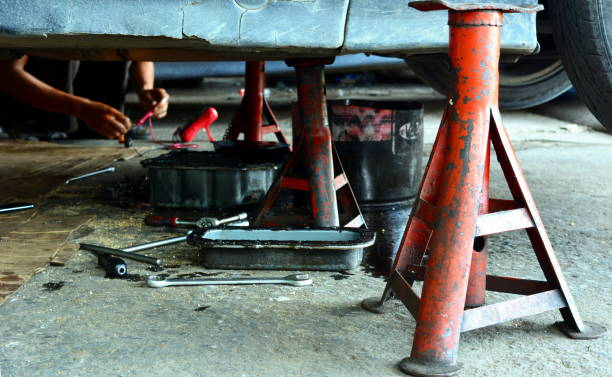
Person working under car safely supported by two orange jack stands.

Today, we’ll delve into an often overlooked yet crucial safety detail: when using jack stands to lift vehicles, must they be raised “simultaneously”? And how much risk does adjusting one side or having inconsistent heights on both sides actually pose?

You might think that as long as the car eventually lands steadily on the jack stands, the “synchronization” during the process doesn’t seem so important. But this kind of thinking is the beginning of many dangers. Lifting a vehicle is not a simple physical task but a delicate operation dealing with gravity, balance, and structural stress. Neglecting any aspect could put your car and your safety at risk.

From an engineering mechanics perspective, we will dissect the potential threats of unilateral or uneven lifting layer by layer and provide a rigorous and feasible safety operation plan to help you do things more safely and professionally.


The Dangerous “False Balance”: The Deadly Temptation of Unilateral Adjustment and Center of Gravity Shift

1.1. Vehicle lifting is not a form of “double-edged sword.”

Let’s first clarify a common misconception. Many people, when lifting a vehicle, unconsciously treat it as a rigid whole, believing that as long as all four corners are lifted, whether the left or right corner is lifted first, the final result will be the same.

However, the body structure of modern cars, especially passenger cars, is not a completely rigid “block of iron.” They are connected to the wheels through the suspension system, and the frame or unibody design takes into account complex stress distribution.

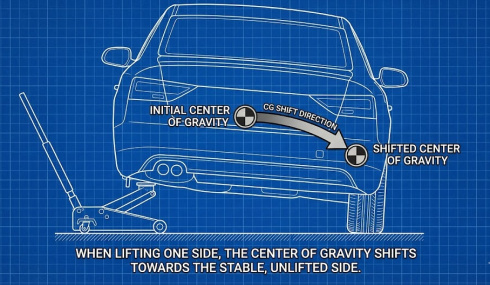
When you use a floor jack to lift a vehicle on one side, but the jack stands on the other side don’t rise simultaneously, the vehicle’s center of gravity (CoG) shifts significantly.

Imagine trying to lift a large bucket full of water with one hand, but only lifting one side—the water immediately rushes to the lower side in an attempt to restore balance. The same applies to a vehicle; its center of gravity quickly shifts to the side that wasn’t lifted or is lower. This dynamic change is far more dramatic than you might imagine.

1.2. Unilateral Adjustment: A Dangerous Game Against Gravity

In a post-accident analysis, a car owner attempted to change brake pads in his garage. He first jacked up the left side of the front of the car, placed a jack stand, and then moved the jack to lift the right side. Just as he was about to place the second jack stand, due to the uneven center of gravity and slightly uneven ground, the vehicle suddenly tilted to the right and eventually slipped off the first jack stand, causing serious damage. Fortunately, the owner was not outside the vehicle at the time.

This kind of unilateral or uneven lifting is essentially a dangerous game against gravity. Once the vehicle’s center of gravity shifts significantly, its stability at the support point will drop drastically.

Even if your jack stands are of the highest quality, if the force they bear is not vertically downward but rather a horizontal shear force, the risk of slipping and tipping over will increase exponentially.


Diagram showing center of gravity shift when lifting a car, prior to using jack stands.

The cost of “asynchrony”: the hidden dangers of structural stress and support failure.

2.1. Structural Stress: The Silent Protest of the Chassis

When the jack stands are not at the same height, or the lifting process is uneven, the vehicle’s body structure will be subjected to enormous, unexpected stress.

You can think of the car body as a large box; if you only lift two opposite corners, the box will twist. The same applies to cars. This twisting can affect the frame, body welds, suspension connection points, and even door gaps.

At best, you might find the doors don’t close smoothly, or some body parts make unusual noises.

At worst, this asymmetrical stress buildup can lead to permanent deformation of the chassis, weakening the body structure. Over time, this can not only affect the vehicle’s driving safety but also cause irreversible damage to subsequent repairs and the vehicle’s lifespan.

2.2. Fatigue and Slippage of Support Points

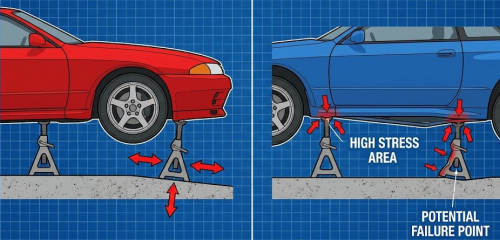
Jack stands are designed to withstand downward compressive loads. When the vehicle’s load is asymmetrical or the center of gravity shifts, the pressure on a single jack stand can far exceed its design specifications, while also generating lateral forces, increasing the risk of its base slipping on the ground.

Imagine a jack stand originally designed to withstand a 3-ton vertical load, but when the vehicle is tilted, it may have to withstand a 4-ton or even greater oblique force, and this force is not evenly distributed across its support surface.

This will not only accelerate the fatigue and wear of the jack stand itself but may also cause it to suddenly yield or slip off the vehicle’s pin welds or other support points under critical conditions.

The following table compares the risks of different support methods:

Support methodAdvantagePotential risks
Even four-point supportLoad balancing and high stabilityEnsure all jack stands are at the same height and the ground is level.
Two-point (coaxial) supportSuitable for shaft end repairEnsure the other axle is braked and wheel chocks are used.
Unilateral or uneven support—The center of gravity shifts, local overloads, structural twisting, and slippage risks are extremely high.

Diagram comparing safe vs. unsafe car lifting with jack stands and potential failure points.

The Art of Synchronization: The Engineering Wisdom of Safe Lifting

How can jack stands be used safely and correctly? The core principle is to keep the vehicle as level as possible and to lift it step by step and gradually.

3.1. Gradual Progress: The Principle of Safe “Small Steps, Quick Progress”

  1. Preparation: Park the vehicle on a hard, flat surface (such as concrete), engage the handbrake, and place wheel chocks under the wheels that are not lifted.

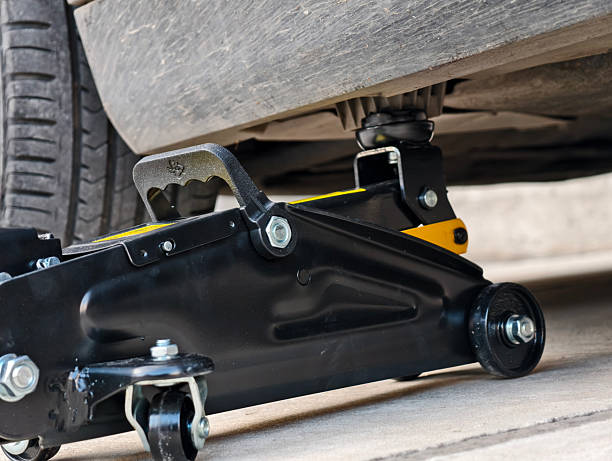
  2. Initial lift: Use a floor jack to slightly lift the vehicle at the center support point (if the vehicle has one) on the front or rear axle or at a recommended lift point on one side.

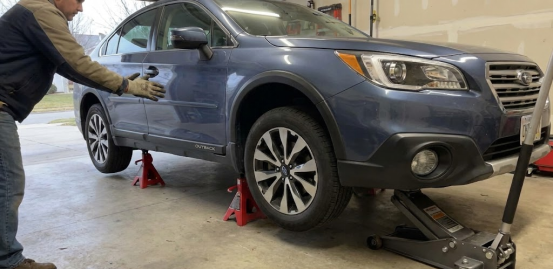
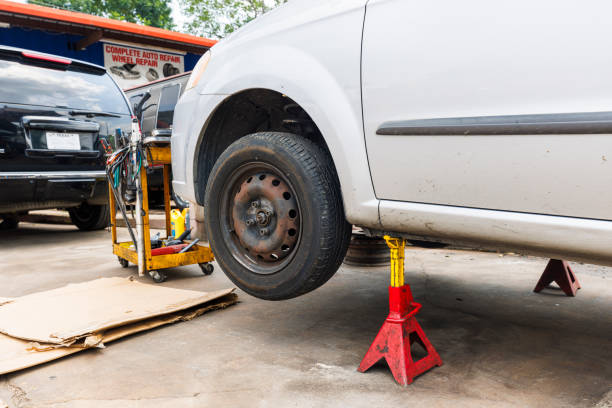
  3. Place the jack stands: On the raised side, place the jack stands below the manufacturer-specified jack points or sturdy frame locations. Ensure their placement is symmetrical and initially adjust them to near the desired height.For unibody construction, jack pads are typically needed to protect the pinch welds from damage.

  4. Alternate lifting: Next, move the jack to the other side of the vehicle and lift the vehicle again at the recommended lifting point, placing the second jack stand. At this point, the heights of the two jack stands should be as consistent as possible.

  5. Gradual lifting: If you need a higher lifting height, do not raise the jack to its highest position all at once.Instead, raise the jack stands on both sides one or two stops at a time, then move to the other side and repeat. Always keep the height difference between the two sides of the vehicle as minimal as possible.This process requires patience, but it is the cornerstone of ensuring safety.

  6. Inspect the Pinch Welds: Ensure the jack stands are securely fastened to the car’s pinch welds or other support points, with no signs of slippage. If using jack pads, check that they are intact and correctly positioned.

3.2. Redundancy and Verification: The Last Line of Defense for Security

Based on my years of experience in garage security, you should never let your guard down, even if you have set up all the jack stands.

  • Stability Test: Before entering the vehicle, shake it vigorously in all directions. If the vehicle shows any shaking, tilting, or signs of jack stands moving, immediately lower the vehicle, re-inspect, and adjust.A stable vehicle should remain completely still when shaken.

  • Redundant support: When performing repairs that may require significant force or prolonged operation, I usually recommend leaving a floor jack under the vehicle, under slight pressure, as an extra safety margin. It’s like adding an extra layer of insurance for your safety.

  • Ground and Jack Stands Weight: Ensure your jack stands are rated to support well over the actual weight of your vehicle. For example, if your SUV weighs 4,000 pounds, a pair of 3-ton (6,000-pound) SUV jack stands would be a safer choice.Also, the ground must be hard and level; avoid using them on tarmac, mud, or grass, as these surfaces may cause the jack stands to sink or tip over.


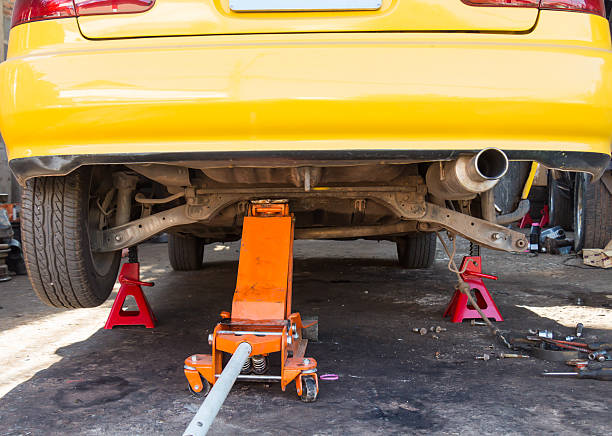
Yellow car lifted by floor jack, safely supported by red jack stands for repair.

DIY is fine; the problem is getting out of control.

Vehicle lifting, especially using tools like jack stands, is one of the riskiest aspects of DIY repair.

Today, we delve into the engineering mechanics behind issues such as adjusting jack stands unevenly, one side being higher than the other, or even the safety of an unevenly raised jack stand. Our aim is to show you that safety is not achieved overnight, nor is it a matter of luck. It stems from respect for detail, adherence to science, and a full understanding of the risks.

A properly configured jack stand, combined with correct operating procedures, is fundamental to ensuring the safety of you and your vehicle. Remember, it’s better to be slow than wrong. Treat every lift as if it were your first time, strictly adhering to safety protocols and ensuring every step is flawless. Because your safety is paramount.


FAQ

Q1: Can I use a jack stand to support the vehicle for a quick inspection?
No. Whether for quick inspections or lengthy repairs, jack stands must be used in pairs and support at least the same axle of the vehicle to ensure stability and distribute the load. A single jack stand cannot provide sufficient anti-tipping capacity and can easily cause the vehicle to tip over, resulting in a serious accident.
Q2: If my garage floor is not completely level, can I still safely use jack stands?
Not recommended. Jack stands must be placed on a hard, completely flat surface, such as concrete. An uneven surface will cause uneven stress on the jack stands, or the feet may not make full contact with the ground, thus reducing stability and increasing the risk of slippage and tipping. In such cases, a safer lifting environment should be sought.
Q3: Does the rated load capacity of jack stands refer to a single jack stand or the total load capacity of both jack stands?
This usually refers to the total weight of a pair (two jack stands). In most cases, such as “3-ton jack stands,” it means that a pair of stands can safely support a weight of 3 tons. Therefore, when choosing, you should ensure that half the weight of your vehicle (or the actual weight you need to support) is much less than the rated load of the jack stands you purchase, to leave sufficient safety margin.
author-avatar

About Gavin Reid

Gavin Reid has been obsessively analyzing garage safety protocols and vehicle support systems for over a decade. After transitioning from a professional service bay to independent safety consulting in 2020, Gavin realized the market was flooded with confusing weight ratings and compromised designs that offered a false sense of security. His Mission: To help DIY mechanics—especially home hobbyists—identify critical failure points in vehicle lifting and ensure every project ends safely. Why Trust Gavin: Engineering Obsessive: He dissects load paths and weld integrity. From metallurgy to geometric stability, he understands the physics that keep two tons of steel from crushing a human chest. Data-Driven Testing: Gavin has stress-tested 40+ models, evaluating lateral stability and locking redundancy rather than just "marketing tonnage." In the Garage: He’s a fixture in local DIY communities, frequently inspecting frame rails for pinch weld placement and documenting metal fatigue on aging gear. Gavin believes that "a lapse in physics is a permanent mistake." He is dedicated to teaching mechanics how to maintain a "zero-trust" relationship with their equipment. Would you like me to provide Gavin’s specific checklist for identifying structural fatigue in used jack stands?