Jack Stands

Why isn’t the jack stand’s posthole design continuously adjustable?

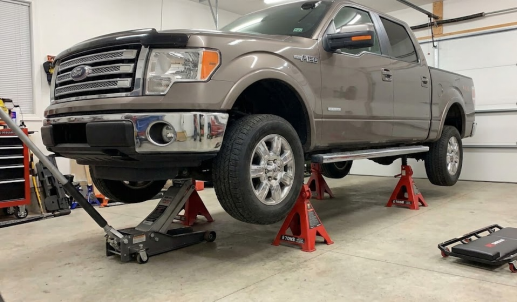
Ford F-150 truck lifted with a floor jack and red jack stands in a garage.

When it comes to safely lifting and securing a vehicle, jack stands are undoubtedly a must-have in every garage. However, have you ever wondered about their design? Why do the jack stand‘s post holes always click and adjust in sections instead of providing a smooth, stepless lifting motion like a hydraulic jack?

This is not a trivial design detail, nor is it a sign of technological backwardness. In fact, this “segmented” adjustment mechanism is the core secret behind jack stands’ ability to provide absolutely stable support under extreme loads. Today, I will guide you through a deeper understanding of this seemingly inconvenient but actually crucial design philosophy from the perspectives of engineering mechanics and safety redundancy.


Withstanding Immense Force: The Core Mission of Jack Stands

When your car is lifted and its weight of several tons is suspended in the air, the only thing supporting it is those two or four small metal pillars—jack stands. This is far more than just a simple matter of “holding it up.” After the vehicle is lifted, its center of gravity changes, and even slight unevenness in the ground, the wind, or the torque you apply when tightening screws under the car can generate unexpected lateral forces or vibrations.

The complexity of these loads far exceeds our intuition. If the support tools cannot provide ultimate stability, any minute displacement can be amplified, ultimately leading to catastrophic consequences. In the accident debriefings I’ve participated in, many support failures stemmed from misunderstandings of tool principles and underestimation of potential risks.


The cornerstone of structural design: shear strength and materials science

Mechanical advantages of discrete hole design: shear strength

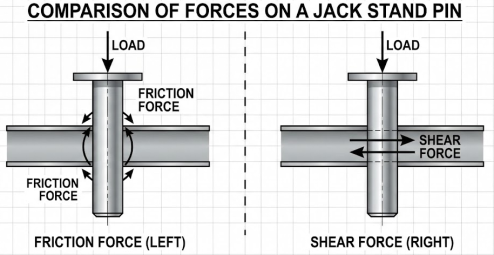
Imagine if jack stands were infinitely adjustable; they might need to rely on friction or complex clamping mechanisms to maintain their height. But under long-term loads, vibrations, oil, or moisture, any mechanism that relies on friction for fixation is at risk of gradual failure—it might not collapse suddenly, but it will slowly slide away without you noticing until it eventually goes out of control.

The discrete hole design completely avoids this risk. When you insert the adjusting rod into the hole, or when the ratchet mechanism’s teeth engage, the vehicle’s weight is directly transferred to the main structure of the jack stands through the pin or teeth. This “point-to-point” contact withstands shear forces.

  • Safety Redundancy: Solid pins or ratchet teeth are designed to withstand loads far exceeding their rated capacity to cope with sudden impacts or off-center loads. They resist loads through the shear strength of the material itself, rather than relying on the coefficient of friction. This means that unless the pin or tooth is directly sheared off, it will remain stable. This design provides extremely high safety redundancy.
  • Avoiding progressive failure: Unlike friction, shear strength typically doesn’t show obvious signs of “slippage” or “deformation” before reaching its limit. It either fully bears the load or breaks suddenly when the limit is exceeded (which is extremely rare in qualified products). This characteristic of “non-progressive failure” ensures the reliability of the support.
Diagram showing friction and shear forces acting on a jack stand pin.

Material selection and manufacturing tolerance considerations

  • High-strength steel and precise hole positioning: Jack stands are typically made of high-strength steel, and their holes must be precision-machined to ensure a tight fit between the pins or ratchet teeth, minimizing clearance. Excessive clearance can cause wobbling, increase localized stress, and thus reduce overall load-bearing capacity.
  • Tolerance control: Strict tolerance control is essential during the manufacturing process. This not only ensures a tight fit between the pin and the hole but also reduces stress concentration caused by shaking during use, further improving long-term reliability.

The dilemma of stepless regulation: complexity, cost, and potential risks

So why can’t we design a jack stand that is both safe and infinitely adjustable? It’s not impossible in theory, but it would face enormous challenges and unacceptable risks in practice.

Complex stepless adjustment mechanisms: challenges of cost and weight

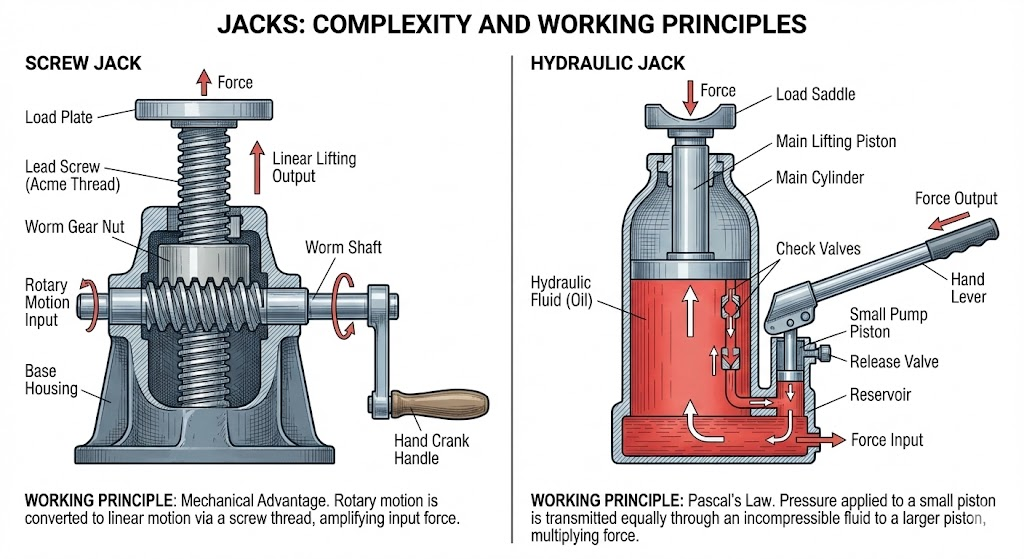
  • Screw jack mechanism: Similar to a screw jack, it allows for stepless adjustment. However, this structure is often very heavy, slow to adjust, and has poor stability under lateral forces. It is suitable for precise adjustments but not for rapid deployment as a car support tool. Its high manufacturing precision requirements also drive up costs.
  • Hydraulic/Pneumatic Systems: While hydraulic jacks offer stepless lifting, they require continuous hydraulic/pneumatic pressure to maintain height. Once seals age, leak, or air pressure becomes insufficient, support gradually diminishes. The core of jack stands lies in providing long-term static support, an inherent safety feature of hydraulic systems. Who would dare entrust their life entirely to a potentially leaky system, working under a vehicle for hours?
Understanding the principles of screw and hydraulic jacks, often used with jack stands.

Potential safety hazards: The “trap” of continuously variable adjustment.

Any continuously adjustable mechanism will inevitably involve more mechanical parts and more complex stress conditions, thus introducing more potential failure points.

  • Friction failure: If the device relies on friction for stability, oil, vibration, high temperatures, or prolonged loads can all weaken the friction, leading to slippage. This is an extremely common risk in garage environments.
  • Mechanical wear: Continuous adjustment means more sliding and friction, which accelerates component wear. When wear accumulates to a certain extent, its load-bearing capacity will be greatly reduced, increasing the risk of failure.
  • Jack stands to provide absolutely stable support. Any design that introduces uncertainty or the risk of gradual failure runs counter to this mission.

My Experience and Warnings from a Garage Safety Consultant Perspective

Based on my years of experience in garage safety, many accidents occur not because the tools themselves are defective, but because users lack understanding of how the tools work or take chances.

The support accidents I’ve witnessed often stem from a misunderstanding of the tool’s principles.

Jack stands on uneven ground; some mistakenly place jack stands on unstable parts of the vehicle, and some even hastily crawl under the car without using wheel chocks. These actions all demonstrate a disregard for the principles of the tool and safety protocols.

DIY is fine, but loss of control is. Respect for tools means not only knowing “how to do it” but also understanding “why.” The discrete adjustment of jack stands is a “compromise” made by its designers to ensure safety—sacrificing a little convenience for ultimate reliability. Users who pursue “parameter worship” and “gambling mentality” are often the high-risk group for accidents.

How to correctly understand and use Jack Stands

Now that we understand the design philosophy of jack stands, using them correctly becomes especially important:

  1. Choose the appropriate load rating: Always choose jack stands with a load rating far exceeding the actual weight of the vehicle. Even if you are only lifting one corner of the vehicle, ensure that a single jack stand has the load-bearing capacity to handle half the weight of your vehicle with a sufficient safety margin. For example, a 4,000-pound (approximately 1.8-ton) car should use at least 3-ton jack stands.
  2. Ensure proper support points: Always place jack stands at support points specified by the vehicle manufacturer, such as sturdy parts of the frame, subframe, or pinch weld locations with reinforced padding. Never place them on the exhaust pipe, oil pan, plastic covers, or suspension components.
  3. Ground conditions: Always operate on a flat, hard surface (such as concrete). Loose soil, gravel, or uneven asphalt surfaces may cause jack stands to tilt or sink.
  4. Do I need wheel chocks with jack stands? The answer is yes. Even if the vehicle is securely placed on jack stands, wheel chocks should be used to wedge the wheels that are not lifted to prevent the vehicle from rolling accidentally. This is a basic and effective safety redundancy.
  5. Stability test: Before fully penetrating under the vehicle, gently shake the vehicle to ensure its stability.
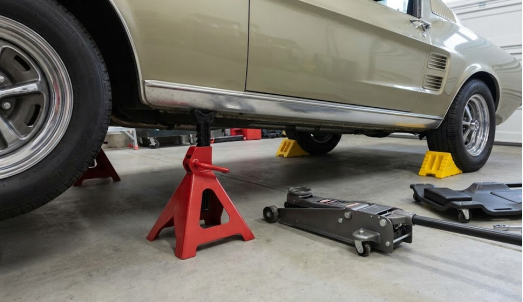
Classic car elevated on a red jack stand, floor jack, and wheel chocks.

Safety is paramount; understanding is essential.

Are jack stands continuously adjustable? Through today’s in-depth analysis, you’ll discover that this isn’t accidental but rather an inevitable choice made by engineers after careful consideration of the balance between safety and practicality. The discrete hole design relies on the shear strength of the material rather than frictional forces susceptible to environmental influences, providing the vehicle with the most stable and reliable static support.

Finally, I hope everyone remembers: a deep understanding of how tools work is the first step to ensuring garage safety. Before you start, think “why”—why is it designed this way? Why do I need to do it this way? —rather than just “how to do it.” This spirit of inquiry will not only improve your DIY skills but also build a solid line of defense for the safety of you and your family.


FAQ

Why are there no continuously variable jack stands on the market?
The reason why there are no continuously variable jack stands on the market is mainly because continuously variable adjustment mechanisms (such as friction or hydraulic) have safety hazards under long-term static loads. They are not as stable and reliable as discrete hole design in terms of shear strength and are prone to failure due to wear, oil leakage or vibration.
Which adjustment method is safer: ratchet or pin adjustment?
ratchet and pin adjustments offer high safety in qualified products. Ratchet adjustments are generally faster and more convenient, while pin adjustments provide a more intuitive physical lock. The key is to choose reputable brands with jack stands that meet safety standards and ensure that the pin or ratchet is fully engaged.
Does the hole design of jack stands affect its load-bearing capacity?
jack stands directly affects their load-bearing capacity. Precise hole placement and tightly fitting pins or ratchet mechanisms ensure even load distribution and full utilization of the material’s shear strength. Any design flaws or excessive gaps in the hole placement can lead to stress concentration, thereby reducing actual load-bearing capacity and safety.
author-avatar

About Gavin Reid

Gavin Reid has been obsessively analyzing garage safety protocols and vehicle support systems for over a decade. After transitioning from a professional service bay to independent safety consulting in 2020, Gavin realized the market was flooded with confusing weight ratings and compromised designs that offered a false sense of security. His Mission: To help DIY mechanics—especially home hobbyists—identify critical failure points in vehicle lifting and ensure every project ends safely. Why Trust Gavin: Engineering Obsessive: He dissects load paths and weld integrity. From metallurgy to geometric stability, he understands the physics that keep two tons of steel from crushing a human chest. Data-Driven Testing: Gavin has stress-tested 40+ models, evaluating lateral stability and locking redundancy rather than just "marketing tonnage." In the Garage: He’s a fixture in local DIY communities, frequently inspecting frame rails for pinch weld placement and documenting metal fatigue on aging gear. Gavin believes that "a lapse in physics is a permanent mistake." He is dedicated to teaching mechanics how to maintain a "zero-trust" relationship with their equipment. Would you like me to provide Gavin’s specific checklist for identifying structural fatigue in used jack stands?