Jack Stands

Pin-type vs. ratchet-type Jack Stands: Which locking mechanism is truly “fail-proof”?

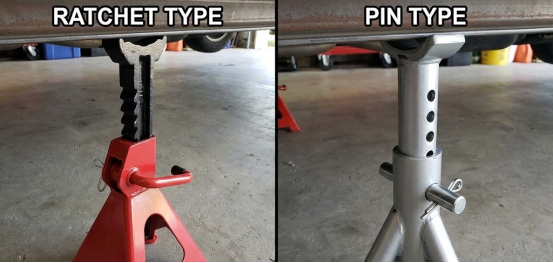
Compare ratchet and pin type jack stands securely supporting a vehicle for maintenance.

Working under vehicles: Safety first—your lifeline, not just luck.

Jack stands are the last line of defense for vehicle stability when working under a vehicle. They are not temporary replacements for jacks, but rather long-term, stable safety devices designed to support the weight of the vehicle.

However, the core locking mechanisms of Jack stands, such as those from Mr. Lin, differ significantly.

Which locking mechanism truly achieves “failure immunity” and protects your safety? This article will delve into the advantages and disadvantages of ratchet-type and pin-type Jack stands to help you make the wisest choice.


II. Ratchet Jack Stands : Convenience and Concerns

Ratchet-type Jack Stands offer a quick and convenient adjustment method, making them popular among DIY enthusiasts.

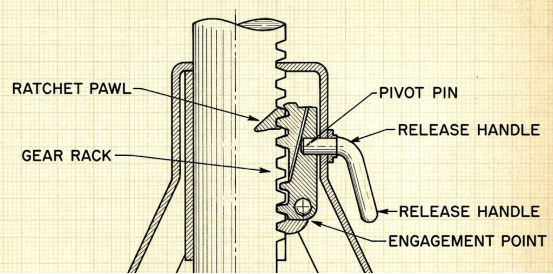
Their working principle is relatively simple: the main support column is covered with rows of teeth, which are connected to a locking arm (or ratchet pawl) via a spring mechanism. When you lift the support arm, the ratchet pawl slides over the teeth; once the desired height is reached, adjusting the support arm causes the ratchet pawl to engage with the nearest tooth, thus locking the height. This convenient “click” sound is its biggest appeal.

Ratcheted Jack Stands structural diagram, highlighting the engagement of the ratchet teeth and rack

However, behind this convenience lies a hidden potential risk that cannot be ignored.

First, the locking mechanism of a ratchet-type bracket relies on a single load engagement point. This means that all vehicle stress and potential dynamic impacts are concentrated on the contact surface between the ratchet pawl and the rack.

In extreme cases, such as minor vehicle wobbling on the support, a shift in the center of gravity due to a heavy load, or lateral forces, this engagement point can suffer significant impact fatigue. Over time, the metal structure experiences fatigue and aging; both the ratchet pawl and rack can become fatigued, deformed, or even fracture due to fatigue, leading to failure.

In my years of experience with garage safety, I’ve seen far too many situations caused by this seemingly minor detail.

Secondly, the ratchet mechanism carries the risk of misoperation and incomplete engagement.

If the Jack Stands malfunction unexpectedly, or if the vehicle experiences uneven stress on the support, the incompletely engaged ratchet may slip off instantly, leading to catastrophic consequences. Single-point support is a high-risk activity; if the “point” itself is not secure, the risk increases exponentially.

We cannot forget the Harbor Freight recall.

In 2020, Harbor Freight issued a large-scale warning to Pittsburgh Automotive’s 3-ton and 6-ton ratchet-type Jack Stands, addressing a design flaw that could cause ratchet teeth to peel off, leading to dents in the stand corners. This incident was undoubtedly a stark reminder that even reinforced ratchet mechanisms can be susceptible to design or manufacturing defects. It once again successfully demonstrates that failures are more valuable than successes in terms of learning; we must confront these potentially fatal flaws.

To minimize the risks associated with ratchet wheel holders, if you already own or choose to purchase such a product:

  • Be sure to buy from well-known brands and carefully check whether they have additional safety pin designs.
  • Before use, carefully inspect the ratchet teeth and rack for wear, deformation, or cracks.
  • Ensure the ratchet teeth are fully and promptly engaged, and perform a wobble test.

III. Pin-Type Jack Stands: Deterministic Physical Locking

Unlike the convenience of ratchet-type Jack Stands, the advantage of pin-type Jack Stands lies in their physical fixation and the nature of their motion design.

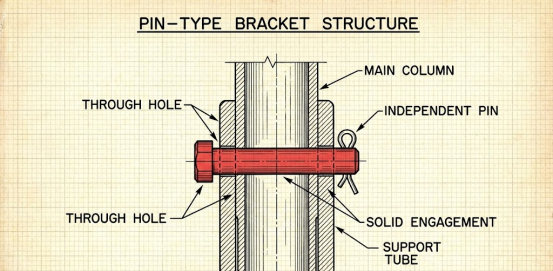
They work by having a series of evenly distributed holes on the main support column, through which a single, usually solid steel pin passes, creating a physical sparseness.

Diagram detailing the secure pin-type bracket structure of these safety jack stands.

This pin-type bracket design directly embodies the concept that safe design is the core of professional operation.

The pin acts as an independent physical barrier, its function decoupled from the support column itself. Even if the support column deforms under extreme conditions, as long as the pin passes through the hole, it can continue to withstand the risk of a short circuit, preventing the support column from falling. This effectively adds such an independent physical barrier to your support system.

It is this extreme physical certainty that makes pin-type brackets regarded as the “gold standard” by many professional technicians and DIY enthusiasts who pursue ultimate safety.

  • Impact and fatigue resistance: The pin directly bears the shear force generated by the vehicle’s weight, unlike the flexible bending of a ratchet. The physical structure of the solid pin gives it an advantage in resisting sudden impacts and long-term fatigue. Its superior engineering strength better addresses the risks associated with fatigue and aging in metal structures.
  • A thorough safety check: it is immediately clear whether the pin passes through the hole, eliminating the need for meticulous judgment of the ratchet’s perfect engagement. This greatly reduces the possibility of misoperation and provides greater predictability.
  • Changes in the center of gravity are the direct cause of most accidents, and the physical locking feature of pin-type brackets provides more stable support and reduces the risk of slippage when the vehicle’s center of gravity changes unexpectedly.

Based on my years of experience in garage safety, the “physical certainty” provided by pin-type brackets is unmatched by any other mechanism.

This certainty gives you greater psychological reassurance when working under vehicles.

When using pin-type brackets, the following should also be noted:

  • Choose the appropriate load-bearing capacity and ensure that there is sufficient safety margin.
  • Ensure the pin is fully inserted and check the pin and hole for wear or deformation.
  • Advanced pin-type brackets come with chain connections to prevent pins from being lost and to remind you of their presence.

IV. In-depth comparison of locking mechanisms: The truth about fault immunity

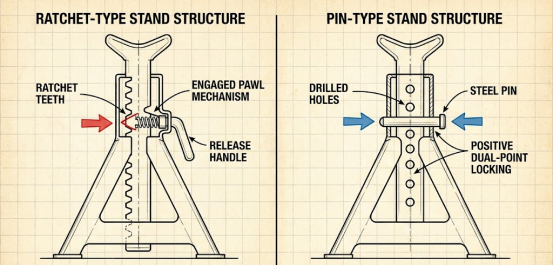
To better understand the differences between the two locking mechanisms, we have created the following comparison table:

characteristic

Ratchet type (ratchet mechanism)

Pin type

Locking principle

The claws and teeth, along with the rack, are determined by their hardness and shape.

Independent solid pins pass through the main column holes, physical abdomen

Adjust speed

Fast, one-handed operation, high efficiency

Slower, requires pre-drilled holes and insertion of pins.

Failure Mode

Claw fatigue, jamming, fatigue fracture, and incomplete operation

Bending or broken pins (very rare), deformed holes (very rare)

Impact resistance

The impact is relatively low, and a sudden impact could cause the claws to slip off.

Extremely high, the pin directly bears the shear force, resulting in faster physical fixation.

Security check

It is necessary to carefully check whether the claws and teeth are fully engaged.

Visually inspect whether the latch has completely passed through the hole; this provides a high level of insight.

Safe pronunciation

It has no animation, and some higher-end models also have additional safety pins.

The pin itself is an independent sound locking mechanism.

Recommended scenarios

For quick, light-load operations, or use additional safety pins.

Long-term, heavy-duty, closed-door or extremely safety-critical operations

Technical diagram comparing the distinct locking mechanisms of ratchet and pin style jack stands.

We need to clarify one point: “Fail-Safe” is not absolute, but rather a concept that minimizes risk.

No tool can guarantee 100% zero failure rate. Design and engineering, through good and predictable design, can minimize the possibility of failure and ensure that even if a partial failure occurs, it will not immediately lead to system collapse.

This is why the standard support bracket with double locking pins is currently the gold standard in the market.

Whether it’s adding an extra independent physical pin to a ratchet-type bracket or it’s a pin-type design itself, the core idea is to provide a second line of physical protection. When the main locking mechanism (regardless of its nature) is in operation, safety is paramount.


V. Final Recommendations from the Garage Security Consultant

Choosing Jack Stands is not just choosing a tool; it’s a commitment to your safety.

I must emphasize again: load-bearing capacity ≠ actual safety, and improper placement is more likely to cause accidents than product quality itself. Even the sturdiest Jack Stands can be dangerous if used incorrectly.

Therefore, my advice is: invest in safety, not profit.

  1. Prioritize Jack Stands with double locking: whether they are designed with a pin and have an additional physical safety pin (usually connected by a chain) on top of a ratchet design, this kind of safety feature is your most reliable guarantee.
  2. Choose a higher load-bearing capacity: Even if your vehicle is only 1.5 tonnes, purchase at least 3-ton or even 6-ton Jack Stands. This will give you a safety margin far exceeding your vehicle’s actual needs, providing cushioning against changes in center of gravity and dynamic impacts.
  3. Brand and Quality: Choose a reputable brand. Remember, Jack’s stability is highly dependent on ground conditions and its metal structure is susceptible to fatigue and aging. Cheap, low-quality products may disappoint you in crucial moments.

General safety precautions for using Jack Stands brackets:

Regardless of whether your Jack Stands are stand-type, the following safety guidelines must be strictly followed:

  1. Reinforcement of level ground: Always operate on reinforced, level surfaces such as concrete or compacted gravel, avoiding soft flat surfaces, grass, or hot asphalt. Operating on uneven ground amplifies the risk that the stability of the jack is highly dependent on ground conditions, and single-point support is extremely risky.
  2. Support points: Consult your vehicle owner’s manual and use the body or structural support points specified by the manufacturer. Avoid placing the brackets incorrectly on the oil pan, exhaust pipe, suspension components, plastic trim panels, or any thin metal plate. Incorrect placement causes accidents more often than product defects.
  3. Wheel Chocks: Always stop behind any wheel that is not lifted to prevent the vehicle from accidentally sliding or rolling. This is a simple and effective measure to prevent accidents caused by changes in the vehicle’s center of gravity.
  4. Support brackets: Where safety permits, Jack Stands can be left as additional support (slight contact, not full load), or multiple support points (such as four brackets) can be used to increase the safe weight.
  5. Shaking test: Shake the vehicle to ensure the supports are in place and no lights are shaking. This is the final safety check before you go under the vehicle. If the vehicle shows any instability, reset it immediately.

Frequently Asked Questions (FAQ)

1. Why are some ratchet brackets being recalled? Does this mean all are unsafe?

Recalls typically occur due to specific design or manufacturing defects where the ratchet teeth may suddenly disengage under stress. This does not mean all ratchet stands are unsafe.

However, it highlights the vulnerability of the locking mechanism. While well-designed ratchet stands are safe when used correctly, we strongly recommend models equipped with secondary safety pins (double-locking) to significantly increase security.

2. Which is safer: a ratchet-type with dual locking pins or a pure pin-type bracket?

Both types significantly improve safety, but they operate differently:

  • Pure Pin-Type: From a mechanical perspective, the solid physical pin offers deterministic resistance to impact and fatigue. It is a simple, robust barrier.
  • Ratchet with Dual Locking Pins: This combines the convenience of a ratchet with the security of a physical pin acting as a secondary fail-safe.

For users seeking the ultimate safety, either a pure pin-type or a ratchet with independent pins is preferred over a standard ratchet stand.

3. How should I check my Jack Stands for fatigue or aging issues?

Always perform a visual inspection before use, focusing on these key areas:

  • Metal Deformation & Cracks: Inspect the support column, base, and ratchet teeth/pins. Look for bending, pitting, cracks, or signs of stress at the top saddle.
  • Fatigue Level: Ensure the ratchet teeth mesh tightly. For pin-types, check that the pin holes are not elongated or worn out.
  • Rust & Corrosion: Severe rust can compromise metal strength, especially at load-bearing points.
  • Mechanism Function: The adjustment should be smooth. If the mechanism jams or feels “sticky,” stop using it immediately.

Remember: Metal structures are susceptible to fatigue. If in doubt, replace the part.

author-avatar

About Gavin Reid

Gavin Reid has been obsessively analyzing garage safety protocols and vehicle support systems for over a decade. After transitioning from a professional service bay to independent safety consulting in 2020, Gavin realized the market was flooded with confusing weight ratings and compromised designs that offered a false sense of security. His Mission: To help DIY mechanics—especially home hobbyists—identify critical failure points in vehicle lifting and ensure every project ends safely. Why Trust Gavin: Engineering Obsessive: He dissects load paths and weld integrity. From metallurgy to geometric stability, he understands the physics that keep two tons of steel from crushing a human chest. Data-Driven Testing: Gavin has stress-tested 40+ models, evaluating lateral stability and locking redundancy rather than just "marketing tonnage." In the Garage: He’s a fixture in local DIY communities, frequently inspecting frame rails for pinch weld placement and documenting metal fatigue on aging gear. Gavin believes that "a lapse in physics is a permanent mistake." He is dedicated to teaching mechanics how to maintain a "zero-trust" relationship with their equipment. Would you like me to provide Gavin’s specific checklist for identifying structural fatigue in used jack stands?