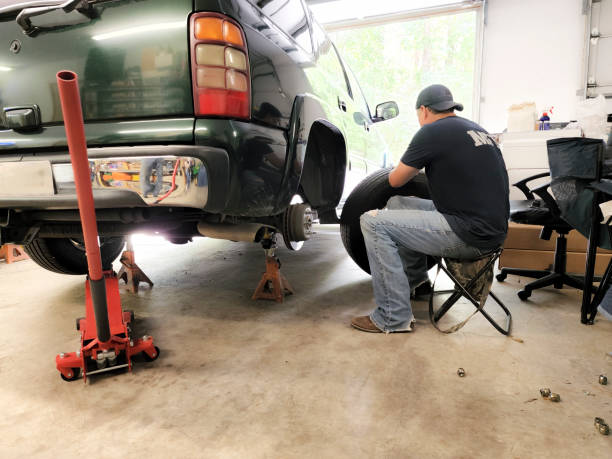
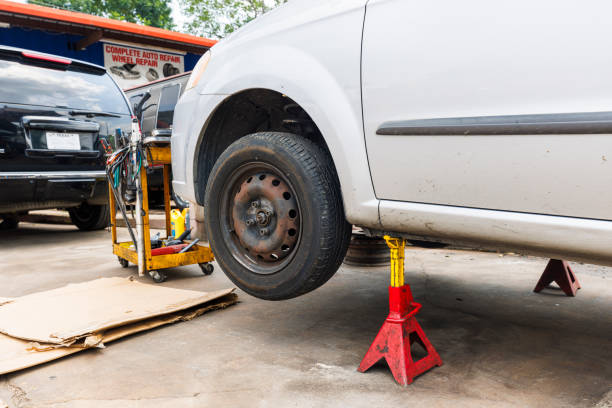
Jack Stands

Car four-wheel jack stands safety lifting

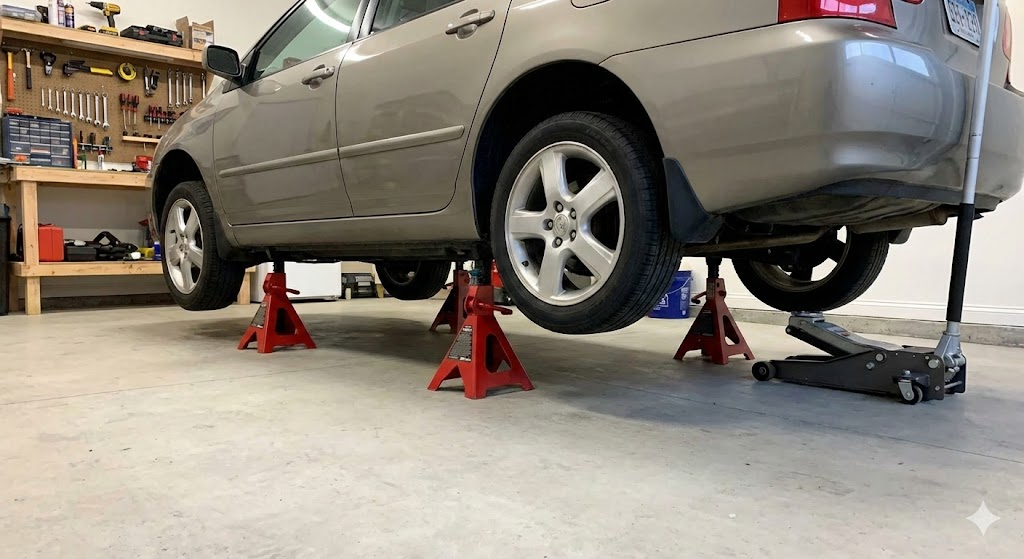
Beige car elevated safely on four red jack stands in a home garage.

Whether it’s to save money or simply to enjoy the thrill of solving problems yourself, lifting your car for advanced tasks like chassis rustproofing, exhaust modifications, and transmission maintenance is often unavoidable.

However, this enthusiasm is often accompanied by potentially huge risks. When you need to lift all four wheels of your vehicle off the ground, the complexity and danger of the operation increase exponentially.

I’ve seen too many cases where a small oversight leads to problems. DIY is fine, but getting out of control is the real issue.

This article will break down every aspect of safe four-wheel lifting for your car from the most rigorous and engineering-oriented perspective. We will go beyond simply “how to do it,” delving into “why it’s dangerous,” and providing a set of operating procedures to ensure the safety of you and your vehicle.

After reading this guide, you will master the true art of safe lifting, confidently perform advanced repairs, and say goodbye to unnecessary worries.

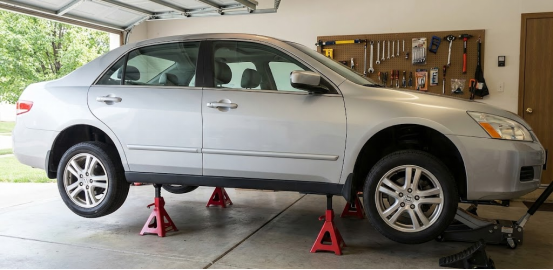
Silver car safely supported by four red jack stands in a clean garage.

A Deeper Understanding of Risk: The “Fatal Temptation” of Four-Wheel Lifts

Before we begin, we must be fully aware of the risks of four-wheel lifting. It’s not just about physical strength; it’s a sophisticated engineering science.


Basic Preparations: The Safe Lifting of the “Great Wall”

Adequate preparation is essential for safe operation.

Tool Selection and Inspection: Your First Line of Defense

Choosing the Right Jacks and Jack Stands: Matching Capacity and Type

When selecting tools, capacity is the primary consideration. The rated load capacity of jacks and jack stands must significantly exceed the actual weight of your vehicle.

As a rule of thumb, I generally recommend choosing tools with a rated load capacity of at least 1.5 times the vehicle’s gross weight to provide sufficient safety margin. For example, a 4,000-pound (approximately 1.8-ton) car should have jack stands with a capacity of at least 3 tons (6,000 pounds) or higher.

Vehicle type

Recommended Jack Stands capacity (single)

Remark

Compact sedans/small SUVs

2

Suitable for vehicles weighing less than 1.8 tons, but 3 tons is safer.

Mid-size sedans/SUVs/Light pickup trucks

3

Suitable for most family cars, providing a good safety margin

Full-size SUVs/Heavy-duty pickup trucks

6 tons (12,000 pounds)

For vehicles with high curb weight and a high center of gravity, it is highly recommended.

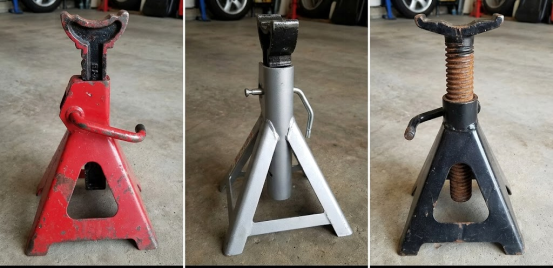
Three different types of jack stands showing common issues: ratchet, pin, and screw.

Jack Stands also have a “lifespan”: A thorough inspection before use.

Before each use, be sure to thoroughly inspect your Jack Stands. Look for any signs of cracks, bends, weld cracks, rust, or deformation. Ratchet mechanism failures are more valuable than successes —don’t let your tool become the next failure.

Site and Environment: The “Golden Rule” for Safe Operations

  • A flat, hard, non-slip surface: this is the golden rule I’ve emphasized for years. Concrete is the best.
  • Ample light and space: Avoid blind spots and constraints. Ensure your work area is well-lit and free of shadows that obstruct your view. There should be sufficient space around you to allow for free movement.

Vehicle preparation: Details determine success or failure

  • Parking brake and wheel chocks: Double protection. Reliable wheel chocks are placed in front of and behind wheels that are not intended to be lifted. This provides extra safety redundancy to prevent the vehicle from accidentally sliding. Do I need wheel chocks with jack stands? The answer is yes, they…
  • Remove unnecessary loads: Reduce uncertainty by emptying the vehicle’s trunk and interior of all unnecessary heavy items to reduce the vehicle’s weight and ensure a stable center of gravity during lifting.
  • Clean up the work area: To avoid tripping risks, remove all tools, wires, and debris, ensuring the floor is clean and tidy. A clean work environment can effectively prevent you from tripping and losing your balance, which could then affect vehicles.

Four-wheel lift core operation: precise dance

Four-wheel lifting is much more complex than single-axle lifting, requiring greater precision and patience.

Positioning Lift Point

Incorrect placement causes accidents more often than product quality issues: This is one of the most common problems I’ve observed in my years of experience. Many people place jacks and jack stands by feel, resulting in damage to the vehicle’s structure and even causing instability.

  • Consult your owner’s manual: Locate the official lifting points. Every vehicle has manufacturer-designated lifting points. These points are typically located on the frame, subframe, or reinforced sections. Always consult your vehicle’s owner’s manual to determine the exact locations of these points. Never lift the jack or…

Consult your owner’s manual: Locate the official lift points. Every vehicle has manufacturer-designated lift points. These points are typically located on the frame, subframe, or reinforced sections. Always consult your vehicle’s owner’s manual to find the exact locations of these points. Never place a jack or jack stands on the oil pan, transmission housing, suspension components, exhaust pipe, brake lines, or any thin sheet metal. Remember, any non-designated point can be dangerous.

Front-end enhancement and support: Establishing the initial platform

  1. Position the jack at the front center lift point: if your vehicle manual specifies the front center lift point.
  2. Slowly raise the vehicle to the desired height, but slightly below the Jack Stands: Slowly raise the front of the vehicle, ensuring the jacks are stable. The raising height should be slightly below your preset Jack Stands height.
  3. Place the front jack stands: Ensure symmetry and stability by placing both jack stands on the designated support points on either side of the front of the vehicle. Make sure the jacks are still under slight load on the jack stands.

Rear-end lifting and support: Achieving four-wheel lift off the ground

  1. Move the jack to the rear center lift point: If your vehicle has a rear center lift point (usually the rear differential housing or crossbeam), use it. If not, you will need to…
  2. Gradual Lifting: Begin slowly lifting the rear of the vehicle, noting changes in its posture. During this process, you need to continuously observe the vehicle’s attitude. Due to the shift in the center of gravity, the vehicle…
  3. Rear Jack Stands Placement: Height Matching and Even Stress Distribution. When the rear of the vehicle is aligned with the front jack stands, place them under designated support points on both sides of the rear of the vehicle. Height matching and even stress distribution are crucial here. All four jack stands must be aligned. I’ve seen far too many cases where this detail causes problems—uneven stress can cause one jack stand to bear excessive pressure, even leading to vehicle malfunctions. Leveling the car on jack stands is not only about visual flatness but also about mechanical balance.

Final Stress and Fine-Tuning: Ensuring the Vehicle’s Stability

  1. Slowly and gradually lower the jacks: This is the most crucial step in evenly transferring the vehicle’s weight to the jacks. Carefully and slowly lower the jacks in small steps, gradually and evenly transferring the vehicle’s weight to all four jacks. Loosen the front jacks first, then the rear jacks, lowering them only a little at a time. Observe the jacks for any displacement or unusual noises.
  2. Check that all jack stands are fully loaded and stable, confirming that the jacks are completely unloaded and the entire weight of the vehicle is supported by the four jack stands. Visually inspect all jack stands.

Ultimate Verification: The “Shake Test”—Your Lifeline

Congratulations, your car is now mounted on Jack Stands.

Why is the “Shake Test” indispensable?

The “Shake Test” is the last line of defense to verify the success of all your operations. It simulates the slight shaking or impact a vehicle might encounter during maintenance, exposing potential instabilities. Visual inspection alone is insufficient, as some subtle contact defects or uneven stress can only be revealed by applying external force. True safety comes from “predictability,” not luck. This test helps you eliminate wishful thinking and minimize uncertainty.

How to correctly execute “Shake Test”

Force: Grasp the sturdiest parts of the vehicle with both hands (such as the wheel arch rims or frame) and shake the vehicle forward, backward, left, and right with moderate force. Do not use excessive force that causes the vehicle to shake violently, but make sure to simulate accidental impacts that may occur during routine maintenance.

Observation points:

    • Do the Jack Stands make any sliding, tilting, or creaking noises?
    • Did the vehicle experience any displacement at the support point?
    • Does the vehicle body feel sturdy and not shake excessively?

If the vehicle shows any signs of instability during the shaking test, stop immediately! Re-jack up the vehicle to find the problem (it could be that the jack stands are not positioned correctly, the height is inconsistent, or the ground is uneven), and then lift and place it again.


Advanced security strategy: Building multi-layered protection

Professionals always prepare for the worst-case scenario.

Safety Redundancy: More Peace of Mind

  • Safety redundancy is central to professional operation: Even if you’ve already installed four jack stands and passed the “Shake Test,” I still recommend keeping one jack under the vehicle, lightly touching the frame, as an extra backup support. This is like adding an extra layer of insurance for your lifeline. Is it safe to go under a car on jack stands? Yes, if done correctly and with safety redundancy.
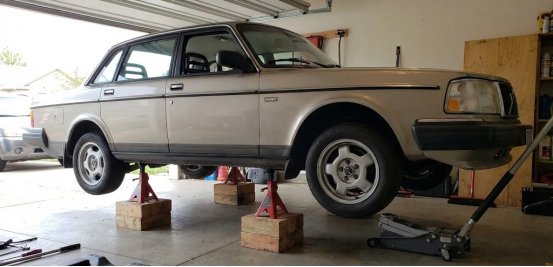
  • Additional support points: wooden blocks or discarded tires. For operations requiring prolonged lifting, you can even consider placing sturdy wooden blocks (such as 4×4 square timbers) or discarded tires next to the jack stands as an additional physical barrier. These measures may seem redundant, but they can provide life-saving protection in extreme situations. What can I use besides jack stands? Sturdy wooden blocks and wheel stops are excellent additions.

Important considerations for long-term support: It’s not just about “putting it on”.

How long can I leave a car on a jackstand? If handled properly, a vehicle can remain on jackstands for extended periods (months or even years). However, you should be aware of the following:

Tires and Suspension: Reducing Long-Term Stress. If the vehicle is lifted for an extended period, it is recommended to slightly increase the tire pressure to prevent flat spots. For the suspension system, because it is in a non-natural extended state when lifted, prolonged exposure may put stress on the shock absorber seals. If possible, consider using wooden blocks under the Jack Stands to support the axles or load-bearing parts of the suspension to distribute stress.

Environmental impact: Moisture and corrosion. Ensure a dry working environment and avoid dampness. Prolonged dampness may cause rust on the Jack Stands themselves or at the vehicle chassis contact points, affecting structural integrity.

Vintage car lifted securely on red jack stands placed on wood blocks.

Master safety and enjoy the fun of DIY.

Safely mounting a car on four jack stands for advanced repairs is not an impossible task. It requires the right knowledge, the right tools, following rigorous procedures, and constant vigilance.

This guide aims to help you build an impenetrable security defense. You now have all the key information from basic preparation, precise lifting, ultimate verification to advanced security strategies. Remember my core belief: DIY is fine, loss of control is the problem.


Frequently Asked Questions (FAQs)

1. Can a car be mounted on a Jack Stand for an extended period of time?

Yes, if done correctly. A vehicle can be lifted onto Jack Stands for extended periods, but you must follow these rules:

  • Ensure stands are on a flat, firm surface.
  • Use the specific support points defined by the vehicle manufacturer.
  • Place wooden blocks under the stands to distribute pressure if the ground is questionable.

Note: Prolonged lifting puts stress on the suspension and tires. Consider slightly increasing tire pressure or using additional supports to relieve load.

2. Are 1-ton Jack Stands enough for a regular car?

For most small to mid-size cars (under 4,000 lbs/1.8 tons), a pair of 2-ton stands is theoretically sufficient, as they share the load.

Recommendation: Do not rely on the bare minimum. My personal experience strongly suggests choosing 3-ton or higher capacity stands. This provides a crucial safety margin if the center of gravity shifts or if you are working on a heavier vehicle.
3. Besides Jack Stands, what other secure support methods are available?

There are several alternatives depending on your specific task:

  • Car Ramps: Ideal for oil changes or simple inspections. They offer high stability but you cannot remove the wheels.
  • Wheel Cribs: Blocks made of high-density foam or wood that support the tires. Great for vehicle display or maintenance where wheel removal isn’t needed.
  • Mobile Lifts (Quick Jacks): Hydraulic systems that lift the entire vehicle. They offer excellent workspace but come at a higher cost.
  • Permanent Lifts: The safest and most professional option, requiring significant investment and dedicated garage space.

Always follow the manufacturer’s instructions regardless of the method chosen.

author-avatar

About Gavin Reid

Gavin Reid has been obsessively analyzing garage safety protocols and vehicle support systems for over a decade. After transitioning from a professional service bay to independent safety consulting in 2020, Gavin realized the market was flooded with confusing weight ratings and compromised designs that offered a false sense of security. His Mission: To help DIY mechanics—especially home hobbyists—identify critical failure points in vehicle lifting and ensure every project ends safely. Why Trust Gavin: Engineering Obsessive: He dissects load paths and weld integrity. From metallurgy to geometric stability, he understands the physics that keep two tons of steel from crushing a human chest. Data-Driven Testing: Gavin has stress-tested 40+ models, evaluating lateral stability and locking redundancy rather than just "marketing tonnage." In the Garage: He’s a fixture in local DIY communities, frequently inspecting frame rails for pinch weld placement and documenting metal fatigue on aging gear. Gavin believes that "a lapse in physics is a permanent mistake." He is dedicated to teaching mechanics how to maintain a "zero-trust" relationship with their equipment. Would you like me to provide Gavin’s specific checklist for identifying structural fatigue in used jack stands?