Jack Stands

What does it mean when your Jack Stands make a “creaking” sound?

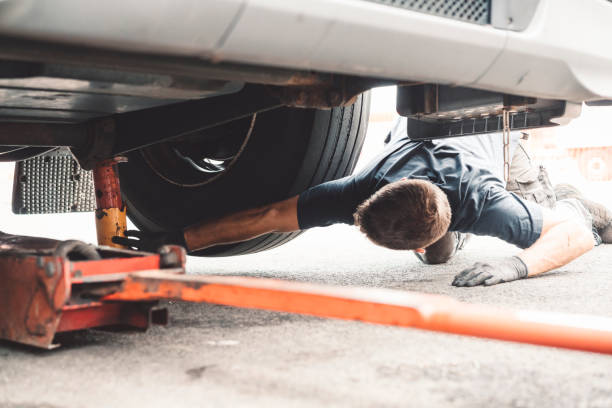
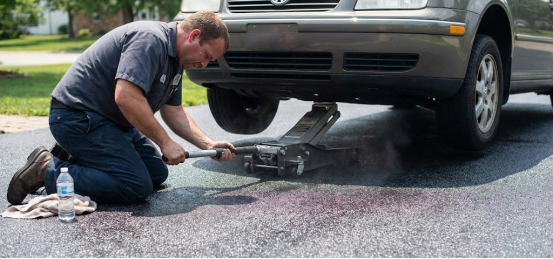
Mechanic uses jack and jack stands to support vehicle.

When you’re alone in your garage, bent over and busy working under your car, and suddenly a metallic “squeak—” comes from the jack stands supporting the vehicle… Does your heart skip a beat in that instant? Do countless images of car crashes flash through your mind?

Don’t panic, this is a “terrifying moment” that almost every DIY car owner has experienced.

As a veteran technician with over a decade of experience in automotive repair safety, I understand your fear at that moment. I ‘ve witnessed firsthand the serious accidents caused by misalignment , so I’m highly vigilant about any potential safety hazards.

However, I also know that often this sound isn’t a harbinger of impending doom, but simply the metal parts adjusting themselves.

Today, I’m not here to scare you, but rather to have a calm, rational, and engineered discussion with you, like an old friend , to teach you how to distinguish the truth from falsehood behind these sounds. After reading this article, you will no longer be caught off guard by a sudden, strange noise, but will have a clearer understanding of how to handle things safely.


Unraveling the Mysterious Noises: What Are Your Jack Stands Saying?

The squeaking sound from the jack stands is like Morse code under your car; it might be saying “Everything’s fine, I’m in position,” or it might be whispering “Danger! I can’t hold on much longer!” The key is that you have to learn to decipher it.

1. Normal “Settling Noise”: The “Self-Adjustment” of Metal Parts

In most cases, the “squeaking” sound you hear is actually a normal metallic settling sound . This is a benign sign.

  • What is a settling sound? When the enormous weight of a vehicle is transferred from the jack to the jack stands , the various metal components of the stand, especially the adjustable pillars and base, undergo minute deformations and displacements . This slight adjustment redistributes the force path of the stand, creating minute friction and pressure between the contact surfaces (such as the ratchet and locking pins, and the base and the ground), producing a “squeak” or “click” sound. This is similar to the sound of new furniture bearing weight for the first time.
  • Why did this happen? This is mainly because:
    • Redistribution of force path: As the vehicle moves from dynamic lifting to static support, the weight is more evenly distributed across the support structure.
    • Fine-tuning of the contact surface between the bracket and the vehicle body: The saddle of the bracket and the support point of the vehicle (such as the frame and subframe) are not perfectly aligned. Under heavy pressure, there will be a process of “finding the angle” to achieve the best load-bearing balance.
    • Ground conditions and the adaptability of the support base: Even on a flat ground, there may be slight undulations. The support base will make minor adjustments to the ground after being subjected to force to obtain the maximum contact area.
  • Characteristics: Settling noise usually occurs when the vehicle is first lowered onto the support or after a slight touch to the vehicle body during work under the vehicle . The sound is usually one-off or brief, not continuous , and is not accompanied by violent shaking or obvious support deformation. Once the support is firmly in place, the sound will stop.
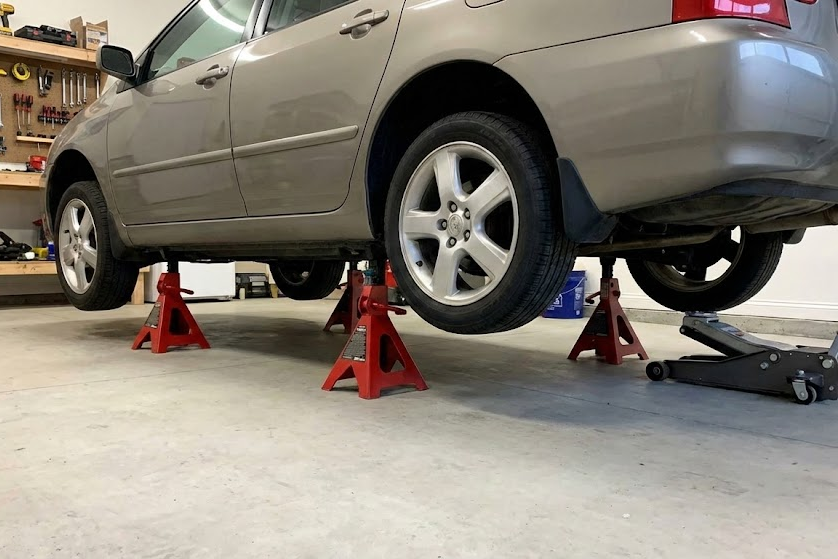
Car safely elevated on four red Jack Stands in a garage for maintenance.

2. Warning Signs: “Fatigue/Cracking Noise”: A Whisper of Danger (Cracking Noise / Stress Noise)

If the squeaking sound is continuous, or if it sounds like a cracking or snapping sound, you must be very vigilant! This could be a warning sign that the jack stands structure is about to fail .

  • What is fatigue/cracking sound? This sound indicates that the metal structure of the jack stands is being subjected to stresses exceeding its design limits, or that there are internal defects leading to metal fatigue or even cracking . It is not simple friction, but a sign that the internal structure of the material is being damaged.
  • Why did this happen?
    • Exceeding load limits: Although jack stands have load capacity parameters, these parameters do not guarantee actual safety in use . If you use a jack stand with a rated load capacity close to or less than the actual weight of the part of the vehicle being supported (for example, using a 2-ton jack stand to support one end of a 5,000-pound SUV), you may overload the jack stand.
    • Material defects or welding problems: Poor manufacturing processes, substandard materials, or poor weld quality can all lead to structural problems in the bracket under normal load. I have seen too many cases of problems caused by this detail , especially with some inexpensive products that lack brand assurance (for example, some batches of Harbor Freight jack stands have been recalled due to design flaws).
    • Stress concentration: If the support point is not selected properly, such as placing the bracket on the body sheet metal instead of a designated reinforcement point, or using single-point support , excessive stress concentration can occur in a certain part of the bracket, accelerating metal fatigue. Single-point support is a high-risk practice .
    • Metal fatigue and aging: The metal structure of jack stands is susceptible to fatigue and aging . Prolonged and repeated use, or impacts and drops, can cause damage to accumulate inside the frame, and even if there is no obvious deformation on the outside, its internal strength may be greatly reduced.
  • Characteristics: Fatigue/cracking sounds are often continuous and repetitive , sometimes accompanied by noticeable vehicle displacement or visible deformation of the brackets (such as bending or sinking). The sound may be sharper and harsher, or duller and more tearing.
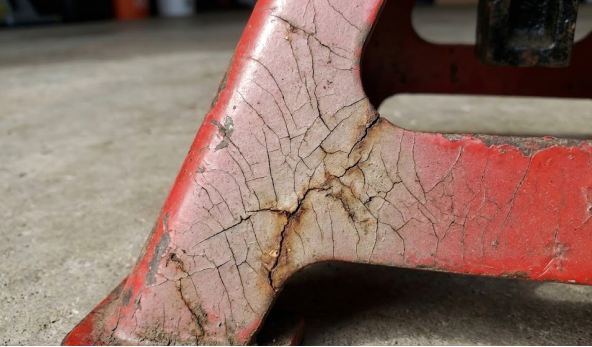
Cracked red jack stands show signs of wear and tear.

3. Influencing Factors: The “Mastermind” Behind the Sound

Besides the support itself, there are some external factors that can greatly affect its stability and may lead to abnormal noises or even accidents.

a. Ground conditions: The number one killer of jack stands ‘ stability.

The stability of jack stands is highly dependent on ground conditions . This is one of the direct causes of most accidents I have found in my years of experience .

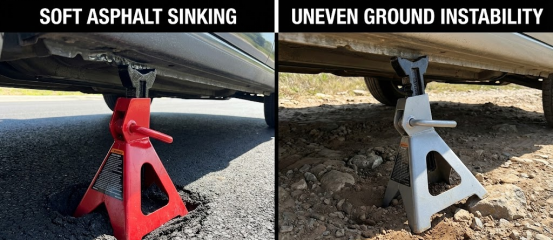
  • Summer Heat and Softening Asphalt: A Deadly Trap! In the sweltering summer, especially on asphalt roads under direct sunlight, high temperatures cause the asphalt to soften . Placing jack stands directly on softened asphalt will cause the base of the stand to slowly or even quickly sink into the asphalt , leading to tilting, uneven stress, and potentially instability. This is why true safety comes from “predictability,” not luck . If you cannot anticipate ground deformation, that is the greatest risk.
  • Uneven cement or gravel surfaces: Even on cement surfaces, potholes, cracks, or slopes can prevent the support frame from being placed stably. Gravel surfaces are even more dangerous, as the support frame base can get stuck in the gaps between the stones, causing instability at the stress point and making it very easy for it to tip over.
Comparison of jack stands on soft asphalt versus uneven ground.

b. Vehicle center of gravity and support points: Every lift is a mechanical challenge

  • Shift in center of gravity: When a vehicle is lifted, the shift in its center of gravity is the direct cause of most accidents . During the lifting process or operation, if the vehicle body is touched or parts are disassembled, it may cause a slight adjustment in the center of gravity, which in turn applies lateral force or torque to the support frame, causing abnormal noises.
  • Improper support point selection: Many DIY car owners ignore the support points specified in the vehicle owner’s manual and arbitrarily place the bracket on non-reinforced structures such as the exhaust pipe, oil pan, suspension components, and body skirts. This not only damages the vehicle but also, due to the insufficient strength or irregular shape of these parts, the bracket cannot provide stable support, causing displacement and abnormal noises. Incorrect placement is more likely to cause accidents than product quality issues .

c. Jack stands for himself: the neglected “internal injury”

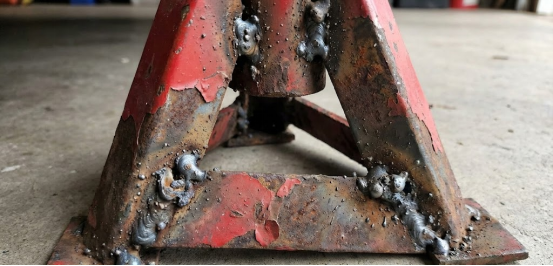
  • Metal fatigue and aging: Even high-quality brackets will experience fatigue and aging issues in their metal structure after years of exposure to the elements, heavy loads, and even occasional drops . Microcracks invisible to the naked eye may appear at weld points, and ratchet mechanisms may wear down.
  • Quality defects and design problems: Be wary of products that are cheap, poorly made, and lack brand certification. These products often have hidden problems in material strength, welding processes, and structural design, and are prone to failure at critical moments.
Rusty and welded jack stands highlight condition and repair.


What to do if you hear unusual noises? A veteran technician’s three-step troubleshooting method.

When that “squeak” sound rings out again, please remember my “three-step troubleshooting method,” which can help you stay calm and make the right judgment at critical moments.

1. First step: Immediately stop and evacuate the safe zone.

Whatever sound you hear, if it’s unusual or makes you uneasy, stop all work immediately . Don’t hesitate, don’t try to peek out, and definitely don’t stay under the vehicle.

  • Any unusual sounds should be taken seriously: it’s better to be safe than sorry. This is the first line of defense for your safety.
  • Never continue working when you are unsure of your safety: remember, the purpose of DIY is to solve problems, not to create more problems.

2. Second step: Calm observation and “secondary confirmation”

After evacuating to a safe distance, take a deep breath and then begin to observe and confirm.

  • Visual inspection:
    • Is the support structure sinking? Pay special attention to the area where the support base contacts the ground; check for indentations, sinking, or signs of melting on the asphalt surface.
    • Is there any noticeable displacement of the vehicle body? Observe whether there are any changes in the relative position between the vehicle body and the support frame, or between the vehicle body and surrounding reference objects.
    • Is there any deformation in the support structure? Check the support column, base, and weld joints for bending, cracks, or unusual deformation.
  • Auditory confirmation:
    • Is the sound continuous or brief ? If it’s brief, it’s likely a settling sound. If it’s continuous and repetitive, the risk is much higher.
    • Is the sound a crisp metallic friction or a dull thud, a precursor to a break ? The former usually indicates benign settling, while the latter should raise extreme suspicion.
  • Fine-tuning the center of gravity: If you initially determine it’s a settling sound, you can use a floor jack to slightly lift the vehicle again, then slowly and steadily lower it back onto the jack stands . This process allows the stands to better “settle” under gravity, ensuring they fully bear the weight rather than being suspended or unevenly stressed. If the sound disappears after lowering it back down, it’s usually a benign settling.

3. Third step: No-load “shaking test” and safety redundancy

After confirming that the bracket and vehicle appear stable, a final safety verification is performed.

  • No-load shaking test: Important! Before you crawl under the vehicle, brace your hands against the side or front and back of the vehicle and gently push or shake it with appropriate force (do not use excessive force to avoid tipping the vehicle over). Check if the vehicle is secure and if the support structure moves, creaks, or shifts. If the vehicle remains perfectly still and the support structure is rock-solid, it is usually safe. However, if any signs of instability appear, check again immediately.
  • Increase safety redundancy: Even if the vehicle appears stable, safety redundancy (an extra layer of support) is the core of professional operation .
    • Leave the jacks on: Leave the lifting jacks under the vehicle, only lightly touching the body and not bearing any weight. This way, if the jacks fail, the jacks will provide an extra layer of cushioning and protection.
    • Spare jack stands/blocks: Add extra spare jack stands or sturdy blocks (such as 4×4 timber) below the vehicle’s critical stress points (such as under the frame beams and wheels) as an additional layer of support. This can significantly improve operational safety.
    • Use wheel chocks: Never forget to use wheel chocks under the wheels that are not lifted to prevent the vehicle from sliding unexpectedly.

Prevention is better than cure: nip risks in the bud

Instead of being terrified when unusual noises occur, it’s better to take preventative measures from the start.

1. Selection and Inspection: Controlling Safety from the Source

  • Load-bearing parameters ≠ Actual safety in use: Always leave ample safety margin . If your vehicle weighs 5,000 pounds (approximately 2.5 tons), then a pair of 3-ton (6,000-pound) jack stands is the minimum requirement, while 6-ton stands offer even greater safety margins. Don’t be misled by specifications; understand the safety philosophy behind them.
  • Brand and Quality: Choose reputable brands with certifications (such as ASME PALD). Don’t risk your safety to save a few dollars. Check user reviews and avoid products with a recall history or a large number of negative feedback.
  • Regular inspection: Before each use, always check the integrity of the jack stands . Inspect the ratchet mechanism for smooth operation, the locking pins for secure fastening, the welds for cracks, and the base for deformation or severe corrosion. Metal structures are susceptible to fatigue and aging ; even the best stands require careful maintenance.

2. Proper placement: a stable foundation

  • A flat, firm surface: Concrete is the preferred surface . Avoid using jack stands on grass, mud, soft soil, or asphalt that softens in the summer heat . If you must work on a non-concrete surface, be sure to place large, sturdy planks (such as thick plywood) under the supports to distribute pressure and prevent them from sinking into the ground. The stability of jack stands is highly dependent on ground conditions .
  • Designated support points for vehicles: Consult your vehicle’s owner’s manual to find the manufacturer’s recommended jack stand placement points (usually the frame beam, subframe, or reinforced lift point). Avoid placing the jack stands on suspension components, exhaust pipes, oil pans, or thin sheet metal parts of the vehicle body . Incorrect placement is more likely to cause accidents than product quality issues .
  • The four-point support principle: Use four jack stands to support the vehicle whenever possible, or at least two stands when lifting one end. Ensure they are at the same height and distribute the load evenly . Single-point support is a high-risk practice and should be avoided whenever possible.

3. Operating habits: Develop a “safety first” mindset

  • Proceed gradually: When raising and lowering the vehicle, the movements should be slow and smooth. Give the jack stands and the vehicle time to “adapt” and “find their position”.
  • Avoid the complacency of “short-time work”: Whether it’s just changing a tire or changing the oil, “short-time work” does not mean safer . Safety procedures must be strictly followed whenever a person enters under a vehicle.
  • Learning from failure cases: Failure cases are more valuable for learning than success stories . Studying analyses of accidents caused by improper operation or tool failure can give you a deeper understanding of risk.

DIY is fine, the problem is getting out of control.

That squeaking noise is Jack Stands trying to tell you something. As a garage security consultant, I hope you learn to listen and discern.

True security comes from predictability, not luck .

DIY car repair can not only save you money, but also give you a deeper understanding of your beloved vehicle, allowing you to enjoy the fun and sense of accomplishment. However, all of this is predicated on safety . Raise your safety awareness, master the correct operating methods, and let every under-vehicle operation be done with confidence, avoiding potential hazards.

If you want to minimize the risks of vehicle lifting, or need more professional tool solutions, consider Jack Stand . We are committed to providing you with the most reliable error-proofing logic and product choices, allowing you to enjoy the fun of DIY with peace of mind.


Frequently Asked Questions (FAQs)

1. Does a jack stand that makes a “squeaking” sound necessarily mean it’s unsafe?

Not necessarily. You must distinguish between settling and fatigue:

Normal Settling: A brief metallic sound occurring when the vehicle is first lowered. This indicates the stand is adjusting to the stress.
Dangerous Fatigue: A continuous, repetitive cracking sound, often accompanied by visible shaking or displacement. This is a warning sign of structural failure.
2. How often should I check my jack stands?

Safety inspections should follow two timelines:

  • Before Each Use: Perform a visual check for weld cracks, base deformation, severe corrosion, and ensure the ratchet mechanism is flexible.
  • Annually: Conduct a thorough deep inspection, especially if stored in humid environments, to check for metal fatigue and aging issues.
3. Are there special precautions for using jack stands in hot weather?

The primary risk in heat is asphalt softening, which causes the stand to tilt and become unstable.

Protocol: Always prioritize a firm, level concrete surface. If you must use asphalt, you must use large, thick wooden planks or steel plates to distribute the pressure across a wider area.

author-avatar

About Gavin Reid

Gavin Reid has been obsessively analyzing garage safety protocols and vehicle support systems for over a decade. After transitioning from a professional service bay to independent safety consulting in 2020, Gavin realized the market was flooded with confusing weight ratings and compromised designs that offered a false sense of security. His Mission: To help DIY mechanics—especially home hobbyists—identify critical failure points in vehicle lifting and ensure every project ends safely. Why Trust Gavin: Engineering Obsessive: He dissects load paths and weld integrity. From metallurgy to geometric stability, he understands the physics that keep two tons of steel from crushing a human chest. Data-Driven Testing: Gavin has stress-tested 40+ models, evaluating lateral stability and locking redundancy rather than just "marketing tonnage." In the Garage: He’s a fixture in local DIY communities, frequently inspecting frame rails for pinch weld placement and documenting metal fatigue on aging gear. Gavin believes that "a lapse in physics is a permanent mistake." He is dedicated to teaching mechanics how to maintain a "zero-trust" relationship with their equipment. Would you like me to provide Gavin’s specific checklist for identifying structural fatigue in used jack stands?