Jack Stands

Jack Stands Stability Revealed: Tripods, Quadrupeds , and Wide Bases

Hey friends. It’s your old advisor here. When we talk about vehicle lifting safety, many people first think of the jack’s tonnage or the support’s load-bearing capacity. That’s certainly true, but often we overlook an equally critical detail: the design of the jack stands base .

Believe it or not, the “stance” of a bracket—that is, its base design—can determine your safety in certain situations more than simply its load-bearing capacity. DIY is fine, but loss of control is. Today, I want to talk to you about this often overlooked yet crucial safety aspect, deeply analyzing the mechanical principles and practical considerations behind different base designs to help you make the safest judgments.

Core of stability: Understanding the “posture” of a jack stands.

Before delving into a comparison of various base designs, we must first clarify one concept: what is true stability?

A. Stability Pyramid: More Than Just “Tonnage”

  1. Load Capacity : This is fundamental, but it’s not everything. A support frame rated for 6 tons may be far less safe than a properly used 3-ton support frame if used on soft ground or with an improperly designed base.
  2. Structural integrity : The strength of the materials and the quality of the welding are key to the support structure’s resistance to deformation and failure. Selecting heavy-duty steel and robustly welded products is a fundamental guarantee.
  3. Base Design & Footprint : This is what we’ll focus on today. It determines the bracket’s ability to resist tipping and distribute pressure, and is crucial to whether a vehicle “stands stably” on the bracket.

B. Mechanics Mini-Lesson: Why is the base design so important?

Imagine you’re standing on the ground. If your feet are together, you’re easily pushed over; if your legs are apart, you’re much more stable. The same principle applies to jack supports.

  1. Center of Gravity and Stability Polygon : When a vehicle is lifted, its center of gravity rises. The design of the support base determines the area of its “stability polygon.” The larger this polygon is, the greater the probability that the vehicle’s center of gravity will fall within it, and the stronger its ability to resist external disturbances (such as the impact of shaking the vehicle or loosening bolts). Once the center of gravity exceeds this polygon, the vehicle may overturn.
  2. Stress path : The vehicle’s weight is transferred from the top of the bracket to its base, and then distributed to the ground. A well-designed base can evenly distribute the load over a larger area of the ground, reducing localized stress concentration, especially when ground conditions are not ideal, and preventing the bracket from sinking into the ground.
  3. Lateral Forces and Torques : When working under a vehicle, any pushing, pulling, striking, or disassembling of heavy objects (such as a gearbox) will generate lateral forces. These lateral forces create a “tilting torque” at the base of the support. The width and shape of the base directly determine its ability to resist these torques. The wider the base, the longer the lever arm against tipping, and the better the stability.

In-depth analysis: Stability comparison of jack stands with different base designs

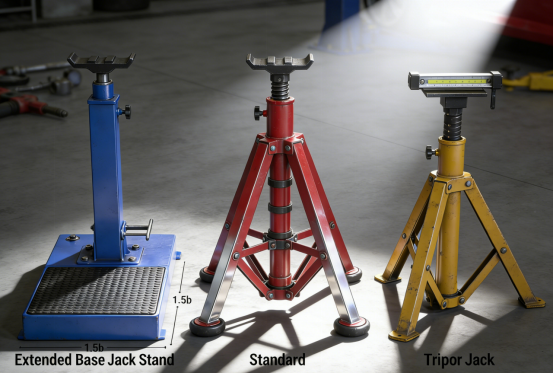
The most common jack stands base designs on the market are three-legged, four-legged standard, and wide/extended base types. Each type has its own design philosophy and applicable scenarios.

A. Tripod Jack Stands

  • 1. Design features : As the name suggests, it has only three legs. It usually adopts a cylindrical or conical structure with a saddle at the top.
  • 2. Advantages : On uneven ground, the tripod structure is inherently easier to maintain contact and less prone to wobbling than a quadruped. Because three points determine a plane, even on uneven ground, all three feet can bear the force simultaneously, avoiding stress concentration.
  • 3. Disadvantages : The support area is relatively small, resulting in a limited area of the stability triangle formed. This means it has weak resistance to lateral forces and is prone to generating “overturning moments.” In my experience, if the vehicle’s center of gravity shifts slightly or it experiences a large lateral impact, the tripod’s anti-overturning ability decreases rapidly.
  • 4. Applicable scenarios : Light vehicles, or emergency situations where ground conditions are complex and it is difficult to ensure that the ground is completely flat. However, even so, extra caution is required, and it is not recommended to use it as the main support tool for heavy maintenance .
 Tripod Jack Stands

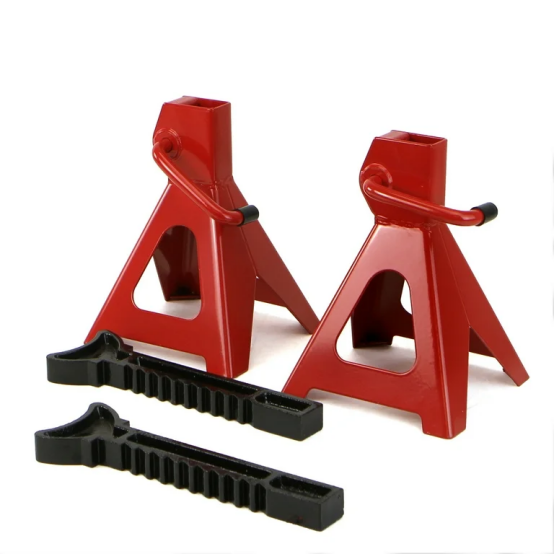
B. Standard Four-Leg Jack Stands

  • 1. Design features : The most common type, the base is usually rectangular or square, with four legs. Height adjustment is usually achieved via a ratchet mechanism or pins.
  • 2. Advantages : It offers a larger support area than a tripod, providing excellent stability on flat, solid surfaces. Compared to a tripod, it better resists lateral forces, offering a wider stability polygon. It’s an economical and practical choice for most family cars and light SUVs.
  • 3. Disadvantages : The biggest problem is on uneven ground . If all four legs cannot bear weight simultaneously, a “wobbling” phenomenon will occur. In this case, the weight of the vehicle may only be borne by two or three legs, leading to stress concentration and even deformation of the support legs, which greatly reduces stability.
  • 4. Applicable scenarios : Most family garages, driveways, and other flat, solid surfaces. Highly versatile, it’s a mainstream choice for DIY car owners.
Standard Four-Leg Jack Stands

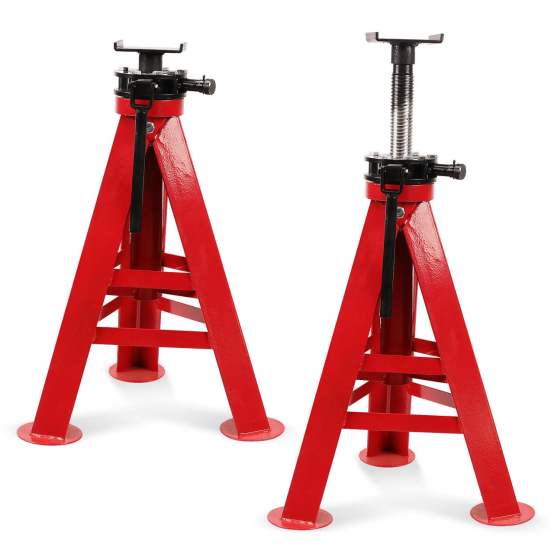
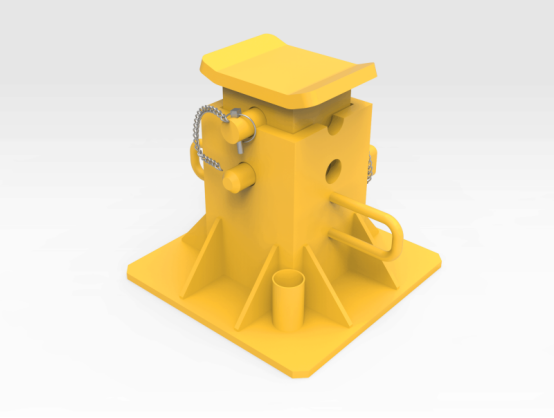
C. Wide/Extended Base Jack Stands

  • 1. Design features : Usually heavy-duty design, with a base much wider than a standard four-legged stand, typically in an H-shape or a wider rectangle.
  • 2. Advantages : Exceptional rollover resistance . The wide base provides maximum stability polygons, safely encasing the vehicle within its support range regardless of slight shifts in the vehicle’s center of gravity. It effectively distributes ground pressure, reducing the risk of the support sinking on soft ground, and resists strong lateral forces from all directions. This is the ideal choice for heavy vehicles, long-term support, or users with the highest safety requirements.
  • 3. Disadvantages : Large footprint, difficult to store. Heavy weight, inconvenient to move. Usually more expensive.
  • 4. Applicable scenarios : heavy vehicles (such as trucks, large SUVs), long-term support (such as engine or transmission overhaul), professional workshops or experienced DIY enthusiasts with the highest safety requirements.
Wide/Extended Base Jack Stands

D. Comparison and Summary Table: Overview of Jack Stands Base Design Stability

Base design typeSupport areaGround adaptabilityLateral force resistanceTypical applicationsRisk Warning
TripodsmallerGood (uneven ground)WeakLight vehicle, uneven ground (emergency)High risk of rollover, not suitable for heavy repairs
Standard four-legged typemediumGood (flat ground)mediumMost sedans/SUVs, flat groundUneven ground may cause shaking and stress concentration.
Wide base/Extended basemaximumGood (flat)Extremely strongHeavy-duty vehicles, long-term support, highest safety requirementsLarge footprint, heavy weight, and high price

Selection and Use: Minimizing Risk

Having learned about the advantages, disadvantages, and potential risks of different base designs, how should we choose and use a jack stands correctly?

A. How to choose the right base design for your vehicle

  1. Sedan/Light SUV :
    1. A standard four-legged model is usually sufficient for daily maintenance needs, provided the ground is flat and firm.
    1. If your budget allows, or if you have higher safety requirements, a wide base bracket is a better choice, as it provides stronger resistance to rollover.
  2. Heavy-duty SUVs/pickups (such as F-150, F-250) :
    1. a jack stands with a wide base, ideally at least 3 tons heavy-duty or 6 tons . These vehicles have a high center of gravity and are very heavy, requiring extremely high anti-tipping capabilities from the stand. A wide base provides a larger support area and greater stability, giving you more confidence when working under the vehicle.
  3. Low-chassis sports cars :
    1. You’ll need to use a low-profile jack to lift the vehicle. Even so, when choosing a jack stands, the stability of the base is paramount. Ensure it provides a sufficiently wide support surface to compensate for potential instability caused by a low center of gravity.

B. Ensure a foolproof operating procedure

Regardless of the type of bracket chosen, proper usage is crucial for ensuring safety.

  1. A flat, solid surface : This is a prerequisite for all safe operations. A concrete surface is the best choice.
  2. Wheel chocks and handbrake : Before lifting the vehicle, be sure to engage the handbrake and place wheel chocks under the wheels that are not being lifted to prevent the vehicle from moving accidentally.
  3. Correct lifting point : Refer to the vehicle manual, place the jack at the designated lifting point, lift to the required height, and then place the jack stands at the support point specified by the vehicle manufacturer.
  4. Stability test : Slowly lower the vehicle so that its weight rests entirely on the jack stands. Then, gently shake the vehicle to confirm that the stand is secure, the vehicle is stable, and there is no shaking or abnormal noise.
  5. Auxiliary support : When disassembling and repairing heavy objects such as engines and transmissions, or when the vehicle needs to be supported for a long time, consider placing sturdy wooden blocks under key load-bearing parts as an extra safety redundancy.

C. Long-term storage and safety

If you need to support your vehicle on a jack stands for extended periods, such as during major repairs or seasonal storage, a wide-base jack stands offers significant advantages. It provides more stable support, reducing the risk of damage from ground changes or accidental impacts. Also, ensure all stands are placed on a firm, level surface and check their stability regularly.

DIY is fine, the problem is getting out of control.

When it comes to vehicle maintenance, safety comes first. Choosing the right jack stands base design and strictly following safety operating procedures will not only protect your vehicle but also ensure your own safety. Professional knowledge is the best insurance; it allows you to work in the garage with more peace of mind and less worry.

To minimize the risks associated with vehicle support, in addition to choosing a suitable jack stands base design , you’ll need a complete set of safe operating guidelines. Remember, every repair deserves your 100% caution.

Frequently Asked Questions (FAQs)

A. Is a 2-ton jack support sufficient?

For most family sedans and small SUVs, a pair of 2-ton (total load capacity 4 tons) jack stands are usually sufficient, as you’ll typically only lift one end of the vehicle, at which point the stands will be supporting half or less of the vehicle’s total weight. However, for heavy SUVs, pickup trucks (like the F-150 or F-250), or any vehicle weighing over 4,000 pounds (approximately 1.8 tons), I strongly recommend opting for 3-ton or 6-ton jack stands for greater safety margins and stability. There’s no such thing as “just right” in safety, only “safer.”

B. Which is safer, a ramp or a jack stands?

This depends on the specific task and vehicle type. Car ramps are generally considered safer in certain situations , especially for simple tasks like changing oil, because they provide a wide, continuous support surface that the vehicle can drive directly onto, offering good stability and a lower risk of tipping over. However, ramps have limitations, such as not allowing wheel removal and potentially being unsuitable for vehicles with low chassis. Jack stands are more versatile, suitable for complex repairs , allowing wheel removal and providing greater operating space. Jack stands are also very safe if properly placed on a hard, level surface and safety procedures are strictly followed. My advice is to choose the most suitable tool based on your repair needs and vehicle characteristics, always prioritizing safety, such as using wheel chocks and engaging the handbrake.

C. Can I leave my car on the jack stand overnight?

Yes, if the jack stands is placed correctly and the ground is firm and level, it is perfectly safe to leave your vehicle on a jack stands overnight or even longer, and it is much safer than using a hydraulic jack alone. Hydraulic jacks are not suitable for long-term support, as their seals may slowly fail, causing the vehicle to drop. The key is to ensure that the jack stands is securely placed on the vehicle’s designated support points, the vehicle’s center of gravity is within the jack stand’s base, and the environment is safe and free from accidental impact risks. For peace of mind, I usually recommend placing a thick wooden board under the jack stands for added stability and informing family members that the vehicle is being lifted.

author-avatar

About Gavin Reid

Gavin Reid has been obsessively analyzing garage safety protocols and vehicle support systems for over a decade. After transitioning from a professional service bay to independent safety consulting in 2020, Gavin realized the market was flooded with confusing weight ratings and compromised designs that offered a false sense of security. His Mission: To help DIY mechanics—especially home hobbyists—identify critical failure points in vehicle lifting and ensure every project ends safely. Why Trust Gavin: Engineering Obsessive: He dissects load paths and weld integrity. From metallurgy to geometric stability, he understands the physics that keep two tons of steel from crushing a human chest. Data-Driven Testing: Gavin has stress-tested 40+ models, evaluating lateral stability and locking redundancy rather than just "marketing tonnage." In the Garage: He’s a fixture in local DIY communities, frequently inspecting frame rails for pinch weld placement and documenting metal fatigue on aging gear. Gavin believes that "a lapse in physics is a permanent mistake." He is dedicated to teaching mechanics how to maintain a "zero-trust" relationship with their equipment. Would you like me to provide Gavin’s specific checklist for identifying structural fatigue in used jack stands?