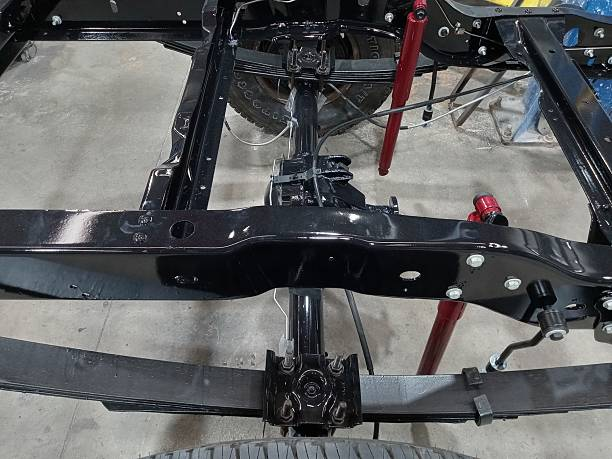
Jack Stands

Subframe Drop: Positioning Jack Stands for Total Undercarriage Access

__BATCH_ALT_1__


1. Challenge the subframe, safety first.

1.1 Welcome to the world of “hardcore” repair: When conventional support points disappear

Hey buddy! I bet you’re no longer a novice DIY enthusiast. You’re about to tackle something much more challenging—like replacing suspension bushings, cleaning the engine bay, or even possibly removing the entire subframe from your car. I know, that sounds adrenaline-pumping because it means you’ll have access to unprecedented chassis workspace.

But wait, before you excitedly pick up your tools, have you considered a crucial question: when your subframes are no longer in the car, will those support points where you usually place jack stands still be usable?

The answer is obvious: no. This is precisely what we’ll delve into today—a crucial safety aspect that even many experienced riders might overlook.

1.2 Why will Subframe Drop revolutionize your Jack Stands experience?

In a typical vehicle lift, we usually place jack stands at reinforcement points specified by the body manufacturer, such as pinch welds, frame beams, or even the subframe. These points are precisely calculated by engineers to safely support the partial or overall weight of the vehicle. However, once you plan to remove the subframe, this designed “safe zone” disappears.

This is not as simple as “moving the jack stands.” It involves a fundamental change in the force path of the vehicle’s overall structure and a rethinking of the logic behind jack stand placement. I’ve seen far too many cases where vehicles have become unstable due to incorrect fulcrum selection in such specific situations.

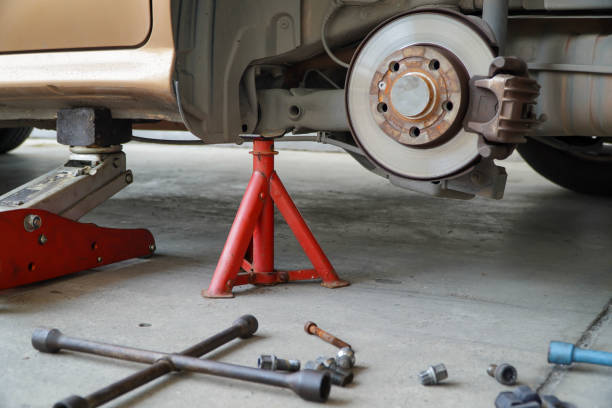
Car lifted on red Jack Stands and floor jack for brake work, tools nearby.

2. Understanding the mechanical challenges and risks of Subframe Drop

2.1 The role of the subframe: not just a connector, but also a core load-bearing component

You might think that a subframe is simply a frame connecting the engine, transmission, and suspension components. That’s true, it is. But more importantly, the subframe is also a major load-bearing node in the vehicle’s chassis structure. It bears most of the vertical loads and lateral stresses from the suspension system and evenly transfers them to the main body structure (unibody).

When a subframe is removed, the forces that were previously transmitted through it need to find a new path. If the jack stands are placed in an inappropriate location, these forces will concentrate in weak areas of the vehicle structure that are not designed to withstand stress.

This can lead to vehicle deformation at best, and at worst, the jack stands could penetrate the vehicle body, or even cause the vehicle to overturn. Metal structures are susceptible to fatigue and aging, and their failure risk increases significantly, especially under incorrect stress conditions.

2.2 Shifts in Center of Gravity and Stability: The Deadly Trap You Can’t See

A vehicle’s stability is highly dependent on its center of gravity. When performing a subframe drop, heavy components such as the engine and transmission are typically removed, or at least their support structure is altered. This significantly changes the vehicle’s overall center of gravity.

Imagine you’re normally lifting a car, supported by four jack stands at stable points. But now, without the support of subframes at the front or rear, the weight distribution is uneven, the vehicle’s center of gravity may shift upwards, and it’s more prone to lateral drift.

If the jack stands are placed on a base that’s not wide enough, in an inappropriate location, or on poor ground conditions, this unstable center of gravity, combined with external pushing or pulling forces, can be a direct cause of many accidents.

Remember, the stability of jack stands is highly dependent on ground conditions; any uneven or softened surface (such as hot asphalt) can make them unstable.

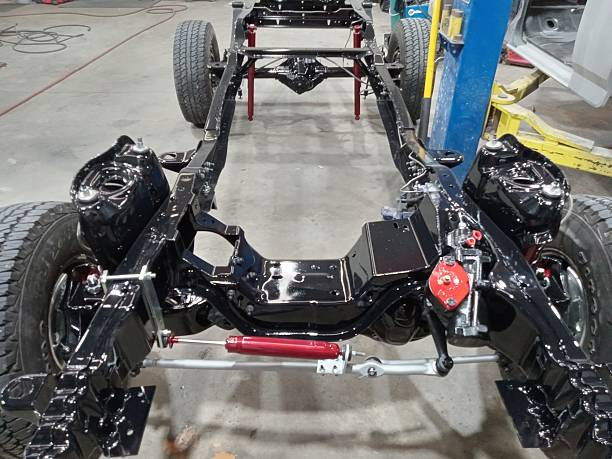
Full view of a restored black truck chassis with new wheels and suspension.

3. Finding new safety “anchors”: Alternative support strategies for unibody vehicles

When the subframe cannot provide support, we need to find new, robust support points on the Unibody body structure that can withstand the load.

3.1 Unibody Frame Rails: The “backbone” of the vehicle body structure

Most modern passenger vehicles use a unibody construction. In this structure, the frame and body are integrated. At the bottom of the vehicle, you’ll find several frame rails running from front to rear. These are the strongest parts of the body structure, responsible for bearing most of the impacts and loads, and are ideal for supporting jack stands.

3.1.1 How to identify and locate Unibody Frame Rails?

Frame rails are typically two or more robust rectangular or square metal beams located beneath the vehicle chassis. They are usually situated on either side of the vehicle, parallel to the pinch welds but closer to the vehicle’s centerline. These frame rails are characterized by their continuous structure, thick metal construction, and generally the absence of other tubing or components wrapped around them.

  • Rule of thumb: Looking along the side of the vehicle, inside the pinch welds, you’ll find these thicker, stronger longitudinal structures. They are usually wider than the pinch welds and look like the “skeleton” of the chassis.
  • Consult the service manual: The safest and most accurate method is to consult your vehicle’s service manual or owner’s manual. These will clearly indicate the vehicle’s official lift points, which are often the Frame Rails or nearby reinforced areas.

3.1.2 Considerations for placing Jack Stands on Frame Rails

  • Choose a flat, firm area: Frame Rails are not flat all the way through. Choose a flat area without any other protrusions (such as bolt heads or wire harnesses) that may interfere.
  • Use Jack Pads or Wooden Blocks: To protect the surface of your Frame Rails from scratches or crushing by the metal tips of the jack stands, I highly recommend using rubber jack pads or hard wooden blocks for cushioning. These jack pads not only protect the frame but also increase friction on the contact surfaces, further enhancing stability.
  • Symmetrical design and consistent height: Ensure that the jack stands on both sides are placed in the same position and adjusted to the same height. This ensures even force distribution on the vehicle and prevents tilting and twisting.
  • Avoid lines and cables: Before placing jack stands, be sure to carefully inspect the area above and around the selected area to ensure that there are no fuel lines, brake lines or cables.

3.2 Crossbeam Adapter: Expanding Your Support Boundaries

In some situations, you may need to support the entire front or rear of the vehicle, not just the sides. This is where a crossbeam adapter comes in handy. It’s a specially designed tool that attaches to your floor jack, allowing you to lift the entire width of the vehicle at once and find a sturdy support point at the central crossbeam or subframe connection point, thus placing the jack stands on the frame rails on both sides.

3.2.1 Working principle and advantages of Crossbeam Adapter

A crossbeam adapter is typically a metal crossbeam with rubber pads that spans the floor jack’s lifting saddle. Its main advantages are:

  • Wider support surface: It can distribute lifting force over a wider area of the vehicle body, reducing the pressure on a single support point.
  • Precision Lift: Allows you to lift the vehicle through the subframe before removing it, and find stable jack stands placement points on the Frame Rails on both sides.
  • Increased stability: By distributing the load more evenly, it helps maintain the vehicle’s initial balance during Subframe Drop.

3.2.2 Adapter Selection and Installation: Ensuring Force Transmission

  • Match your jack and vehicle model: Ensure the Crossbeam Adapter is compatible with your floor jack and is long enough to cover the width of your vehicle’s support points.
  • Check load-bearing capacity: Although the Crossbeam Adapter itself does not directly support the vehicle, it bears the lifting force of the floor jack. Choose a reliable product with a load-bearing capacity that matches your floor jack.
  • Secure Installation: Ensure the adapter is securely installed on the floor jack and not loose. Before use, slightly lift the vehicle to check the adapter’s stability.

3.3 Avoid incorrect placement: Where should the support never be placed?

This point cannot be overstated.

Failures are more valuable for learning than successes.

I’ve seen far too many people, due to a desire for convenience or a lack of experience, place jack stands in a fatally flawed position:

3.3.1 Vulnerable chassis components: oil pan, exhaust pipe, plastic parts

  • Oil pan/Transmission pan: These are the bottom covers of the engine or transmission, usually made of thin metal or plastic, and are very fragile, unable to withstand any weight. If they are not supported, they may leak oil or even be punctured.
  • The exhaust system: Including the exhaust pipe, muffler, and catalytic converter, is not a structural support point. It is suspended under the vehicle body, and supporting it would lead to bending or breakage.
  • Fuel lines/Brake lines: These are the vehicle’s lifelines, delicate and easily damaged. A flattened or punctured line can have disastrous consequences.
  • Plastic underbody panels/plastic bumpers: These are designed for aerodynamics or protection and do not have load-bearing capacity.

3.3.2 Suspension components: These are not designed to support the weight of the entire vehicle.

  • Lower control arms/linkages: Although they appear robust, these components are designed to withstand dynamic loads and guide wheel movement, not to support the full weight of the vehicle when stationary. At certain angles, they can deform or break due to improper stress.
  • Shock absorbers/springs: These are for damping and supporting the suspension, and should never be used as support points for jack stands.
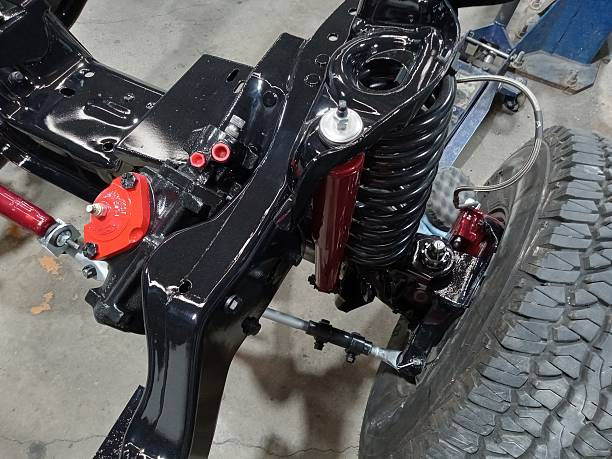
Detailed view of the shiny black truck frame's new front coil spring suspension.

4. Practical Procedures and Safety Checklist

My recommended jack stands placement and security check procedure when performing a Subframe Drop:

4.1 Preparations before vehicle lifting: Choke Wheels and ground assessment

  1. Choose a location: Ensure the work area is flat, firm, well-lit, and free of clutter.
  2. To park the vehicle: Park the vehicle in P gear (automatic) or 1 gear (manual) and engage the handbrake.
  3. Place wheel chocks: Place secure wheel chocks in front of and behind the wheels that you don’t intend to lift. For example, secure the rear wheels if you are removing the front subframe.

4.2 Precision Lifting and Jack Stands Placement Process

  1. Initial lift: Use a floor jack with a Crossbeam Adapter (if using) or directly on the mainframe (such as the reinforcement point of the central Frame Rails). The goal is to lift the vehicle slightly off the ground, but not too high.
  2. Locating jack stands:
    • To find Unibody Frame Rails: Carefully inspect the underside of the vehicle for sturdy Unibody Frame Rails.
    • Use jack pads: Place rubber jack pads or hard wooden blocks between the top of the jack stands and the frame rails.
    • Symmetrical placement: Place the two jack stands on the Frame Rails on both sides of the front (or rear, depending on the subframe you are operating) of the vehicle, ensuring they are symmetrical, aligned, and can support the strongest areas.
  3. Adjust the height and lock: Adjust the jack stands to the appropriate height, ensure all support points are on the same level, and securely lock their safety pins or ratchet mechanisms.
  4. Slowly lower: Slowly release the floor jack, allowing the vehicle’s weight to gradually and evenly fall onto the jack stands.
  5. Retain the floor jack as redundancy: Lower the floor jack slightly so that it makes only slight contact with the vehicle body, serving as an additional safety barrier.

4.3 Final stability test: Shake it once to ensure it runs smoothly.

Before you crawl under the car, be sure to perform a stability test.

  • Slight shaking: Grab a part of the vehicle with both hands (such as the wheel arch or the edge of the bumper) and try to gently shake the vehicle.
  • Observation: Observe the jack stands for any signs of slipping, tilting, or deformation. The vehicle should feel very stable.
  • Instability Re-adjustment: If any instability is felt, immediately raise the vehicle again and adjust the position or height of the jack stands until it is completely stable.

4.4 Considering safety redundancy: the value of auxiliary support

  • Backup support: Place spare wooden blocks, scrap tires, or additional jack stands under the vehicle as a second line of defense.
  • Regular inspections: During long-term operations, regularly inspect the jack stands to ensure they remain stable and check for signs of ground subsidence.

FAQ

What type of Jack Stands should I use after a Subframe Drop?

For operations like subframe drops that require extreme stability, we recommend:

  • Wide Bases: Larger footprints provide better lateral stability to resist swaying.
  • Dual Locking Mechanisms: Adds a mechanical failsafe (like a safety pin) in addition to the ratchet.
  • High Capacity: 6-ton stands often feature these robust structural benefits even for lighter vehicles.
Load capacity ≠ actual safety; a wider base performs better under complex stress conditions.
Does the placement of Jack Stands depend on the vehicle model?

Yes, they are closely related. Unibody vehicles vary significantly in the shape, location, and strength of their frame rails.

Always consult your vehicle’s service manual for officially recommended lift points. Strongest support areas may differ, or specific jack pads may be required for safe placement.

If Crossbeam Adapter is not available, are there any alternatives?

You can lift and support the vehicle in stages:

  1. Lift one side at a designated frame rail point using a floor jack.
  2. Place the first jack stand and ensure it is secure.
  3. Repeat the process on the other side.

This method requires careful control of balance; each lift increment should be small to prevent significant tilting.

Single-point support is high-risk. Ensure the first side is rock-solid before lifting the second.
author-avatar

About Gavin Reid

Gavin Reid has been obsessively analyzing garage safety protocols and vehicle support systems for over a decade. After transitioning from a professional service bay to independent safety consulting in 2020, Gavin realized the market was flooded with confusing weight ratings and compromised designs that offered a false sense of security. His Mission: To help DIY mechanics—especially home hobbyists—identify critical failure points in vehicle lifting and ensure every project ends safely. Why Trust Gavin: Engineering Obsessive: He dissects load paths and weld integrity. From metallurgy to geometric stability, he understands the physics that keep two tons of steel from crushing a human chest. Data-Driven Testing: Gavin has stress-tested 40+ models, evaluating lateral stability and locking redundancy rather than just "marketing tonnage." In the Garage: He’s a fixture in local DIY communities, frequently inspecting frame rails for pinch weld placement and documenting metal fatigue on aging gear. Gavin believes that "a lapse in physics is a permanent mistake." He is dedicated to teaching mechanics how to maintain a "zero-trust" relationship with their equipment. Would you like me to provide Gavin’s specific checklist for identifying structural fatigue in used jack stands?