Jack Stands

A new approach to getting vehicles out of trouble in sand: using traction boards in conjunction with Jack Stands to safely lift vehicles.

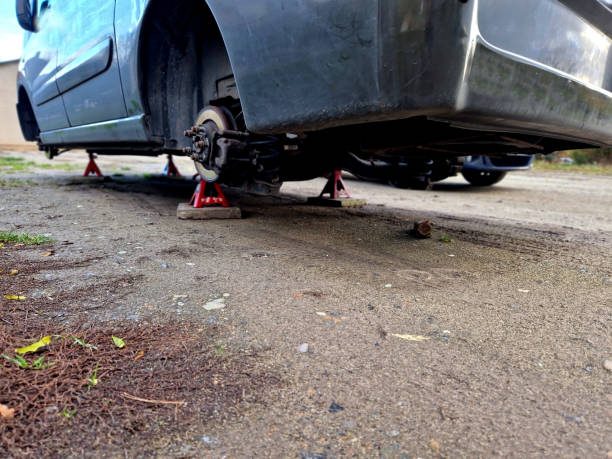
Car safely lifted on red Jack Stands for maintenance, wheels removed on a dirt surface.

In off-road adventures, when your vehicle gets stuck in the sand and needs to be lifted for repairs or to get out, traditional jack stands often become a “soft-footed shrimp,” causing fear and anxiety. Today, we won’t talk about everyday garage operations, but rather a more challenging topic: Beyond the Garage, how to cleverly utilize your traction boards in combination with jack stands to achieve a safe and stable vehicle lifting in soft sand.


1. Repairing equipment on sandy terrain during off-road driving.

Imagine you’re enjoying off-roading when you suddenly get stuck or need emergency repairs. You pull out your jack stands, only to find them sinking deeper and deeper into the soft sand, teetering on the verge of collapse. This scenario is a nightmare for any off-road enthusiast.

Traditional jack stands were primarily designed for hard, flat paved surfaces, such as garages or asphalt roads.

Their base area is relatively small. On low-load-bearing surfaces like sand, the weight of a vehicle exerts immense pressure through the small base area, causing the sand to collapse rapidly and the support point to instantly lose stability.

This is why using jack stands on sand, even with high load-bearing capacity, can pose significant risks.

Because on sand, load-bearing capacity ≠ actual safety.

When a vehicle is lifted on an unstable support point, even a slight shift in the center of gravity can trigger a chain reaction. The vehicle’s center of gravity is already high, and combined with the inherent fluidity of the sand, any slight swaying can cause the single-point support to fail.

This is the direct cause of most accidents.

Therefore, we need a solution that can transform the “softness” of the sand into “hardness,” providing a reliable “mobile base” for jack stands.


2. Sandy soft-legged shrimp? Jack Stands’ “inherent deficiencies” and the principles of mechanics

Let’s first understand from an engineering and mechanics perspective why jack stands “don’t adapt” to sandy terrain.

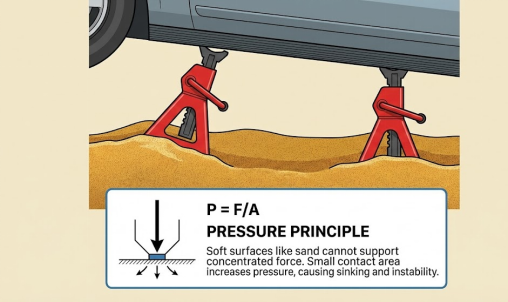
Ground conditions are key: the interplay of pressure and contact area. Pressure = Force ÷ Area.

When your vehicle (force) acts on the sand through the small base (area) of the jack stands, the resulting pressure is enormous.

The sand particles have low friction and a loose structure, unable to withstand this high pressure, and naturally sink in.

This is similar to how wearing high heels on the sand leaves a deep imprint, while walking barefoot or in flat shoes doesn’t result in such a deep sinking. The jack stands on the sand are like those high heels.

Illustration of Jack Stands sinking into sand due to pressure, showing instability principle.

The risks of shifting center of gravity and single-point support: Off-road vehicles generally have a higher center of gravity than passenger cars.

This means that during lifting, any lateral forces or uneven ground will be amplified.

On hard ground, jack stands provide relatively stable support, but on sand, uneven sinking can cause an uncontrollable shift in the vehicle’s center of gravity, exerting shear forces rather than vertical pressure on the jack stands, far exceeding their design limits.

Single-point support is a high-risk maneuver, especially in such unstable environments.

Metal structures are susceptible to fatigue and aging. Even the highest quality jack stands will experience fatigue over time and with use. This fatigue can be accelerated under extreme conditions (such as sand subsidence or uneven stress).

Therefore, it’s crucial to not only pay attention to usage methods but also regularly inspect your jack stands for signs of aging such as deformation and weld cracks.


3. Traction Boards: More than just getting out of trouble, they are the “mobile foundation” of Jack Stands.

Now, we’ll reveal how to turn your Traction Boards into a lifesaver for jack stands on the sand.

Traction boards, such as MaxTrax or other brands of off-road recovery gear hacks, are designed to provide extra grip on soft surfaces (sand, mud, snow) to help vehicles get out of trouble. They are typically made of high-strength engineering plastics, have a large surface area, and a robust structure.

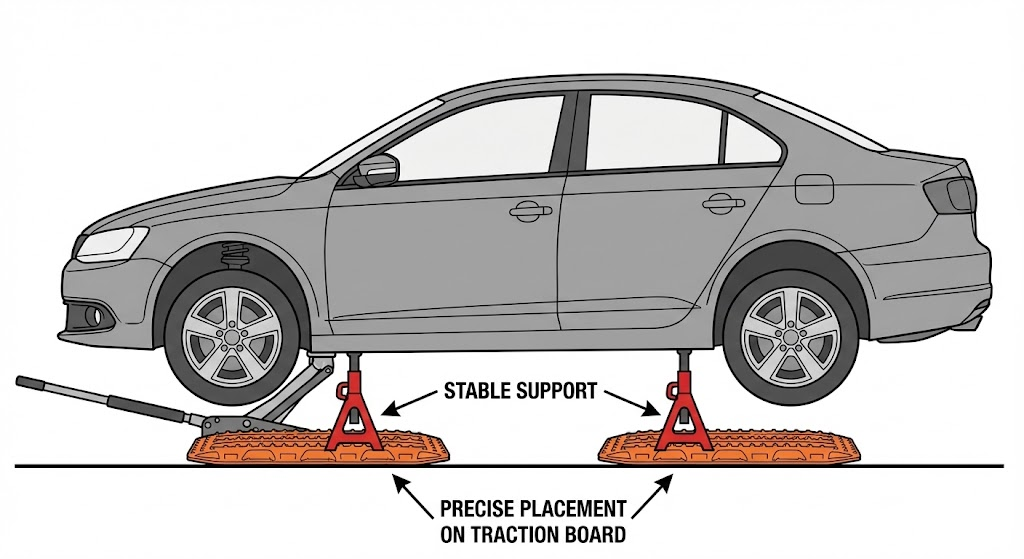
The principle behind this: Distributing pressure across a surface – when traction boards are laid flat on sand and jack stands are placed on top, the vehicle’s weight is no longer directly applied to the small base of the jack stands.

Instead, it is evenly distributed across a larger area of sand through the traction boards.

This significantly reduces the pressure per unit area, effectively preventing the jack stands from sinking. From a mechanical perspective, this is equivalent to replacing “high heels” with “snow boots,” allowing for a wider pressure distribution and thus simulating the support effect of a hard surface.

Material and Structural Advantages: High-strength and Bending-Resistant Traction Boards can withstand the immense weight of a vehicle while maintaining their structural integrity, preventing them from easily bending or breaking.

Their non-slip surface texture also helps prevent jack stands from slipping, providing additional stability. This multi-functionality not only solves the problem of finding large planks but also maximizes the value of existing off-road equipment. [Image Suggestion: Top-down view of Traction Boards laid flat on sand, showing their large area and structure; text explaining their material advantages could be added.]


4. Practical Guide: Five-Step Method for Safe Sand Lifting Using Traction Boards and Jack Stands

Now that you understand the principles, it’s time for practical application. Remember, safety is always the top priority.

Step 1: Site Assessment and Preparation

  • Choose the best location: Try to find a relatively flat area with slightly denser sand. If a slope cannot be avoided, be sure to position the front or rear of the vehicle towards the top of the slope, not the side.
  • Secure the vehicle: Shift the vehicle into a low gear (Park for automatic transmissions) and engage the handbrake. More importantly, wheel locks are essential! Place them in front of and behind the wheels that are not lifted to ensure the vehicle cannot roll. This is your last line of defense.
  • Clean up the work area: Remove any rocks, branches, or other debris that may affect stability near the jack stands and traction board placement points.

Step 2: Precise installation of Traction Boards

  • traction boards,Placement: Lay one or more Traction Boards closely side-by-side under the designated jack stands support points. Ensure the entire base of the jack stands rests completely on the central area of the Traction Boards, leaving sufficient safety margins at the edges.
  • Direction: Traction boards should be laid flat against the ground as much as possible, and their long sides should ideally be perpendicular or parallel to the direction of vehicle lifting, depending on your lifting method and the sand conditions. The key is to provide a stable, non-shaking surface.
Car safely supported by Jack Stands on traction boards for stable maintenance.

Step 3: Securely mounting the Jack Stands

  • Correct placement points: Always refer to your vehicle’s owner’s manual to find the manufacturer-specified points.
  • Incorrect placement points cause accidents more often than product quality issues.

  • pinchThese are usually the frame beams, subframe, or reinforced pin inch welds.
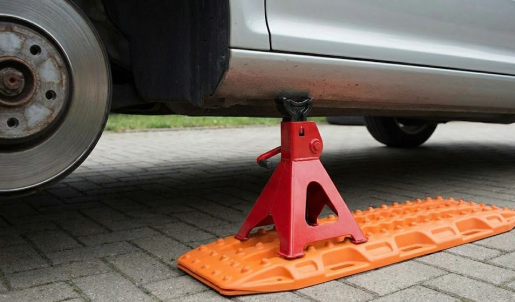
  • Vertical placement: Place the jack stands vertically and securely on the laid traction boards. Ensure that the base of the jack stands is fully in contact with the traction board surface, without any gaps or tilting.
  • Consistent Height: If using multiple pairs of jack stands to lift the same axle of the vehicle (e.g., the front axle), ensure they are adjusted to the same height.

Step 4: Lifting with jacks and “laying” the vehicle in place.

  • Slow Lift: Use your hydraulic jack to lift the vehicle slowly and smoothly. During the lifting process, closely observe the stability of the traction boards and jack stands. If any signs of sinking or slipping occur, stop immediately and reassess.
  • Securely lower the vehicle: Once it has been lifted to the required height, carefully lower it so that its weight rests steadily on the jack stands, rather than relying solely on the jacks. Jack stands are for support, and jacks are for lifting.
  • Safety redundancy:

    Safety redundancy (an extra layer of support) is key to professional operation.


    In high-risk environments like sandy terrain, I usually recommend keeping a hydraulic jack in a slightly weight-bearing position as an additional backup, but not relying on it entirely.

Close-up of a red Jack Stand firmly placed on an orange traction board supporting car.

Step 5: Safe evacuation after the operation

  • Lift first, then lower: After completing the operation, use a hydraulic jack to slightly lift the vehicle again, making room for the jack stands.
  • Careful evacuation: Remove the jack stands, then slowly lower the vehicle.
  • Final step: Remove traction boards and wheel locks. Before driving, check that all tools are stored away and ensure the work area is clean and tidy.

5. Every lift is a commitment to safety.

The allure of off-road adventures lies in the unknown, but vehicle maintenance safety must never be compromised. The ingenious combination of traction boards and jack stands not only offers innovative off-road jack base alternatives but also maximizes the value of existing equipment, adding a solid layer of safety to your off-road adventures.

terrain butRemember, true off-road masters are not only those who conquer challenging terrain, but also those who can ensure their own and their vehicle’s safety in any environment.

Next time you need to perform repairs in the sand, try this method to make your jack stands as stable as a mountain, thanks to using Maxtrax as a jack base.

If you’d like to learn more about jack stand options and how to ensure vehicle lifting safety in different terrains, please visit our Jack Stand Safety Master Guide page, where you’ll find more comprehensive solutions to explore.


FAQ

Q1: Besides Traction Boards, what other off-road jack base alternatives can be used in sandy areas?

Besides traction boards, you can consider these options:

  • Dedicated Jack Bases: Usually made of high-density plastic, specifically designed to increase the contact area.
  • Sturdy Wooden Boards: Thick plywood or solid wood blocks. Ensure the wood is not rotten or cracked and is sufficiently large/thick.
Whichever you choose, ensure it can evenly distribute pressure and the structure is robust.
Q2: When using Jack Stands in sand, how do you determine if Traction Boards are stable enough?

To determine stability, follow these key points:

  • Flat Placement: Ensure they are flat on the sand without warping or wobbling.
  • Pre-load Test: Before fully releasing the vehicle onto the stands, gently shake the vehicle and observe the sand for any shrinkage or displacement.
If any signs of instability are observed, stop immediately and readjust.
Q3: When using Traction Boards with Jack Stands for sand lifting, are there any special requirements for the Jack Stands themselves?

Choosing high-quality hardware is indispensable. Recommendations include:

  • Large Base Area: To further aid pressure distribution.
  • Double-Locking Mechanism: For an extra layer of mechanical safety.
  • Structural Integrity: Avoid cheap stands or those with wear/deformation.

Regularly inspecting your jack stands to ensure they are in good condition is fundamental to ensuring safety.

author-avatar

About Gavin Reid

Gavin Reid has been obsessively analyzing garage safety protocols and vehicle support systems for over a decade. After transitioning from a professional service bay to independent safety consulting in 2020, Gavin realized the market was flooded with confusing weight ratings and compromised designs that offered a false sense of security. His Mission: To help DIY mechanics—especially home hobbyists—identify critical failure points in vehicle lifting and ensure every project ends safely. Why Trust Gavin: Engineering Obsessive: He dissects load paths and weld integrity. From metallurgy to geometric stability, he understands the physics that keep two tons of steel from crushing a human chest. Data-Driven Testing: Gavin has stress-tested 40+ models, evaluating lateral stability and locking redundancy rather than just "marketing tonnage." In the Garage: He’s a fixture in local DIY communities, frequently inspecting frame rails for pinch weld placement and documenting metal fatigue on aging gear. Gavin believes that "a lapse in physics is a permanent mistake." He is dedicated to teaching mechanics how to maintain a "zero-trust" relationship with their equipment. Would you like me to provide Gavin’s specific checklist for identifying structural fatigue in used jack stands?