Jack Stands

Why can’t Jack Stands be placed under leaf springs?

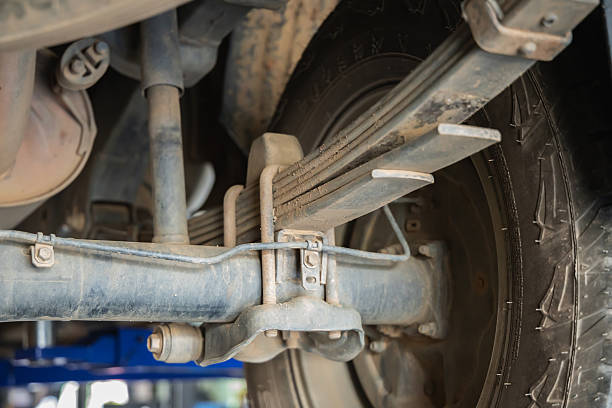
Underside view of truck leaf spring suspension. Always use Jack Stands for safety.

Hey friend! Have you ever seen those heart-stopping videos on social media? A car owner is in their garage, lifting their vehicle for repairs, and suddenly it bounces up or even falls off its support. I’ve seen far too many cases like this, especially from pickup truck owners who habitually place jack stands under leaf springs.

That’s a huge no-no!

Those seemingly “easy” and “convenient” operations often hide fatal risks. Today, we’ll cut to the chase and tell you directly why you should never place jack stands under leaf springs. This isn’t alarmist; it’s based on solid engineering principles and painful lessons learned.

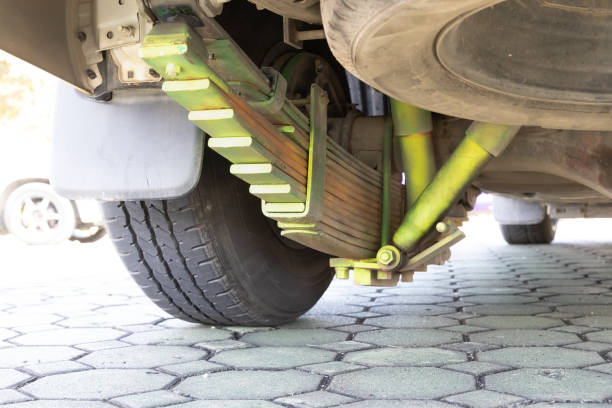
Rear vehicle leaf spring suspension near tire. Secure with Jack Stands before working.

Leaf Springs: The Misunderstood “Lever Point” and a Potential Energy Bomb

Many DIY enthusiasts believe that leaf springs, with their thick and sturdy appearance, can withstand weight and therefore provide good support. However, this perception is precisely the biggest misconception.

Why are leaf springs unsuitable for support? Engineering and Mechanics Principles

First, we need to understand the original design purpose of leaf springs.

  • They are part of a vehicle’s suspension system.
  • Their main task is to absorb road impacts.
  • They provide suspension elasticity and comfort.

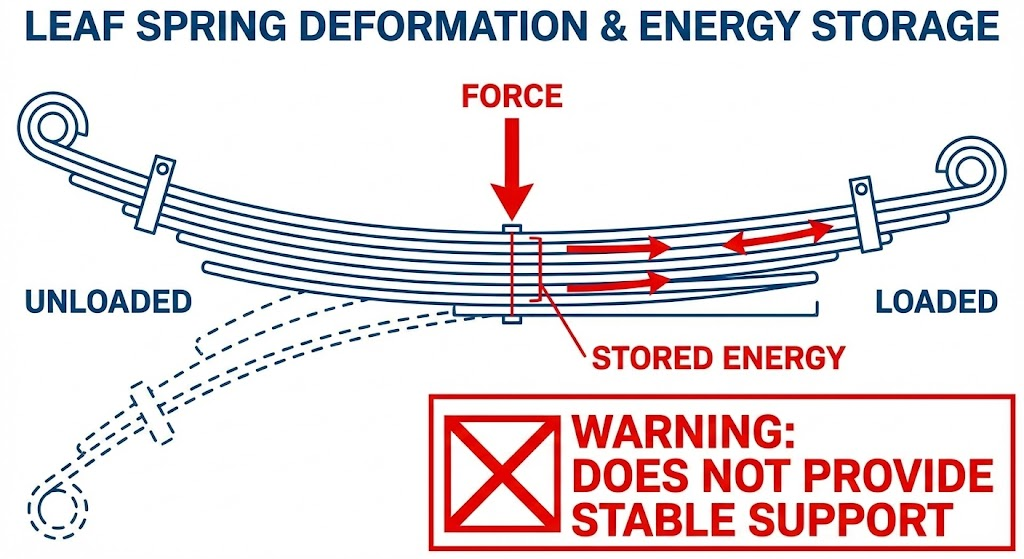
You can think of them as a giant set of bow-shaped spring plates. When the weight of the vehicle presses on them, they deform, storing the impact energy and then releasing it when appropriate.

Here’s the problem: When your vehicle is lifted by a floor jack and you place the jack stands under compressed leaf springs, you’re essentially “locking” a huge amount of elastic potential energy there.

If you slightly shift the vehicle’s stress points while removing wheels or other parts, or if the contact point between the leaf springs and the jack stands slips, this stored energy will be released instantly and uncontrollably!

The vehicle will bounce off the jack stands like it’s been launched by a slingshot, with potentially disastrous consequences.

Furthermore, placing jack stands under leaf springs is not a stable point of support. In the accident debriefings I’ve participated in, shifts in the center of gravity are the direct cause of most accidents. Once a vehicle is lifted, its center of gravity naturally rises; the more unstable the support point, the greater the risk of the vehicle rolling over or falling off.

Remember, true safety comes from “predictability,” not luck.

Diagram showing leaf spring deformation, warning against using for stable support, unlike Jack Stands.

How dangerous is the instantaneous release of energy?

I’ve seen far too many problems arise from this detail. Once, a pickup truck owner was replacing the rear axle shock absorbers, placing jack stands in front of the leaf springs. When he loosened the bolts to remove the old shock absorbers, the leaf springs, unrestrained, rebounded violently, causing the rear of the vehicle to momentarily lift off the ground before slamming back down, nearly injuring him.

This is a true illustration of the danger of jack stands on leaf springs.

Many people think, “I’m only doing this for a short time; it should be fine.” My friend, “short time work” doesn’t mean safer. Accidents often happen in the blink of an eye, and complacency is the biggest enemy of safety.

Furthermore, supporting a leaf spring is essentially single-point support, lacking the safety redundancy emphasized in professional operations. Once one support point fails, the vehicle is completely unprotected.

Failures are more valuable than successes; we must learn from these lessons.

Metal fatigue and aging: unseen risks

Leaf springs, subjected to the constant bumps, impacts, and vibrations of vehicles, can develop fatigue and aging issues due to their metal structure. This damage may be invisible to the naked eye, but their structural integrity is severely tested under additional, unintended static stress. Placing jack stands at these points is akin to building a skyscraper on sand—the risks are multiplied.


The correct support point for Jack Stands

Since leaf springs are off-limits, where should we put jack stands? The answer is simple: find a robust structure designed to bear the overall weight of the vehicle.

Frame and Subframe: A Solid Foundation

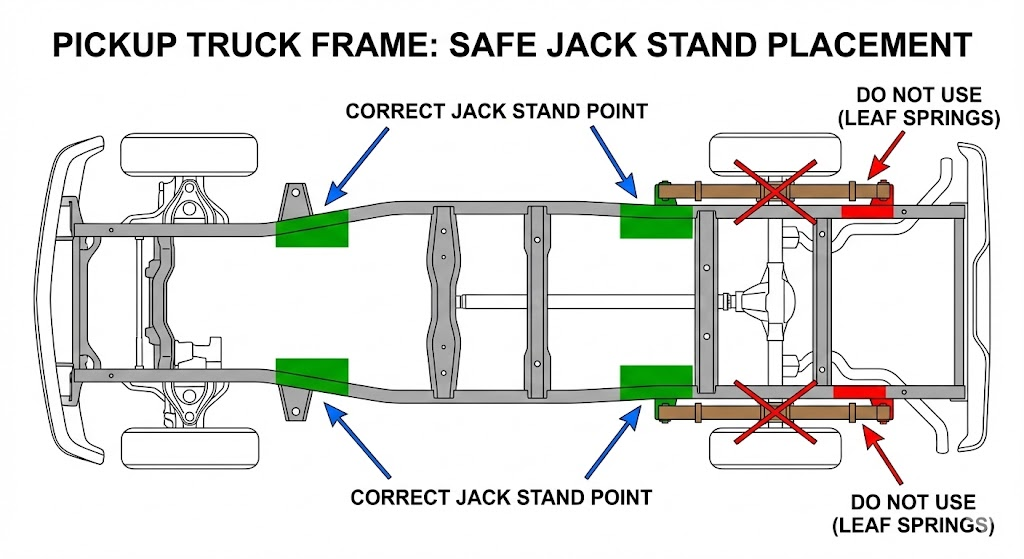
For trucks, SUVs, or some older cars with independent frames, the frame is the ideal support point. These straight, robust metal beams evenly distribute the vehicle’s weight, providing unparalleled stability.

For most modern cars and CUVs with unibody construction, there is a dedicated subframe at the bottom, which is also an excellent support location.

When placing jack stands, always choose a flat, sturdy area so that the saddles of the jack stands fully contact and cover the frame or subframe. Ensure each jack stand is at the same locking height, and gently rock the vehicle to confirm its stability before proceeding. This is true truck suspension safety and safe jack points for pickups.

Diagram of safe Jack Stands placement points on pickup truck frame, avoiding leaf springs.

Axle Tube and Differential: Reliable Options for the Rear Axle

For non-independent rear axles, such as those in many pickup trucks or SUVs, the robust axle tube and differential housing center are also acceptable support points. These components are designed to bear the weight of the vehicle and driving forces.

However, it’s important to note that when supporting the axle tube, it’s best to use rubber pads or thick wooden blocks to protect the surface and ensure the jack stands‘ saddles make stable contact. As for the differential, only its central portion should be used as a support point, ensuring sufficient contact area to avoid uneven pressure on the differential housing.

What are pinch welds? Do they fit in jack stands?

Pinch welds are reinforced edges on the underside of the vehicle body, typically below the side skirts, used to connect body panels. They are often the lifting points for the vehicle’s original scissor jack.

However, not all pinch welds are suitable for long-term jack stand support.

If you need to place jack stands on pinch welds, it is highly recommended to use dedicated jack pads. These pads typically have V-grooves that perfectly hold the pinch welds in place, protecting the vehicle body from deformation and providing a more stable contact surface.

Remember, incorrect placement is more likely to cause accidents than product quality issues.


Your safety begins with understanding the “why.”

Friends, vehicle repair safety is paramount. Understanding why you should never place a jack stand under leaf springs and mastering the correct support points is the first lesson you’ll learn when doing DIY repairs in your own garage. Hopefully, today’s sharing will give you a deeper understanding of vehicle lifting safety.

DIY is fine; losing control is the problem. Your safety begins with understanding the “why.”

If you want to minimize this risk and learn more about choosing and using vehicle lift safety tools, please visit our Jack Stands Master Guide for more comprehensive solutions.

FAQ

Q1: Besides leaf springs, what other places are off-limits for jack stands?

Avoid placing jack stands on non-structural or fragile components, including:

  • Exhaust pipes, oil pans, and transmission housings.
  • Plastic skid plates and suspension arms (unless specifically designated).
  • Any thin metal sheets or easily deformable components.
Any component not designed to withstand static loads should be strictly avoided.
Q2: How do I determine where to put the jack stands on my car?

The Owner’s Manual is the most authoritative resource. It clearly indicates jacking and support points, often with specific illustrations.

Other resources include:

  • Professional repair forums or experienced mechanics.
  • Common safe points: sturdy frame rails, subframes, or designated axle tubes.
Q3: Why emphasize safety redundancy? Isn’t one jack stand safe enough?

One jack stand is never safe enough because equipment can fail due to mechanical issues or ground changes. We recommend:

  • Dual Support: Use at least two jack stands per axle.
  • Backup Jack: Keep the floor jack slightly engaged as a secondary fail-safe.
  • Wheel Chocks: Always lock unlifted tires to prevent rolling.
Safety redundancy minimizes the risk of catastrophic accidents while working under the vehicle.
author-avatar

About Gavin Reid

Gavin Reid has been obsessively analyzing garage safety protocols and vehicle support systems for over a decade. After transitioning from a professional service bay to independent safety consulting in 2020, Gavin realized the market was flooded with confusing weight ratings and compromised designs that offered a false sense of security. His Mission: To help DIY mechanics—especially home hobbyists—identify critical failure points in vehicle lifting and ensure every project ends safely. Why Trust Gavin: Engineering Obsessive: He dissects load paths and weld integrity. From metallurgy to geometric stability, he understands the physics that keep two tons of steel from crushing a human chest. Data-Driven Testing: Gavin has stress-tested 40+ models, evaluating lateral stability and locking redundancy rather than just "marketing tonnage." In the Garage: He’s a fixture in local DIY communities, frequently inspecting frame rails for pinch weld placement and documenting metal fatigue on aging gear. Gavin believes that "a lapse in physics is a permanent mistake." He is dedicated to teaching mechanics how to maintain a "zero-trust" relationship with their equipment. Would you like me to provide Gavin’s specific checklist for identifying structural fatigue in used jack stands?