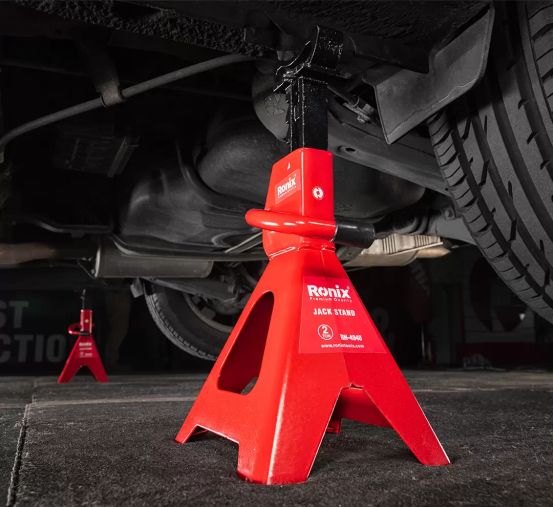
Jack Stands

jack stands and lifting machines: not substitutes, but complementary safety barriers.

Jack supports and lifting machines: not substitutes, but complementary safety barriers.

Today, I would like to discuss a core topic with you: jack stands and lifting machines are not simply substitutes, but complementary tools that each have unique safety responsibilities.

Why is the idea of “choosing a stent to save money and choosing a helicopter to save effort” a one-sided understanding?

Many car owners, especially those trying deep DIY repairs for the first time, often develop some one-sided perceptions.

Myth 1: Believing that a lifting machine can completely replace a jack stands.

“Since a lift can raise a car higher and provide more operating space, is there no need for a jack stands?” This is a question I often hear. On the surface, lifts do offer unparalleled convenience: one-button lifting, a spacious working area, and no need to struggle under a car.

But this convenience masks the fundamental difference in design philosophy between lifts and jack stands. Lifts are complex mechanical-hydraulic systems, while jack stands are purely mechanical supports. Their risk profiles and safety redundancy capabilities are drastically different.

Myth 2: Equating safety with load-bearing capacity

“My lift is 4 tons, my car is only 2 tons, it’s definitely safe!” This kind of “parameter worship” is extremely dangerous. While load-bearing capacity is an important aspect of safety, it is by no means the only one.

The stability of the tool, its failure modes under different working conditions, and its suitability for the usage scenario all have a decisive impact on overall safety. A 4-ton lift, if lacking proper maintenance or operated improperly, may be far less safe than a pair of correctly positioned 3-ton jack supports .

A schematic diagram comparing the structures of a lifting machine and a jack stands, highlighting the hydraulic system of the lifting machine and the mechanical structure of the stand.

Car lifts: Efficient and convenient engineering solutions

Car lifts are undoubtedly an indispensable piece of equipment in modern professional workshops.

Working principle and design advantages of lifts

Whether hydraulic, pneumatic, or electric, the core function of a lift is to quickly and smoothly raise a vehicle to the required height using a power system. They typically feature large trays or booms that evenly distribute the vehicle’s weight, providing excellent under-work space and a standing working posture. This ensures efficiency in high-frequency, high-volume professional repair environments.

The role of lifts in professional maintenance

In busy repair shops, lifts significantly reduce the time spent moving vehicles up and down work bays, improving technician efficiency. They make complex tasks such as gearbox disassembly and assembly, exhaust system replacement, and chassis maintenance much easier. In short, lifts are designed for professional environments where efficiency is paramount.

Limitations and potential risks of lifts

However, lifts are not without their drawbacks.

  • First, the high initial investment and significant space requirements make them difficult to popularize in home garages.
  • Second, as a complex electromechanical-hydraulic system, a lift carries the potential risk of single-point failure . Aging hydraulic seals, hydraulic oil leaks, electrical control system malfunctions, and even jammed mechanical safety locks can all lead to unexpected vehicle descent. Even professional lifts equipped with multiple safety locks cannot completely eliminate all risks.
Close-up view of the lifting machine's safety locking mechanism, with its mechanical structure labeled.

3. Jack Support: Foundation, Redundancy, and Core Safety Guarantee

Compared to a lifting machine, the structure of a jack support may seem simple, but it embodies the most basic and reliable philosophy of mechanical safety.

Mechanical Design and Stability Principles of Jack Support

jack stands lies in their purely mechanical locking mechanism . Whether ratchet or pin-type, once locked, it forms a rigid support. Its load-bearing capacity and stability depend primarily on material strength, welding quality, and base design.

A wide base (such as a tripod or quadruped design) effectively distributes ground pressure, preventing the stand from sinking on soft ground. Its force path is clear, directly transferring the vehicle’s weight to the ground. Once correctly positioned and locked, its likelihood of failure is far lower than systems relying on hydraulic or electrical power.

The force path and stability analysis diagram of the jack support shows how the base distributes the pressure.

Why do specialized workshops still rely on jack supports?

Surprisingly, even in specialized workshops equipped with expensive lifts, jack stands remain an indispensable tool. The reason is simple: redundant support . During particularly heavy or prolonged operations, technicians often use jack stands to provide additional support at critical stress points while the lift is supporting the vehicle. This is a practice of multiple safety redundancies designed to minimize the risk of unexpected lift failures.

In addition, in certain specific maintenance scenarios, such as when it is necessary to remove the area covered by the lift pallet, or when it is necessary to precisely position the support of a certain component, the jack stands can provide flexibility that the lift cannot match.

The irreplaceable role of jack stands in DIY scenarios

For home DIY users, the irreplaceable nature of the jack stands is even more significant.

  • Economic efficiency: Compared to lifting machines that cost tens of thousands of yuan, a high-quality jack support system has a very low investment cost.
  • Portability: Easy to move and store, without taking up a lot of garage space.
  • Mandatory safety awareness: When using a jack support , users must first lift the jack with a hydraulic jack, then manually place and lock the support. This “lifting and then supporting” step is key to establishing safety awareness.

4. Core Difference: Diverging Security Philosophies

To understand the fundamental differences between jack supports and lifting machines, we need to start with their respective safety philosophies and design concepts.

Support path and stress points: the “surface” of the lift and the “points” of the support frame.

Lifts typically support vehicles using large rubber trays or booms, distributing weight across multiple points or areas under the vehicle. This provides more even support and reduces stress on the vehicle’s structure.

Jack supports , on the other hand, typically act on specific lifting points or longitudinal beams of the vehicle frame, providing point or line-of-sight support. This type of support requires the user to have a clear understanding of the vehicle’s load-bearing structure to ensure the supports are placed on sturdy metal points, avoiding damage to chassis components.

Failure Mode and Risk Control: The Fundamental Difference Between Hydraulic Systems and Mechanical Locking

This is the most fundamental difference between the two.

  • Hydraulic System: The safety of a lift (especially a hydraulic one) depends on the integrity of the hydraulic system, the performance of the seals, and the reliability of the safety valves. Although modern lifts are designed with multiple safety mechanisms, such as mechanical safety locks, the hydraulic system itself is still susceptible to failures such as slow pressure loss, seal aging, and pipe rupture. These failures are often unpredictable and, if they occur, can cause the vehicle to descend suddenly or slowly.
  • Mechanical locking: The design philosophy of jack supports is “once locked, never to fail” (unless overloaded or manufacturing defective). Its safety is based purely on mechanical principles, independent of hydraulic fluid, seals, or electricity. This “passive safety” characteristic provides a final, robust line of defense in the event of a hydraulic system failure. I’ve seen far too many problems arise from this detail , with people mistakenly believing that the “safety lock” on hydraulic jacks or lifts is foolproof.

Balancing Investment Returns and Risks: How DIY Users Can Make Rational Choices

For DIY users, choosing the right tool requires comprehensive consideration of repair frequency, repair depth, vehicle weight, and personal budget.

User ScenarioRecommended Tool Strategy
Simple Tasks (Occasional oil changes, tire checks)A high-quality jack stands with a hydraulic jack is sufficient to meet your needs.
Frequent Maintenance (Chassis overhaul, engine disassembly)If you have sufficient budget and garage space, investing in a lift can greatly improve efficiency and comfort.

But whichever option you choose, please remember: investing in safety is always worthwhile. It’s not a cost, but a guarantee for your life.

5. Construct a multi-layered protection system

As a garage security consultant, my core advice is: never rely on a single tool; build a multi-layered protection system.

Safety regulations and inspection points for lifting machine operation

If you own or plan to use a lift, please be sure to:

  1. Regular maintenance: Strictly follow the manufacturer’s recommendations to regularly check the function of hydraulic oil, seals, steel cables, pulleys, and all safety locks.
  2. Operational training: Ensure that all operators have received professional training and are familiar with the correct operating procedures and emergency handling methods for the lift.
  3. Vehicle positioning: Ensure the vehicle is accurately positioned on the lift, with its center of gravity centered, and all support arms securely placed on the lifting points specified by the vehicle manufacturer.
  4. Additional support: When performing any work that may be prolonged or heavy, be sure to use a high-quality jack stands in addition to the lifting equipment for redundant support.

Correct selection, placement and use of jack supports

for the use of jack supports :

  • Load Capacity: Follow the “3/4 rule“—choose brackets with a total load capacity of at least 3/4 of the vehicle’s heaviest axle weight. For example, if your vehicle’s front axle weighs 2 tons, then the total load capacity of a pair of brackets should be at least 1.5 tons (750 kg or more per bracket). For most passenger cars, a pair of 3-ton brackets (1.5 tons per bracket) usually provides sufficient safety margin; for SUVs and trucks, brackets with a load capacity of 6 tons or higher should be considered.
  • Base stability: Prioritize the selection of a support with a wide base and a stable structure to ensure stability on different ground surfaces.
  • Locking mechanism: Ensure that the locking pin or ratchet mechanism is secure and reliable, without any loosening.
  • Place it on a firm, flat surface: Never use the jack stands directly on dirt, grass, or soft asphalt . If the ground is not firm enough, place a thick wooden plank or steel plate under the stand to distribute the pressure and prevent it from sinking.
  • Use the vehicle’s designated lifting points: Always place the jack bracket on the vehicle manufacturer-designated frame longitudinal beams, axles, or other sturdy lifting points. Never place it on non-load-bearing components such as the oil pan or suspension arms.
  • Shaking test: After the vehicle is fully supported by the jack stands , gently shake the vehicle to ensure it is stable and does not shake before going under the vehicle.

Based on my years of experience in garage safety , multiple safety redundancies are the last line of defense against accidents. No single tool, no matter how advanced, can guarantee 100% safety.

Can a car be left on jack stands overnight?

Yes, if the jack stands are positioned correctly, the ground is firm and level, and the vehicle is stable, you can leave your car on the jack stands overnight. Jack stands are designed for long-term support.

In contrast, hydraulic jacks should not support a vehicle for extended periods due to the risk of depressurization.

How to determine if a jack support is reliable?

A reliable jack stand should have the following characteristics:

  • Material: High-quality heavy steel with firm, flawless welding.
  • Base: A wide, flat base for better stability.
  • Locking mechanism: Clear, secure ratchet or pin locking.
  • Load capacity: Rated capacity far exceeding your vehicle’s weight.
  • Brand reputation: Choose well-known brands with safety certifications.
author-avatar

About Gavin Reid

Gavin Reid has been obsessively analyzing garage safety protocols and vehicle support systems for over a decade. After transitioning from a professional service bay to independent safety consulting in 2020, Gavin realized the market was flooded with confusing weight ratings and compromised designs that offered a false sense of security. His Mission: To help DIY mechanics—especially home hobbyists—identify critical failure points in vehicle lifting and ensure every project ends safely. Why Trust Gavin: Engineering Obsessive: He dissects load paths and weld integrity. From metallurgy to geometric stability, he understands the physics that keep two tons of steel from crushing a human chest. Data-Driven Testing: Gavin has stress-tested 40+ models, evaluating lateral stability and locking redundancy rather than just "marketing tonnage." In the Garage: He’s a fixture in local DIY communities, frequently inspecting frame rails for pinch weld placement and documenting metal fatigue on aging gear. Gavin believes that "a lapse in physics is a permanent mistake." He is dedicated to teaching mechanics how to maintain a "zero-trust" relationship with their equipment. Would you like me to provide Gavin’s specific checklist for identifying structural fatigue in used jack stands?