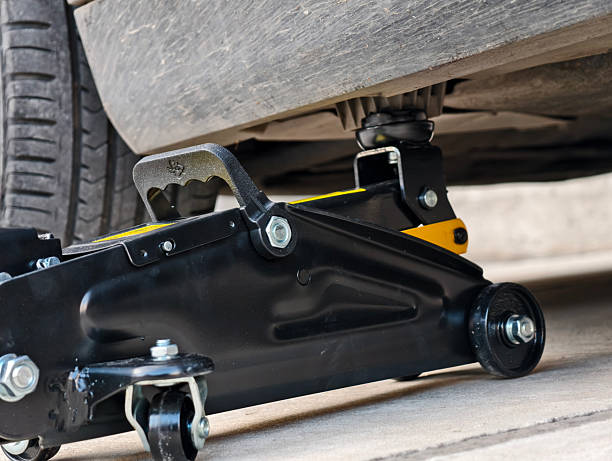
Jack Stands

Jacks and bracket pads: protect vehicle body welding points and improve vehicle lifting safety.

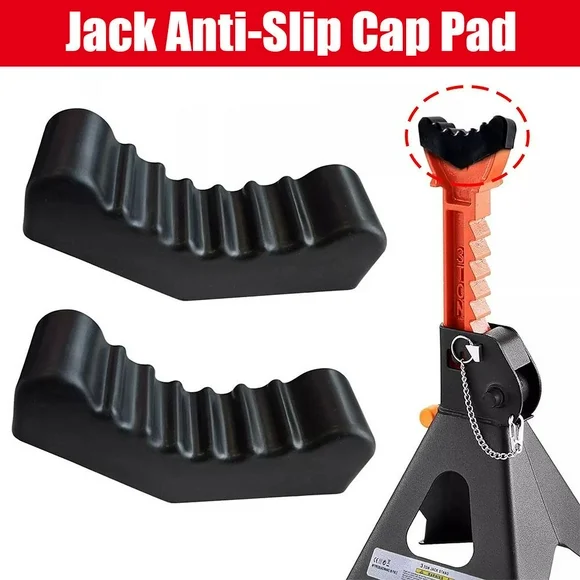
Black anti-slip cap pads designed for use on top of jack stands.

I. Overlooked details: Welding points between the jack bracket and the vehicle body

As more and more car owners choose to perform their own car maintenance and repairs, the DIY garage culture is flourishing. This approach not only saves money but also allows owners to gain a deeper understanding of their vehicles.

However, behind the convenience and cost-effectiveness often lies a potential risk of insufficient awareness. Many people focus on how to properly lift the vehicle but often overlook a seemingly small but crucial detail—protecting the contact point between the jack bracket and the car body.

The core issue is that when the rigid tip of a metal jack bracket comes into direct contact with the pinhole weld on the vehicle’s underbody, it can cause “invisible” damage. Initially, this might manifest as paint peeling and damage to the protective coating, but over time, it can lead to structural deformation and even severe long-term corrosion.

My garage safety experience tells me that these small details are often the root of major problems later on.

The purpose of this article is to reveal these overlooked risks and provide a simple yet crucial solution—Jack Stands Pads—to help you ensure the safety and integrity of your vehicle while enjoying the fun of DIY.


II. Why are the weld points on the car body so fragile?

A. Structure and function of body welding points (Pinch Weld)

Body welding points, typically located beneath the side skirts at the bottom of a vehicle, are a crucial component of the body structure. Their structural feature lies in their formation from multiple layers of high-strength steel sheets through precise folding and spot welding processes, resulting in protruding edges, much like a “sandwich cookie.”

These welding points are not only key to the overall strength of the body but are also contact points designated by the manufacturer for lifting the vehicle, designed to withstand concentrated loads. They ensure that during vehicle lifting, forces are evenly distributed to the body frame, maintaining structural integrity.

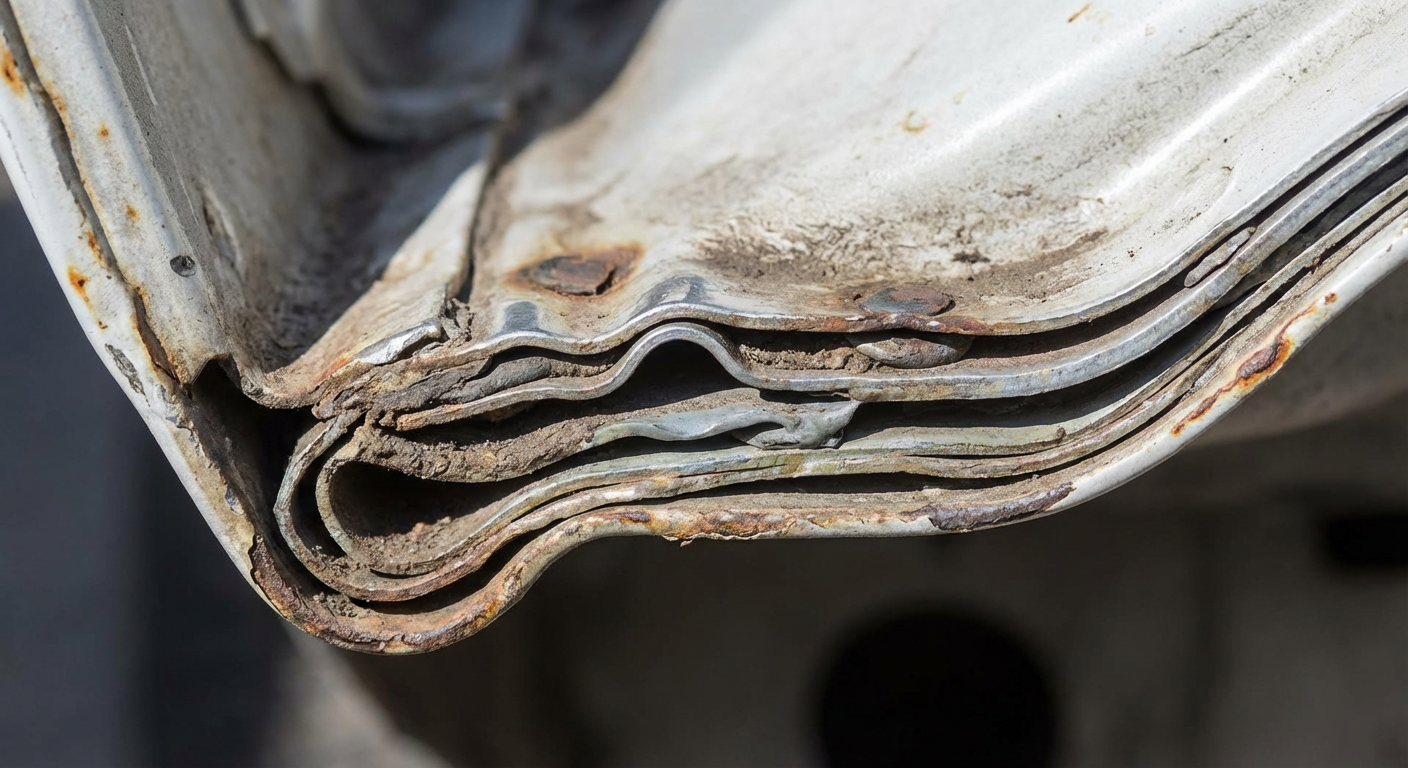
Close-up of severe pinch weld damage caused by improper jack stands contact.

B. Hazard mechanisms of direct contact with metal stents

When the metal tip of a jack stands (whether it’s the common V-groove or a flat top) comes into direct contact with the vehicle’s welded joints, the entire weight of the vehicle is concentrated in a very small contact area due to stress concentration.

This localized pressure can far exceed the material’s yield strength, leading to a series of irreversible damages:

  1. Paint peeling and damage to the anti-corrosion layer: These are the most direct and common types of damage. The paint is the vehicle’s first line of defense, while the anti-corrosion layer prevents the metal from contacting corrosive substances. Once these are peeled off by the sharp edges of metal supports or under high pressure, the underlying steel will be directly exposed to air, moisture, and salt, creating a serious risk of rust.
  2. Plastic deformation of metal: Permanent bending, flattening, or even tearing may occur at the edges of the weld joint. This damage not only affects the vehicle’s appearance, but more importantly, it weakens the structural integrity of the area. The load-bearing capacity of the damaged area will further decrease during subsequent lifts, creating a vicious cycle.
  3. Increased risk of slippage: The coefficient of friction between metal and metal is relatively low. Jack supports are more prone to lateral slippage when the vehicle shakes slightly, the ground is uneven, or the operation is improper. In the accident debriefings I’ve participated in, this slippage has been one of the main causes of vehicle falls, resulting in personal injury and property damage.
  4. Accelerated Corrosion: Once the paint and anti-corrosion coating are damaged, water, salt, road dirt, and chemicals can directly contact the exposed steel. This accelerates the oxidation process, causing corrosion at weld points from the outside in, and even internally. Long-term corrosion not only affects the vehicle’s lifespan but can also lead to structural failure at critical moments, endangering occupant safety.
  5. The cumulative effect of repeated damage: Each lift, without protecting the weld points, applies high pressure repeatedly to the same location. This cumulative effect leads to material fatigue, which may eventually result in more severe and irreversible structural damage during a later lift.
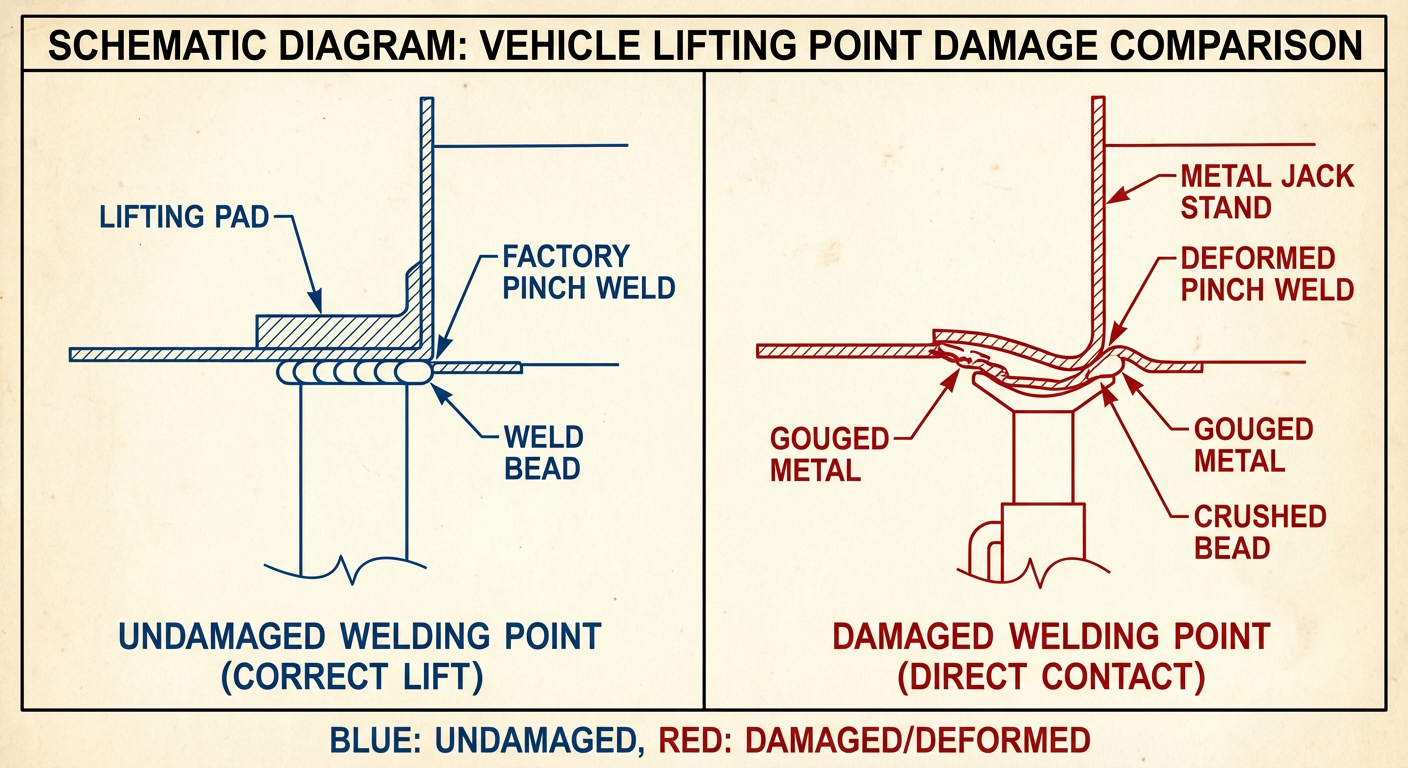
Diagram comparing undamaged vs. damaged vehicle lifting points from metal jack stands.

III. The Science of Jack Stands Pads

Jack support pads are not optional “luxury items,” but essential accessories that ensure the structural integrity of the vehicle and the safety of lifting operations. Through scientific design and material selection, they effectively solve the problems caused by direct metal contact.

A. The principle and advantages of rubber pads

High-quality jack support pads are typically made of high-density rubber or polyurethane materials. Their key advantages are:

  1. Buffering and stress dispersion: These elastic materials effectively absorb and disperse concentrated loads applied to the top of the jack bracket. The softness of the pads allows them to better conform to the surface of the vehicle body welding points, distributing the pressure that was originally concentrated on a small area of the metal bracket evenly over a larger contact area. This is like putting a “shock-absorbing coat” on the vehicle, effectively protecting the paint and the underlying metal structure from indentations and damage.
  2. Increased Friction and Stability: Rubber and polyurethane materials have a naturally high coefficient of friction. When the pad is placed between the jack bracket and the vehicle body, it significantly increases the adhesion between the two, effectively preventing the bracket from accidentally slipping due to slight shaking during vehicle lifting, lowering, or maintenance. This enhanced stability is crucial for personnel working under the vehicle, greatly reducing the risk of the vehicle falling.
  3. Durability and Material Selection: High-quality jack stands pads are not ordinary rubber. They must be abrasion-resistant, oil-resistant, and weather-resistant, able to withstand the weight of the vehicle and the wear and tear of daily use over long periods, while resisting the oil, chemicals, and temperature variations common in garage environments. Choosing pads made of professional-grade rubber or polyurethane is key to ensuring their safety and lifespan.

B. The Necessity and Design of Slotted Adapters

Many modern cars, especially those with a unibody design, have weld joints that are not simply straight structures, but rather have specific grooves or protrusions. In this case, slot adapters become particularly necessary.

  1. Precise positioning and anti-detachment: The slotted adapter is designed to perfectly fit the shape of these original lifting points, firmly “gripping” the weld points and forming a mechanical lock. This precise fit prevents lateral movement of the jack bracket during vehicle vertical lifting or maintenance, effectively preventing the bracket from falling off. This is a significant safety upgrade over traditional V-slot brackets.
  2. General vs. Custom:
    • Universal slot adapter: It is usually designed with a standard-sized V-groove, which is suitable for most jack supports with flat or slightly curved welding points, providing convenient and quick universal protection.
    • Customized slot adapters: Designed for the unique lifting point shapes (such as circular holes or special square slots) of specific car models or brands (e.g., BMW, Mercedes-Benz, Tesla), providing a precise fit. This customized design offers the most perfect fit, optimal protection, and unparalleled stability. Users with higher safety redundancy requirements typically focus on these customized products.
  3. Materials and structural considerations: Slotted adapters are typically made of high-strength rubber or polyurethane in a single molding process to ensure they do not deform or crack under immense pressure. Some high-end products may have an embedded metal core to increase strength and load-bearing capacity, ensuring structural integrity even in extreme conditions and providing double protection.

IV. How to Choose the Right Jacket Mount for Your Car

Choosing and using the correct jack support pads is key to ensuring safe vehicle lifting.

A. Assess the type and size of your vehicle body welding points.

Before purchasing pads, you first need to understand the type of weld points on the bottom of your vehicle:

  1. Flat Pinch Weld: Welds in some older models or specific areas may be relatively flat. In this case, a universal flat-top rubber pad or a pad with a standard V-groove is usually suitable.
  2. Slotted Pinch Weld: More common in modern cars, this type of weld may have more complex shapes, such as deeper grooves, wider edges, or even specific square or round lift holes. For these models, you will need to choose an adapter with a corresponding slot or irregular opening.
    • Consult the vehicle owner’s manual: this is the most authoritative and reliable source for identifying the correct lift point and type. The manual will usually detail the recommended lift point location and the type of tools required.

B. Select matching pads according to the type of jack support.

The design of the jack support pad also needs to match your support type:

  1. Universal flat-top bracket: If your jack bracket has a flat top, you can choose a rubber pad with a flat bottom, a V-groove on the top, or one that can be directly placed on a flat pad.
  2. V-groove bracket: Most jack brackets are designed with a V-groove at the top. In this case, you need to choose a groove adapter that can fit into the V-groove and provide protection, ensuring there is no large gap between them.

C. Precautions during installation and use

After purchasing the right pads, proper installation and use are equally important:

  1. Ensure cleanliness and absence of foreign objects: Before placing the pads, be sure to thoroughly clean the welded joints on the vehicle body and the surface of the pads. Ensure there is no sand, dirt, oil, or other foreign objects that could cause slippage or damage. A clean contact surface is fundamental to ensuring friction and stability.
  2. Place securely and check fit: The shim must be firmly placed between the top of the jack bracket and the welded points on the vehicle body. Before the vehicle is fully lowered onto the bracket, repeatedly check its fit to ensure there is no wobbling, tilting, or gaps. Briefly test the vehicle’s stability to ensure everything is in order.
  3. Regularly check for wear and tear: Before each use, as a garage safety consultant, I always remind everyone to visually inspect all safety tools. Check the pads for cracks, cuts, deformation, or excessive wear. Severely worn pads will lose their original cushioning and anti-slip functions and may even fail under load; they should be replaced promptly.
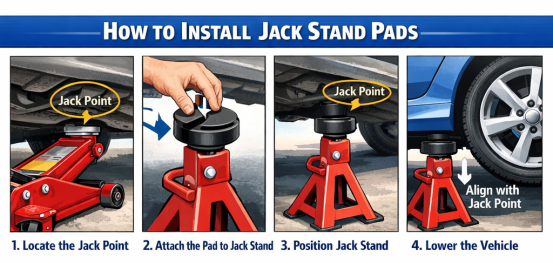
Instructions showing how to properly install protective pads onto jack stands.

V. Constructing a comprehensive vehicle lifting safety system

Jack support pads are one part of the safety system, but to ensure overall safety, more details need to be considered.

A. Select a suitable jack support with the appropriate load-bearing capacity.

This is where I’ve seen far too many people make this mistake. Many mistakenly believe that as long as they buy a 2-ton (4000-pound) support bracket equal to the vehicle’s total weight (e.g., 4000 pounds), they’ll be fine.

I must emphasize that the support bracket’s load-bearing capacity is rated per pair (or per bracket), and what you’re actually lifting is often only half or a corner of the vehicle.

Based on my years of experience in garage safety, I strongly recommend choosing a lift with a capacity at least 1.5 times greater than your actual lifting weight to provide ample safety margin. For example, a sedan weighing 4,000 pounds (approximately 1.8 tons) might be supporting around 2,000-2,500 pounds when lifting its front end. In this case, a pair of 3-ton (6,000 lb) or higher lifts would be a safer choice. For heavier SUVs or pickup trucks (such as the F-150), a 6-ton lift offers even better stability and height.

B. Ground inspection and wheel locks before lifting

  1. Flat, hard surface: Always perform vehicle lifting operations on a hard, flat surface (such as a concrete garage floor). Never use the jack stands on dirt, gravel, grass, or uneven asphalt surfaces, as these surfaces may cause the stand to sink, slip, or tip over.
  2. Wheel brakes: This is the last line of defense against accidental rolling of the vehicle. Always use wheel locks on the diagonally opposite wheels that are not lifted (usually the rear wheels if the front wheels are lifted; or the front wheels if the rear wheels are lifted). Even on flat ground, the handbrake (parking brake) should be engaged and wheel locks used for added safety.

C. Correct identification and use of lifting points

The lifting points for each vehicle are meticulously calculated and tested by the manufacturer, and it is essential to strictly follow the instructions in the vehicle owner’s manual. These points are typically the strongest parts of the vehicle’s structure and the most capable of withstanding concentrated loads.

Avoid unsupported areas: Never place the jack or bracket on undesignated areas such as the exhaust pipe, oil pan, transmission housing, plastic skid plates, suspension arms, brake cables, or brake lines. These areas cannot support the vehicle’s weight and could cause serious vehicle damage (such as crushing the oil pan or damaging brake lines) or more dangerous accidents.

D. Other Alternatives: Advantages and Disadvantages of Car Ramps vs. Wheel Cribs

Jack stands pads are used in conjunction with jack stands, but depending on the repair task, you may also consider other lifting tools:

Tool typeAdvantageShortcomingApplicable Scenarios
Jack supportHeight adjustable, provides good underbody space, and features removable wheels.Stability depends on proper placement and ground conditions, and requires the use of a jack.Tire replacement, brake maintenance, suspension system repair, exhaust system work, etc., require the removal of wheels or extensive undercarriage operations.
Car rampIt has high stability (large contact area), is easy to operate, and is suitable for beginners.The wheels cannot be removed, the height is fixed, low-chassis vehicles may get scratched, and sufficient space is required to drive in.Quick jobs that do not require removing the wheels, such as oil changes, bottom checks, and simple exhaust system checks.
Wheel frameIt provides a wide and stable support surface, is tire-friendly, and is suitable for long-term storage.It usually requires lifting with a jack before being placed; the wheels cannot be removed.For situations where long-term vehicle storage, display, chassis cleaning, etc., require high stability and do not require wheel removal.

Regardless of the tool you choose, stability and error prevention are paramount. Understanding the limitations and best-in-class use cases of each tool, and implementing multiple security measures, is the only way to truly ensure foolproof operation.


VI. Small investment, big safety – Protect your car, starting with the details.

Jacks and jack stands play an indispensable role in vehicle repair safety. They not only protect the vehicle’s exterior but are also crucial for maintaining its structural integrity, preventing costly repairs and potential safety risks caused by minor damage.

We understand your care for your vehicle and your emphasis on safety. We are committed to providing professional solutions that truly solve problems and enhance safety redundancy, ensuring you can approach every DIY project with confidence.


FAQs

A. Do all jack supports require shims (spacers)?
Yes, using spacers is strongly recommended in almost all cases. Even with brackets featuring V-grooves, the metal edges can still damage the paint and structure of the vehicle’s welded joints.
💡 Why it matters: Spacers provide essential cushioning and protection, which is key to reducing risk and extending the life of your vehicle. It is a small investment for maximum safety.
B. Can I use wooden blocks instead of special pads?
In emergency situations, sturdy, crack-free hardwood blocks (such as 2×4 or 4×4-inch blocks) can serve as a temporary alternative, but long-term or regular use is not recommended.

Wood is less stable in density, hardness, and slip resistance than professional rubber/polyurethane blocks. It is prone to rotting from moisture or cracking under pressure, posing serious safety hazards. Professional blocks are tested to distribute pressure evenly and increase friction.
C. How can I determine if the welding points on my car body are damaged?
Carefully inspect the area around the weld joints. You should look for the following warning signs:
  • Paint Damage: Look for scratches, peeling, or fine cracks.
  • Structural Change: Touch the metal to feel for any noticeable bending, flattening, or dents.
  • Oxidation: Reddish-brown rust indicates the anti-corrosion layer is compromised, exposing the metal to air.
Any of these signs suggest that the weld joint may be weakened and requires further inspection to prevent the spread of corrosion.
author-avatar

About Gavin Reid

Gavin Reid has been obsessively analyzing garage safety protocols and vehicle support systems for over a decade. After transitioning from a professional service bay to independent safety consulting in 2020, Gavin realized the market was flooded with confusing weight ratings and compromised designs that offered a false sense of security. His Mission: To help DIY mechanics—especially home hobbyists—identify critical failure points in vehicle lifting and ensure every project ends safely. Why Trust Gavin: Engineering Obsessive: He dissects load paths and weld integrity. From metallurgy to geometric stability, he understands the physics that keep two tons of steel from crushing a human chest. Data-Driven Testing: Gavin has stress-tested 40+ models, evaluating lateral stability and locking redundancy rather than just "marketing tonnage." In the Garage: He’s a fixture in local DIY communities, frequently inspecting frame rails for pinch weld placement and documenting metal fatigue on aging gear. Gavin believes that "a lapse in physics is a permanent mistake." He is dedicated to teaching mechanics how to maintain a "zero-trust" relationship with their equipment. Would you like me to provide Gavin’s specific checklist for identifying structural fatigue in used jack stands?