Jack Stands

Jack Stands: Correct Techniques and Safety Guide for Lifting High-Chassis Vehicles

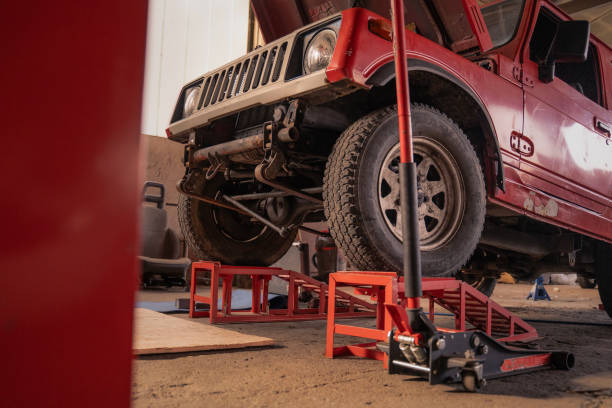
Red Jeep lifted by a floor jack and sturdy red Jack Stands for maintenance.

Have you ever wondered: for high-chassis vehicles, such as SUVs, pickup trucks, or even lifted trucks, the safety challenges of lifting and supporting them far exceed those of ordinary cars? Is my 3-ton jack stand sufficient? How should I support the raised vehicle? Are wooden blocks safe?

If you’re in your garage or driveway preparing for a serious DIY repair of your car, this article will provide you with rigorous and authoritative professional advice from Jack Stands to help you avoid potential risks and complete the work safely and efficiently.

In-depth analysis: The unique challenges of lifting high-chassis vehicles and Jack Stands’ choice

Lifting a vehicle with a raised chassis is not as simple as just inserting a jack bracket. It involves complex principles of mechanics and the wisdom of tool selection.

A. High center of gravity and heavy weight: considerations based on fundamental mechanical principles

The special characteristics of high-chassis vehicles lie in their inherent physical properties:

Vehicle Weight and Local Load Capacity: Choosing the Right Tonnage

A typical sedan weighs around 1.5 tons, while a mid-size SUV or pickup truck can easily weigh 2 or even 3 tons or more. For example, a Ford F-150’s curb weight might be between 4,000 and 5,000 pounds (approximately 1.8 to 2.3 tons).

While a single jack stands typically only needs to support a portion of the vehicle’s weight (e.g., when lifting the front or rear, about half the vehicle’s total weight), considering the uneven loading, swaying, and safety margins in actual operation, choosing a jack stands that far exceeds the vehicle’s local load capacity is crucial. A 3-ton (6,000-pound) jack stands is standard for most SUVs and light trucks, but for heavier or modified vehicles, a 6-ton or even 12-ton jack stands is necessary to provide sufficient safety.

The contradiction between height and stability: The risks of a raised center of gravity.

When a vehicle is lifted, its center of gravity rises significantly. The higher the center of gravity, the worse the vehicle’s stability, and the greater the risk of overturning during lateral swaying or uneven stress. This requires the jack stands not only to reach the required height, but also to provide excellent stability at that height.

B. Common Misconceptions When Choosing Jack Stands: “High enough” does not equal “safe”.

When choosing a jack stands, many people only focus on its rated load capacity, but overlook another crucial parameter for high-chassis vehicles— the maximum extension height.

Limitations of Standard Jack Stands: The Engineering Trade-off Between Height and Load Capacity

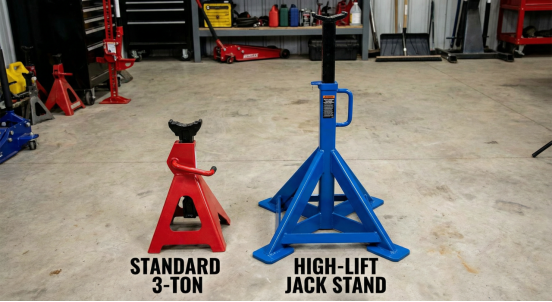
Common 3-ton jack stands typically have a maximum lifting height of around 45-50 centimeters (approximately 18-20 inches). This may be barely sufficient for most factory-installed SUVs or trucks. However, for lifted vehicles or complex operations requiring greater ground clearance, the height of these standard stands is often far from adequate.

High-Lift Jack Stands: Designed for Heavy Vehicles.

To meet the specific needs of high chassis and modified vehicles, there are specialized high-lift jack stands (or Tall Jack Stands for Lifted Trucks) on the market. They typically have the following characteristics:

  • Greater Maximum Extension Height: These brackets are designed to provide a greater lifting range, easily reaching a working height of 60-70 cm (24-28 inches) or even higher, which is sufficient to meet the needs of most lift-modified vehicles.
  • Wider base design: Key to increased stability: When supported at heights, the size of the support base directly determines its anti-tipping ability. High-lift supports typically have a wider and more robust base than ordinary supports, effectively distributing ground pressure and significantly improving stability at extremely high positions.
  • Redundant safety design: Multiple locking mechanisms: Many high-lift brackets are equipped with additional safety pins or dual locking mechanisms, providing a second layer of protection in addition to the ratchet rack, further reducing the risk of accidental slippage.
Comparing a standard 3-ton and a high-lift blue Jack Stand for vehicle support.

C. Prohibited methods of raising the height: The fatal trap of the “wooden block and brick method”

When a jack stands is not high enough, some DIY enthusiasts will try to place blocks of wood, bricks, or even other debris under the stand or between the stand and the car body.

As a consultant who has worked in garage safety for over ten years, I must sternly warn: this is an extremely dangerous and potentially fatal practice!

Material strength and stress analysis: Why wooden blocks and bricks are unreliable

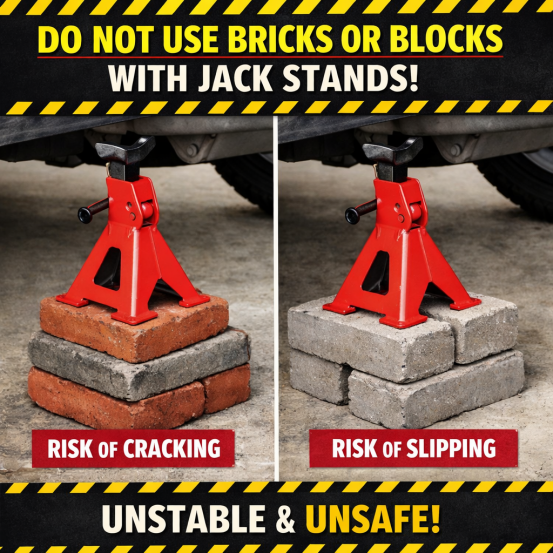
  • Brittleness and structural weaknesses: Although materials such as bricks and cement blocks are hard, they are also brittle and prone to sudden fracture when subjected to uneven vehicle loads or lateral shear forces. Once fractured, the vehicle will instantly lose its support.
  • Uneven stress and slippage: Although wood blocks have a certain degree of toughness, their strength along the fiber direction is much higher than that along the perpendicular direction. When the weight of a vehicle is concentrated on the wood blocks, they may be compressed, cracked, or even slip due to their smooth surface under stress. This is especially true when multiple wood blocks are stacked, as displacement between layers is more likely to occur, creating an unstable “death trap.”
  • Shear force risk: The support point of the jack bracket is usually a small contact surface. When the vehicle shakes or is subjected to force at this point, a strong shear force will be generated. Wood blocks and bricks simply cannot withstand this localized and dynamic shear force.
Warning: Never use bricks or blocks with Jack Stands; it's unstable and unsafe.

Placing a wooden board under the jack base: The only permitted scenario for “elevation” and the correct method.

The only permissible scenario for “elevation” is placing a sturdy, intact, and sufficiently large thick wooden board (e.g., a 2×8 or 2×10 inch hardwood board) under the jack base, and this is limited to dirt, gravel, or asphalt surfaces, to prevent the jack base from sinking. This is not to increase height, but rather to:

  • Distribute pressure: Distribute the local pressure of the stent to a larger ground area to prevent the stent from sinking into soft ground.
  • Provide a stable surface: On uneven ground, provide a flat, solid base to ensure the support is stable.
  • Key points: The wooden board must be flat, free of cracks, and larger than the base of the support frame. It must only be placed between the ground and the base of the support frame. It is strictly forbidden to place any object between the support frame and the vehicle lifting point.

III. Steps for Safely Lifting High-Chassis Vehicles by Experienced Technicians

Safe lifting is a systematic project, and every step must be taken seriously.

A. Everything is ready: Thorough preparations before the ascension

Site Selection: Solid, Level, and Unobstructed.

Choose a flat, level, and hard surface. Concrete surfaces are the best choice. Avoid operating on grass, mud, gravel, or sloping driveways, as these surfaces may cause the jack support to sink, slip, or tip over.

Vehicle inspection and securing: parking brake and wheel stops

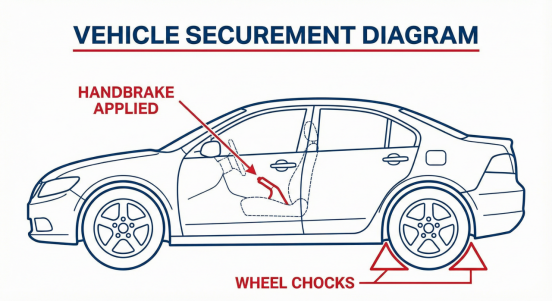
  • Come to a complete stop and engage the parking brake.
  • For the side to be lifted (e.g., lift the front, then secure the rear wheels), place sturdy wheel chocks in front of and behind the wheels that remain on the ground. This is the last line of defense to prevent the vehicle from rolling.
Vehicle securement diagram showing handbrake and wheel chocks, complementing Jack Stands safety.

Read the manual: Know your vehicle’s official lift points.

Every vehicle has manufacturer-specified safe lift points. These points are typically reinforced areas of the chassis, subframe, solid axles, or specific pinch welds. Consult your vehicle’s owner’s manual to find these official lift points. Never place the jack or bracket on fragile or non-load-bearing areas such as the oil pan, transmission housing, exhaust pipe, plastic parts, or suspension arms.

Tool preparation: Select the correct tonnage and maximum height jack stands and hydraulic jack.

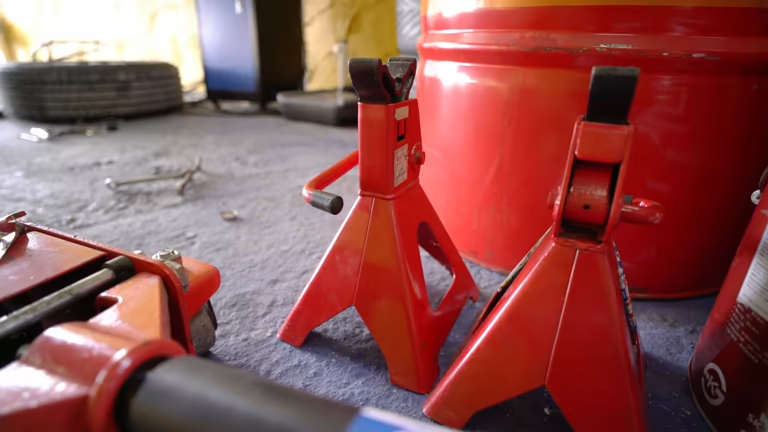
  • Jack stands: Select jack stands with sufficient tonnage and maximum extension height to meet the vehicle’s weight and required lifting height. For heavy-duty pickup trucks or vehicles requiring lifting, 6-ton or even 12-ton tall jack stands are a more reliable choice.
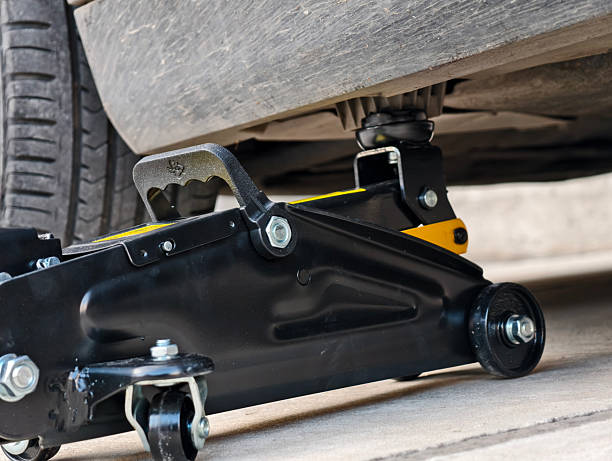
  • Floor Jack: Ensure your floor jack has sufficient load-bearing capacity and lifting stroke to raise the vehicle above the lowest setting of the support frame. For high-chassis vehicles, a long-reach or high-lift floor jack may be required.

I’ve seen far too many problems caused by incompatible tools; small oversights can lead to disaster. Choosing the right tools is the first step to safety.

B. Precision Operation: Lifting and Placing the Support

Slowly lift: Use hydraulic jacks to raise to the appropriate height.

  • Place the hydraulic jack below the designated lifting point on the vehicle.
  • Slowly and smoothly lift the vehicle until it reaches the required height and is high enough to place the jack bracket in place.
  • Ensure the jack is stable and avoid lateral forces: During the lifting process, the jack should always be kept vertical to avoid shearing forces generated by the vehicle’s lateral swaying.

Positioning bracket: Locate the frame longitudinal beam or a designated high-strength point.

  • After the vehicle is lifted to a sufficient height, place the jack bracket under the vehicle’s sturdy frame rails, subframe, or other high-strength support points specified by the manufacturer. These points are typically located behind the wheels (front wheels) or in front of the wheels (rear wheels).
  • Bracket Placement: Ensure stability and avoid pipelines: Ensure the bracket head is level with the vehicle’s contact surface and avoid pressing on vulnerable components such as brake cables, oil lines, electrical wires, or exhaust pipes.
  • Special considerations for high-chassis vehicles: Step-by-step lifting may be necessary. If the vehicle is too high, a single hydraulic jack may not be sufficient to lift it to the required height in one go. You can consider lifting the vehicle partially with the jack, placing sturdy wooden blocks underneath (only between the bottom of the jack and the ground or as temporary support), and then lifting again until the jack stand can be placed. Make sure each step is secure.
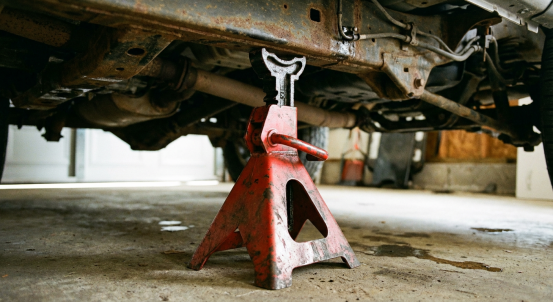
A robust red Jack Stand securely supports a rusty vehicle frame during repair work.

Slow descent: Allow the vehicle to land steadily on the support structure.

  • Once the jack stands is in place and adjusted to the same height (ensuring the vehicle is level), slowly operate the pressure relief valve of the hydraulic jack to allow the vehicle to slowly descend until its full weight is firmly placed on the jack stands.

In my years of experience with garage safety, patience at this stage is key to avoiding accidents; never rush. The contact between the vehicle and the support must be smooth and without impact.

C. Final confirmation: Safety redundancy before operation

Before any body part goes under the vehicle, always conduct a final safety check:

Shaking Test: To verify vehicle stability, gently push and pull the sides and front and rear of the vehicle with both hands, feeling for any shaking or instability. The vehicle should feel rock-solid with no shaking. If any instability is felt, immediately reassess the bracket position and height.

Visual inspection: Check that all jack supports are in place and that the load is evenly distributed.

Walk around the vehicle to carefully inspect that all jack supports are securely placed on their designated support points and that each support has a safety pin inserted (if applicable). Ensure the vehicle is level on the supports to avoid uneven loading.

Additional protection: Consider using the hydraulic jack as a second line of defense

As an extra safety margin, you can slightly press the hydraulic jack against the vehicle’s lifting point again, applying slight pressure but not full weight. This way, even if the jack bracket fails, the hydraulic jack can still provide a second layer of protection.


IV. Safety is a responsibility to your car and family.

Lifting a vehicle for maintenance requires a high degree of focus and proper technique. Choosing the right tools, following rigorous procedures, and always prioritizing safety are not only responsible for your car but also for yourself and your family.

Hopefully, this guide will help you develop a proper understanding of vehicle lifting safety, allowing you to perform every DIY project in your garage with peace of mind and confidence.


Frequently Asked Questions and Safety Tips

Can my 3-ton jack stand support my modified truck?
It depends on the specific weight and lift level of your truck. While a 3-ton pair theoretically supports 6,000 lbs, modified trucks with higher centers of gravity have unique needs:
  • Maximum Extension Height: Standard stands often can’t reach the required working height of lifted trucks.
  • Base Width: Higher lift heights require a wider base for stability.
For modified trucks, we strongly recommend using 6-ton or higher capacity stands with extra-wide bases. Safety redundancy is always a worthwhile investment.
Besides jack supports, what other safer lifting solutions exist?
Depending on your budget and task, consider these professional alternatives:

– Car Ramps: Best for quick fluid changes; offers high stability but wheels cannot be removed.
– Wheel Cribs: High-density supports that are more stable than stands for long-term work.
– Mobile Lifts (e.g., QuickJack): Hydraulically driven systems that lift the whole vehicle; an excellent middle ground.
– Permanent Car Lifts: The ultimate professional solution for maximum safety and convenience.
How to choose a suitable jack stand for high-chassis vehicles?
Pay close attention to these critical parameters:
  • Rated Load: 6-ton or 12-ton models are better for large SUVs and pickups.
  • Maximum Height: Ensure it can comfortably reach the lifting point of your lifted truck.
  • Locking Mechanism: Prefer brackets with security pins or double-locking designs.
  • Base Size: A larger footprint is essential for stability at high extensions.

⚠️ Safety Tip: Never Compromise on the Bottom Line

  • Never work under a vehicle supported solely by hydraulic jacks.
  • Never use a broken, deformed, or cracked jack stand.
  • Never use a jack stand on a slope or uneven ground.
  • Never place items between the bracket and vehicle to gain height.
  • Never lift a vehicle without wheel stops (chocks).

“DIY is fine, but losing control is the problem. Safety is not an option—it is the bottom line.”

author-avatar

About Gavin Reid

Gavin Reid has been obsessively analyzing garage safety protocols and vehicle support systems for over a decade. After transitioning from a professional service bay to independent safety consulting in 2020, Gavin realized the market was flooded with confusing weight ratings and compromised designs that offered a false sense of security. His Mission: To help DIY mechanics—especially home hobbyists—identify critical failure points in vehicle lifting and ensure every project ends safely. Why Trust Gavin: Engineering Obsessive: He dissects load paths and weld integrity. From metallurgy to geometric stability, he understands the physics that keep two tons of steel from crushing a human chest. Data-Driven Testing: Gavin has stress-tested 40+ models, evaluating lateral stability and locking redundancy rather than just "marketing tonnage." In the Garage: He’s a fixture in local DIY communities, frequently inspecting frame rails for pinch weld placement and documenting metal fatigue on aging gear. Gavin believes that "a lapse in physics is a permanent mistake." He is dedicated to teaching mechanics how to maintain a "zero-trust" relationship with their equipment. Would you like me to provide Gavin’s specific checklist for identifying structural fatigue in used jack stands?