Jack Stands

Why can’t we use only one side of the Jack Stands for “tilt-out” work?

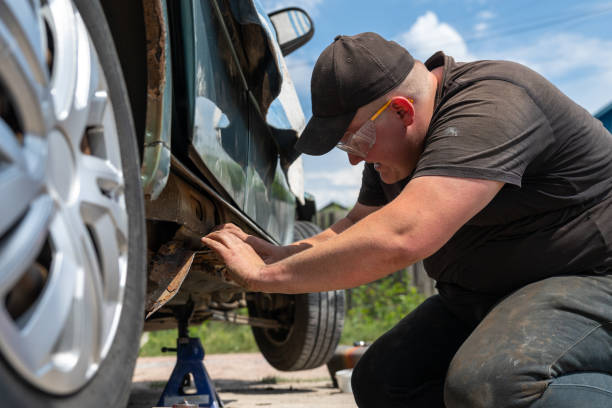
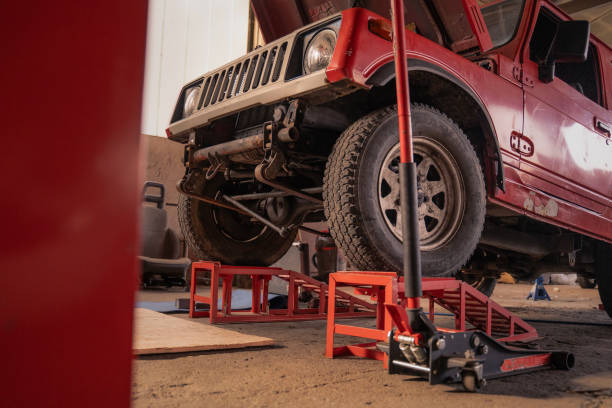
Man using jack stands to safely work on a rusty car's underside.

What you perceive as a “shortcut” might actually be a dangerous one.

Hey friend! Have you ever had this thought: to quickly change the oil, check a part of the chassis, or just want to be lazy, simply use two jacks to lift the front left and rear left of the car, putting it in a “tilted” position? Or just lift the two wheels on one side? I know, the temptation of DIY repairs is huge—it’s cheap and convenient, especially in your own garage.

But these seemingly efficient “shortcuts” often hide huge risks.

Jack stands were originally designed to lift vehicles safely and stably, allowing you to work underneath. However, when misused, especially for unilateral support, their inherent stability is completely compromised.

Today, we’ll delve into the underlying mechanics to reveal the truth, showing you “why” you shouldn’t do this and how to perform vehicle repairs safely.


Mechanical Principles Analysis: Why “Side-Tilt” Supports Are So Dangerous

A. Shift in center of gravity: a fatal imbalance

The stability of a car hinges on its center of gravity . When you place a vehicle on a flat surface, the center of gravity is typically near the vehicle’s geometric center, and all forces are evenly distributed downwards, resulting in a balanced vehicle.

However, this balance is instantly disrupted once you attempt to perform a “tilt-out” maneuver.

1. Vehicle center of gravity: not just the “middle point,” but the core of stability.

A vehicle’s center of gravity is not a fixed point; it adjusts slightly depending on the vehicle’s load distribution, fuel level, and even its posture.

However, when the vehicle is parked smoothly, the projection of the center of gravity always lies within the support surface formed by the four wheels. The larger this support surface, the better the vehicle’s initial stability.

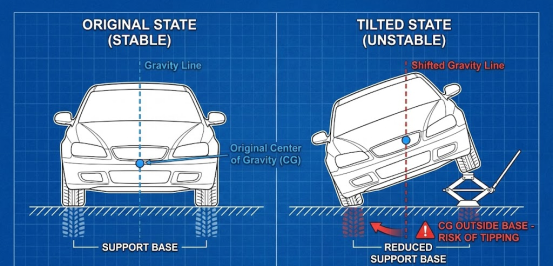
Vehicle Center of Gravity Diagram - showing original COG and how it shifts outside the support base when tilted.

[Image: Vehicle Center of Gravity Diagram, showing the original center of gravity (COG) and the center of gravity after tilting, illustrating how the center of gravity shifts outside the support surface. Alt Text: Vehicle Center of Gravity Diagram – showing the original COG and how it shifts outside the support base when tilted.]

2. How does unilateral support break the balance?

Imagine you’re only supporting one side of the vehicle (say, the front left and rear left). The vehicle will tilt to the right. At this point, the vehicle’s center of gravity will quickly shift to the unsupported right side.

Once the center of gravity moves out of the narrow support area formed by your remaining two Jack Stands and two wheels, a huge overturning moment will be generated . It’s like a seesaw; once the weight shifts off-center, the other end quickly drops.

Based on my years of experience in garage safety, shifts in the center of gravity are the direct cause of most accidents . This artificially created shift in the center of gravity keeps the vehicle on the verge of imbalance. You might think it’s “just a little tilt,” but mechanically, that slight tilt is enough to generate a huge overturning force.

3. A small action, a big risk

When a vehicle tilts, gravity acts in a new direction. If the center of gravity falls outside the support surface of the stand, gravity will generate a moment that causes the vehicle to tip over.

The magnitude of this moment is proportional to the distance the center of gravity has shifted. Even if your Jack Stands are very heavy, they will not be able to perform their intended load-bearing capacity if the force is not vertically downward but accompanied by a lateral component.

B. The test from vertical to lateral

1. The original design concept of Jack Stands: designed for vertically downward loads.

All Jack Stands , whether ratchet-type or pin-type, are designed and strength-calculated based on the premise that they must withstand the vertical downward pressure from the vehicle.

Their support and base structures are designed to effectively transfer the vertical load to the ground.

2. Lateral forces, shear forces, and torsional stresses: Unexpected loads on the support structure.

However, the situation is entirely different during “tilt” operations. The tilted vehicle body exerts lateral forces on the Jack Stands . These lateral forces generate shear stresses, attempting to bend the stand’s uprights or damage the ratchet/pin structure.

Worse still, even a slight slippage of the vehicle on the stand can generate torsional stresses. These are not the primary loads that the Jack Stands are designed to withstand.

  • Key takeaway: A 3-ton Jack Stand means it can safely withstand a 3-ton vertical load, not a 3-ton lateral shear force. In a tilted state, even if the vehicle’s total weight is far below the stand’s rated load capacity, the stand may still fail due to non-vertical forces.
Type of forceJack Stands Design CapacityStress conditions under tilting operationrisk
Vertical pressurehighDecrease, but accompanied by lateral force componentStructural fatigue, poor stability
Lateral shear forceLowSignificantly increasedThe support deformed and overturned.
Torsional stressExtremely lowPossible occurrencesInstant failure

3. The Hidden Killer That Amplifies Risk

Even if you select Jack Stands strictly according to the load-bearing parameters , the ground conditions are equally crucial. A flat, firm concrete surface is ideal.

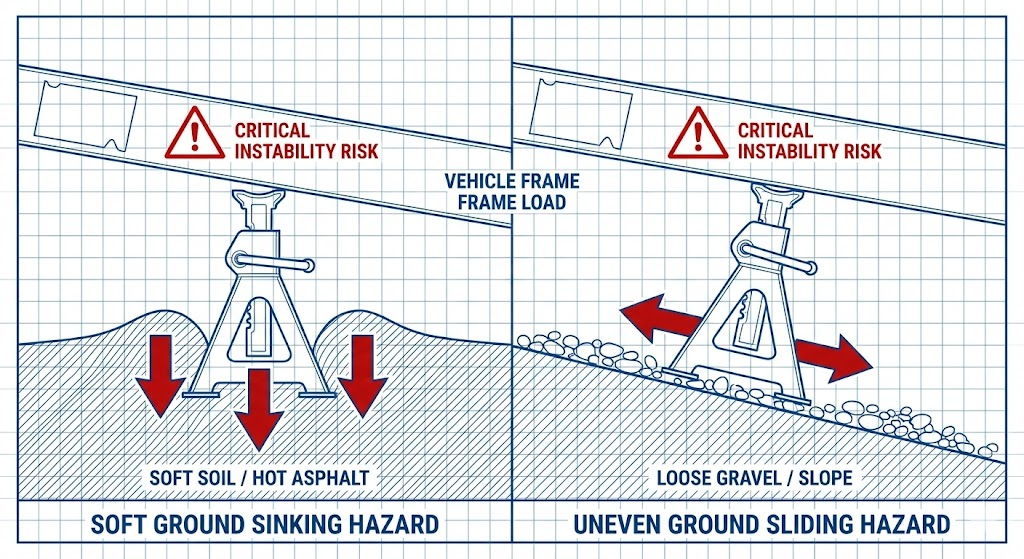
If used on uneven ground, asphalt (which softens at high temperatures), or dirt or gravel, the stability of Jack Stands is highly dependent on the ground conditions .

Safety diagram highlighting sinking and sliding hazards for jack stands on soft/uneven ground.

[Image: Jack Stand on Uneven or Soft Ground Diagram – showing base sinking or sliding risk. Alt Text: Jack Stand on Uneven or Soft Ground Diagram – showing base sinking or sliding risk.]

During side-tilt operations, the vehicle’s center of gravity shifts to one side, causing the support on that side to bear greater pressure, while the support on the other side may be under insufficient support or even suspended in mid-air.

This makes the support base more prone to sliding, sinking, or twisting on the ground, thus instantly losing support.

C. Invisible damage

1. Uneven load on the vehicle chassis: potential structural deformation

When a vehicle is unevenly supported, its chassis experiences unprecedented torsion and stress. Structural components, such as the frame, subframe, and even the body panels, are subjected to stresses outside of their design specifications.

Over time, even without an immediate accident, this can lead to potential deformation of the vehicle ‘s structural components, affecting its handling and safety.

2. Metal fatigue and sudden failure: the accumulation of time and stress

It’s not just the vehicle body that’s affected; the jack stands themselves are also susceptible to uneven stress.

Metal materials undergo fatigue when subjected to alternating or unexpected stresses over extended periods . This fatigue is cumulative and may not manifest immediately, but at a certain “critical point,” the jack stands can suddenly fail without warning.

I’ve seen far too many problems stemming from this detail; a seemingly robust jack stand, when used incorrectly, can be far more fragile than you imagine.

3. The price of “just a little bit more”

In the accident debriefings I’ve participated in, I’ve seen more than once where car owners, simply for a simple oil change, only lifted one side of the vehicle. As a result, perhaps due to a slight slip on the ground, or perhaps because the vehicle’s center of gravity shifted further during the shaking, the Jack Stands collapsed instantly. Luckily, the car was only damaged; unfortunately… the cost was irreparable by any amount of money. Those who took the risk of “just a little bit more” ultimately paid a heavy price.


The Golden Rules for Safely Lifting Vehicles

Now that we understand “why” it’s dangerous, let’s learn “how” to lift a vehicle safely.

A. Choose the appropriate Jack Stands

1. Capacity and Redundancy: It’s better to have too much capacity than too little, and leave sufficient safety margin.

  • The chosen Jack Stands must have a load-bearing capacity significantly exceeding the actual weight of your vehicle. For example, a car weighing 2 tons (approximately 4400 pounds) will require at least one pair of 3-ton stands (3 tons each, for a total support of 6 tons). This extra capacity is your safety redundancy.
  • Typically, the load-bearing capacity of jack stands is calculated per pair, but for safety, I always recommend estimating it based on the load-bearing capacity of a single stand.

2. Stability: Wide base, double locking and anti-slip design

  • Wide base : Ensures the bracket has a sufficiently large contact surface to distribute pressure and reduce the risk of sinking and slipping.
  • Double locking mechanism : In addition to ratchet or pin, it is best to have an additional safety pin or latch to provide double protection.
  • Anti-slip design : The bottom of the bracket should have an anti-slip pad or texture to increase friction with the ground.

3. Quality and Brand: Invest safely and avoid wishful thinking.

Choose a reputable brand and inspect the welding quality and structural integrity.

This investment concerns your life; there is no room for complacency.

B. Selection and placement of the lifting point

1. Consult the vehicle manual: the only authoritative source, irreplaceable.

This is the most crucial step! The lift points on each vehicle are precisely calculated and tested by engineers; they are the strongest and most pressure-resistant locations on the vehicle’s structure.

Never choose lift points arbitrarily , as this could damage the vehicle or cause the support frame to slip. Your owner’s manual is your first line of defense.

2. Use in pairs: Must be placed symmetrically front to back.

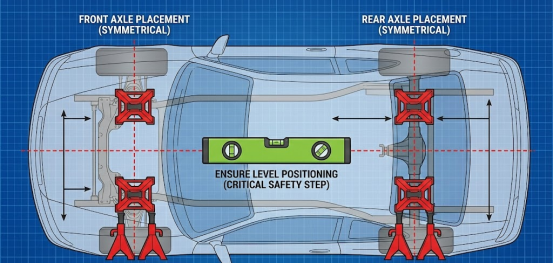
This is crucial! If you need to lift the front of the vehicle, you must use two Jack Stands to support the left and right sides of the front axle . If you need to lift the rear of the vehicle, you must also use two Jack Stands to support the left and right sides of the rear axle .

This symmetrical placement ensures that the vehicle’s center of gravity remains within the stable support surface formed by the supports, and guarantees even force distribution.

  • Key takeaway: Single-point support is a high-risk activity . Whether it’s a jack or Jack Stands , never support a vehicle using only a single point or a straight line.
  • Ensure horizontal alignment : When placing the supports, make sure they are at the same horizontal level and on the same axis.
Overhead view showing correct, symmetrical placement of four jack stands for vehicle support.

[Image: Correct Jack Stand Placement Diagram – showing pairs on front or rear axle, symmetrical and level.]

3. Stable landing: Ensure all supports are evenly stressed and avoid tilting.

After using a jack to lift the vehicle to the desired height, carefully place the jack stands below the designated lifting point.

Then, slowly and smoothly lower the jacks until the vehicle’s weight rests entirely or mostly on the jack stands . Before completely removing the jacks, gently shake the vehicle to confirm that it is absolutely stable on the stands without any wobble or slippage.

C. Safety Redundancy: An extra layer of protection, an extra layer of peace of mind.

1. Auxiliary support: Keep the jack in place, have wooden blocks as backup, or use additional supports.

The core of professional operation is safety redundancy . Even if the vehicle has landed safely on the Jack Stands , I personally recommend:

  • Do not completely remove the jack : keep the jack slightly below the lifting point, maintaining a light contact as an extra safety measure.
  • Use sturdy wooden blocks : Place some sturdy wooden blocks (such as 4×4 square timber) under other sturdy points on the vehicle chassis as emergency supports.
  • Multi-purpose support : If you have the space, use four Jack Stands to support the four corners, or add another pair near the main support points.

Core understanding: Safety redundancy (an extra layer of support) is the core of professional operation . It can effectively reduce the catastrophic consequences of the failure of a single support point.

2. Wheel stops: Prevent accidental slippage, especially when lifting a single axle.

Whether you are lifting the front or rear axle, be sure to place sturdy wheel chocks in front of and behind the wheels that are left on the ground .

This will effectively prevent the vehicle from slipping due to accidental impacts or uneven terrain during maintenance.

3. True security comes from “predictability,” not from “good luck.”

We cannot rely on “good luck” to ensure our safety. Every operation should be based on a full understanding of the risks and strict safety measures. True safety comes from “predictability” —knowing the consequences of each action and being able to effectively avoid potential dangers.


Common Misconceptions and Corrections

A. Myth 1: “I’m just doing a quick oil change, it’s fine, it’s a short time.”

correct: Shorter operation time does not necessarily mean greater safety . Accidents often happen in an instant, regardless of the length of time the operation takes. One mistake can lead to lifelong regret. No matter how simple the operation or how short the time, safety regulations must be strictly followed.

B. Myth 2: “My Jack Stands are very sturdy, no problem, they’re from a big brand.”

correct: Incorrect placement is more likely to cause accidents than product quality . Even the best tools will fail to provide the necessary safety if used improperly. Stability is a systemic issue involving multiple factors such as vehicle center of gravity, bracket placement, and ground conditions, rather than solely relying on the strength of a single component.

C. Misconception 3: “We’ve always done it this way before, and nothing’s ever happened. Isn’t that experience?”

correct: Failures are more valuable for learning than successes . Past instances where “nothing went wrong” only indicate good luck, not that your operations were correct. Professionals always learn from their mistakes and continuously improve their procedures. The price of complacency often arrives when you are least prepared.


DIY is fine, the problem is getting out of control.

Friends, when it comes to vehicle maintenance, safety is always the top priority and there is no room for compromise.

DIY can certainly be fun and rewarding, but only if you are a responsible DIY car owner . This means combining knowledge with practice, having a clear understanding of potential risks, and being willing to invest time and effort to learn and perform correct and safe operating procedures.

I hope this article has given you a deep understanding of the dangers of “tilt-out” bracing and that you have mastered the correct vehicle lifting methods.

Next time you’re about to work in your garage, please think twice and ensure that every operation you perform is predictable and controllable .

author-avatar

About Gavin Reid

Gavin Reid has been obsessively analyzing garage safety protocols and vehicle support systems for over a decade. After transitioning from a professional service bay to independent safety consulting in 2020, Gavin realized the market was flooded with confusing weight ratings and compromised designs that offered a false sense of security. His Mission: To help DIY mechanics—especially home hobbyists—identify critical failure points in vehicle lifting and ensure every project ends safely. Why Trust Gavin: Engineering Obsessive: He dissects load paths and weld integrity. From metallurgy to geometric stability, he understands the physics that keep two tons of steel from crushing a human chest. Data-Driven Testing: Gavin has stress-tested 40+ models, evaluating lateral stability and locking redundancy rather than just "marketing tonnage." In the Garage: He’s a fixture in local DIY communities, frequently inspecting frame rails for pinch weld placement and documenting metal fatigue on aging gear. Gavin believes that "a lapse in physics is a permanent mistake." He is dedicated to teaching mechanics how to maintain a "zero-trust" relationship with their equipment. Would you like me to provide Gavin’s specific checklist for identifying structural fatigue in used jack stands?