Jack Stands

RV owners warn: Stabilizer jacks are not jack stands! Never use them to change a tire.

RVs parked on a serene beach at sunset. Jack stands ensure stability while camping.

recreational vehicles).Today, we’re going to talk about a very serious topic, one that could even be said to be a matter of life and death: the lifting safety of RVs (Recreational Vehicles).

Many RV owners, especially beginners, often have a question when facing tire changes or chassis maintenance: “My RV has stabilizer jacks; can I use them to lift the vehicle?” Now I will take you through an in-depth look at the essential differences between these two tools, reveal the truth about RV lifting safety, and ensure that you can do DIY without any problems.


The true function and limitations of Stabilizer Jacks

Stabilizer Jacks: These are simply “anti-sway legs,” not “load-bearing supports.”

Let’s start with Stabilizer Jacks. As the name suggests, its core word is “stabilizer.” Its design purpose is singular: to reduce RV swaying when stationary, providing a sense of stability, not “weight-bearing.” When you park your travel trailer or 5th wheel and lower these outriggers, you’ll find the vehicle becomes more stable and stops swaying while walking, but that’s where its purpose ends.

From an engineering perspective, stabilizer jacks are typically constructed of lightweight steel or aluminum alloy. Their load-bearing path is not designed for vertical load-bearing but rather to distribute lateral forces and prevent the vehicle from swaying from side to side.

Their load-bearing capacity is extremely low, usually only a few hundred pounds, far from sufficient to support the overall or partial weight of the vehicle. Forcing the vehicle’s weight onto Stabilizer Jacks is akin to asking a frail child to lift a thousand-pound object—the inevitable result is structural bending, breakage, or even the more catastrophic event of RV rollover.

The nominal load capacity of a tool does not mean that it can withstand dynamic impacts or complex stresses under long-term static loads. Stabilizer jacks are designed from the outset to be unsuitable for lifting.


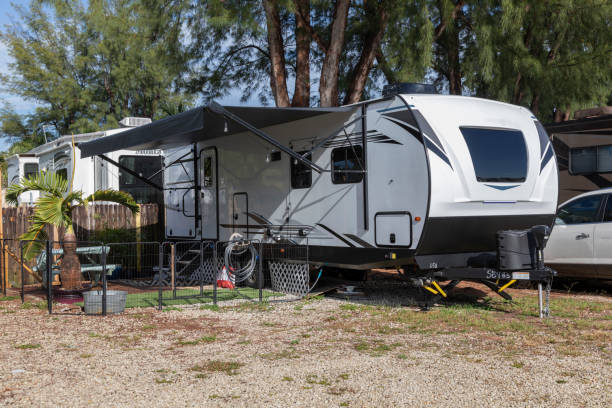
Modern travel trailer with awning deployed in an RV park. Always use jack stands for leveling.

Jack Stands: The “stabilizing force” for RV lifting safety.

Since Stabilizer Jacks is incapable of fulfilling the role, who is the true “heavyweight hero”? The answer is Jack Stands.

Understanding the design philosophy of Jack Stands: load-bearing capacity, stability, and redundancy

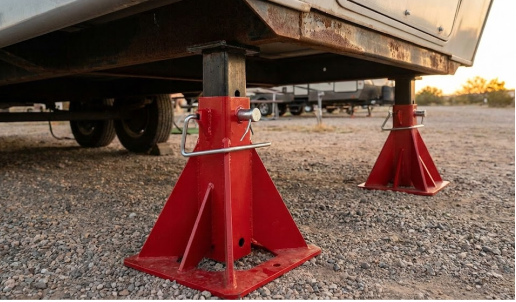
Jack Stands are designed with a completely different philosophy than Stabilizer Jacks . They are specifically designed to support the weight of a vehicle, providing stable, long-term support. They are typically made of heavy-duty steel and feature a wide base and multiple locking mechanisms (such as ratchet or pin-type) to ensure absolutely reliable support once the vehicle is lifted.

From a mechanical perspective, Jack Stands are designed for vertical load-bearing, ensuring vehicle stability. The wide base provides a larger contact area with the ground, significantly enhancing its anti-rollover capability and effectively reducing the risk of sinking on potentially soft surfaces such as asphalt.

jack standSingle-point support is a high-risk activity . Unlike the distributed stability of stabilizer jacks, each Jack Stand independently bears enormous vertical pressure when under load, making its own stability and load-bearing capacity crucial.

.Safety redundancy (an extra layer of support) is at the heart of professional operation .

support orIn the field of garage safety, we always emphasize “an extra layer of protection, an extra layer of peace of mind.” This means that even if your jack stands are theoretically sufficient to support the vehicle, we still recommend taking additional safety measures where possible, such as placing a hydraulic jack (floor jack) nearby as a backup support, or using wheel chocks to prevent the vehicle from sliding.

Close-up of sturdy red jack stands supporting an RV trailer on gravel.

Choosing and Considering RV-Specific Jack Stands: Heavy-duty and Wide Bases are Key

jack standsFor RVs, especially large vehicles like travel trailers and 5th wheels with high centers of gravity and heavy weight, the requirements for the stability and load-bearing capacity of Jack Stands are much higher than for ordinary cars.

  • jack stands.Capacity Selection: Choose 6-ton or higher capacity Jack Stands . An RV can easily weigh several tons, and even lifting just one corner can result in a significant local weight. Choosing a load-bearing capacity far exceeding the RV’s single-point or half-vehicle weight is the first step in establishing safety redundancy.
  • Base Design : Emphasizing the importance of a wide base . A wide base distributes the vehicle’s weight over a larger area, reducing ground pressure and effectively preventing jack stands from sinking on soft surfaces such as asphalt or mud.

    Core Concept: The stability of jack stands is highly dependent on ground conditions.


  • Height Adjustment and Locking : Ensure your Jack Stands have a reliable height adjustment and locking mechanism. Pin-type mechanisms are generally more robust than ratchet-type, but ratchet-type is more convenient for quick adjustments. Regardless of the type, ensure it is fully locked in place.

Shifting center of gravity is the direct cause of most accidents. When lifting a vehicle with a high center of gravity, such as an RV, any slight sway or tilt can quickly cause a shift in the center of gravity, leading to disaster. Therefore, choosing stable and reliable jack stands is crucial.

Jack Stands of different tonnages: Applicable RV types and safety factors

Jack Stands TonnageApplicable vehicle types (example)RV Suitability (Recommendation)Safety considerations
3 tonsSmall cars/SUVsNot recommended for use in RVsInsufficient load-bearing capacity and poor stability pose extremely high risks to RVs.
6 tonsMedium-sized trucks/SUVsTravel Trailer / Small 5th WheelMinimum safety settings are required; operate with caution and ensure the ground is flat and hard.
10/12 TonHeavy trucks/large RVsLarge 5th Wheel/Class A/C MotorhomeRecommended , providing ample safety redundancy, more suitable for heavy-duty RVs

DIY Tire Change or Chassis Maintenance: Safe Operating Procedures and Warnings

Step-by-step guide to properly lifting an RV

  1. .A flat, firm surface : This is the first and most crucial step. Ensure you are working on concrete or compacted gravel surfaces, avoiding any slopes or loose soil. Core understanding: The stability of jack stands is highly dependent on ground conditions .
  2. Wheel Chocks: Place wheel chocks in front of and behind the wheels when the vehicle is not lifted to prevent it from accidentally sliding during lifting. This is the last line of defense against RV rolling.
  3. Proper Floor Jack: Select a hydraulic floor jack of appropriate tonnage and in good condition. For RVs , you may need a low-profile or long-reach jack to reach deeper jacking points .
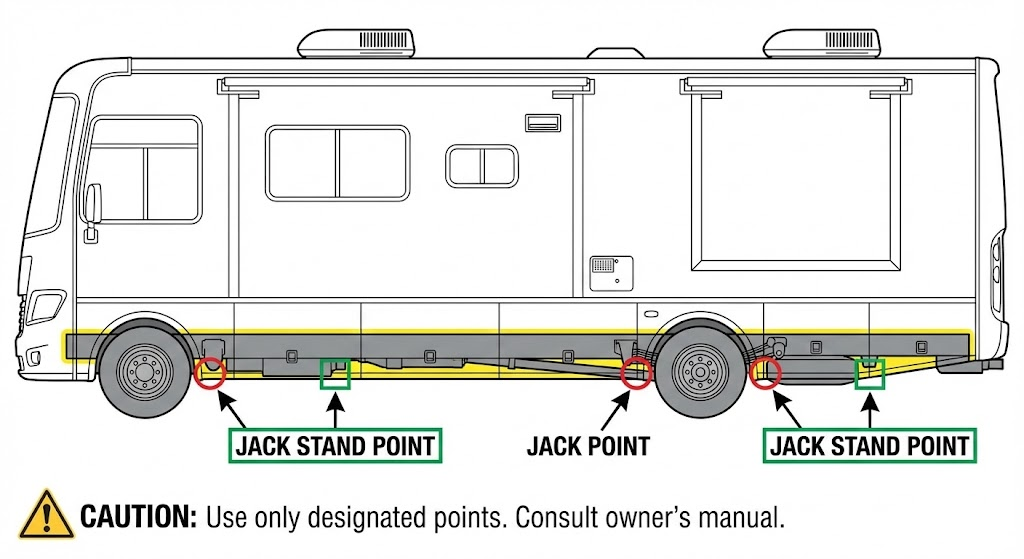
  4. .Jacking Points : Lift strictly according to the frame or bearing points specified in the RV manufacturer’s manual . These points are structurally reinforced points calculated by engineers to withstand lifting pressure. Never place the jack or jack stands on the oil pan, plastic parts, exhaust pipe, drive shaft, or any non-specified bearing points. Key takeaway: Incorrect placement causes accidents more often than product quality issues. .
  5. jack standsJack Stands Placement .: Securely place the :Jack Stands under the support points, ensuring they are at the same height and fully locked. If lifting the entire shaft, place one on each side.
  6. Slight shaking test:jack stands Before entering the bottom of the RV,: gently shake the vehicle to ensure it is absolutely stable on the jack stands., If the vehicle shakes at all, readjust.
  7. .Hydraulic jacks as backup : After lifting and placing the jack stands , the hydraulic jacks can be lowered slightly so that they no longer bear the main weight, but still remain in contact with the frame, as an additional safety redundancy. Core concept: Safety redundancy (an extra layer of support) is the core of professional operation .

Diagram illustrating proper jack stand points and jack points for an RV.

Building Your Garage Security Fortress: Respect and Selection of Tools

Beyond parameters, understand the “personality” of the tool.

In the world of RV maintenance, we can’t just stay at the “common sense” level; we must also deeply understand the “characteristics” and limitations of the tools. Investing in the right tools is investing in your life and property safety. For large vehicles like RVs, you can never have too much safety redundancy.

Core understanding: True safety comes from “predictability,” not luck. We cannot rely on luck for safety; instead, we must ensure that every step is under control through professional knowledge, the right tools, and rigorous operations.


Safety is paramount; professionalism ensures peace of mind.

Stabilizer Jacks and Jack Stands , though similar in name, serve completely different functions. The former provides “stability,” while the latter provides “safety support.” Using them interchangeably is tantamount to playing with fire. As a garage safety consultant, I hope every DIY RV owner will treat tools with reverence, choose the appropriate tools, and strictly adhere to operating procedures. DIY is certainly fun, but this fun must be built upon controllable risks. Remember, your RV deserves to be treated with the utmost safety.


Frequently Asked Questions (FAQ)

Are RV’s Stabilizer Jacks really unusable for lifting vehicles?

Yes, absolutely not. Stabilizer Jacks are designed to prevent RVs from swaying when parked, not to bear all or part of the vehicle’s weight. Their structural strength is insufficient to support the forces required for lifting; forcing them to be used will damage them or even cause the vehicle to overturn, posing serious safety risks.

Remember, load-bearing capacity ≠ actual safety; they are for stability, not lifting.
What size Jack Stands should I choose for my RV?

For RVs, we strongly recommend choosing Jack Stands with a capacity of at least 6 tons or more. Given the weight and high center of gravity of RVs, higher tonnage provides greater safety margin and stability.

Be sure to choose Jack Stands with a capacity far exceeding the actual load-bearing requirements based on your RV’s Gross Vehicle Weight Rating (GVWR) and single-point load-bearing needs. Also, choose Jack Stands with wide bases to accommodate the RV’s weight and reduce ground stress.

Besides Jack Stands, what other tools can securely support RV?

Besides jack stands, a professional car lift is the safest long-term support solution, but it’s expensive and requires fixed installation. For DIY users, heavy-duty wheel chocks are also a good option, offering a larger contact area and stability.

Regardless of the support tool used, a heavy-duty hydraulic jack must be used in conjunction with the lift, and wheel chocks should always be used to ensure the vehicle doesn’t slip.

Remember, single-point support is a high-risk activity, and true safety comes from “predictability,” not luck.
author-avatar

About Gavin Reid

Gavin Reid has been obsessively analyzing garage safety protocols and vehicle support systems for over a decade. After transitioning from a professional service bay to independent safety consulting in 2020, Gavin realized the market was flooded with confusing weight ratings and compromised designs that offered a false sense of security. His Mission: To help DIY mechanics—especially home hobbyists—identify critical failure points in vehicle lifting and ensure every project ends safely. Why Trust Gavin: Engineering Obsessive: He dissects load paths and weld integrity. From metallurgy to geometric stability, he understands the physics that keep two tons of steel from crushing a human chest. Data-Driven Testing: Gavin has stress-tested 40+ models, evaluating lateral stability and locking redundancy rather than just "marketing tonnage." In the Garage: He’s a fixture in local DIY communities, frequently inspecting frame rails for pinch weld placement and documenting metal fatigue on aging gear. Gavin believes that "a lapse in physics is a permanent mistake." He is dedicated to teaching mechanics how to maintain a "zero-trust" relationship with their equipment. Would you like me to provide Gavin’s specific checklist for identifying structural fatigue in used jack stands?