Jack Stands

Jack Stands Ultimate Guide to New Energy Vehicles: A Comprehensive Analysis of Electric Vehicle Battery Safety and Compatibility

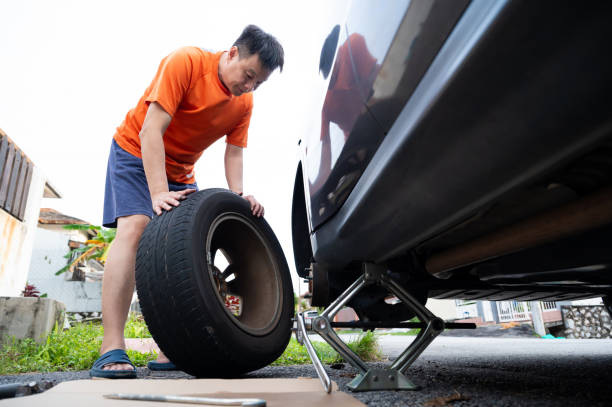
Man changing a car tire, with the vehicle securely supported by jack stands.

As new energy vehicles, especially electric vehicles like Tesla, begin to become commonplace in our garages, a major safety hazard that many people overlook has emerged – vehicle lifting safety.

You might think that lifting a vehicle is as simple as finding a jack and putting up a few Jack Stands, right? For traditional gasoline-powered cars, this process might be ingrained in your DNA. But for electric vehicles, especially those with battery packs all over the chassis, traditional experience might cost you far more than you expect.

DIY is fine, but losing control is. Today, I’ll take you through the unique challenges of lifting new energy vehicles to ensure every operation you perform is flawless.


I. The “Hidden Landmines” in the Chassis of New Energy Vehicles: Why are Traditional Lifting Methods No Longer Safe?

Although both gasoline-powered and electric vehicles have four wheels, they differ fundamentally in their underlying structure. These differences are the fundamental reason why we must re-examine safety strategies when lifting electric vehicles.

A. Structural differences between new energy vehicles and gasoline vehicles: center of gravity, weight, and chassis layout

1. Battery Pack: The Fragile Yet Core “Lifeline”

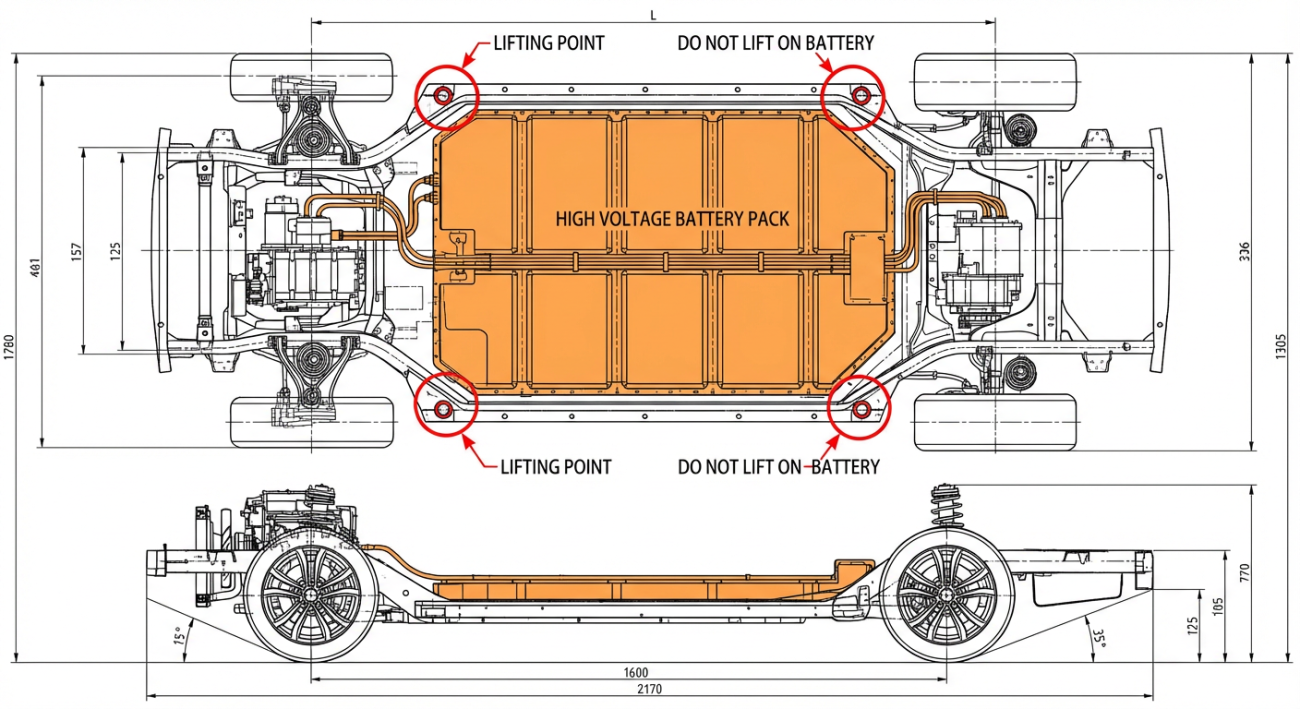
The core power source of an electric vehicle—the battery pack—is typically designed in a flat shape and integrated under the vehicle’s chassis. This not only lowers the vehicle’s center of gravity and improves driving stability, but also brings new challenges. This massive battery pack, although protected by an outer shell, has a complex and precise internal structure, making it extremely sensitive to localized stress concentrations. In my experience reviewing accidents, I’ve seen far too many cases where improper selection of support points led to deformation of the battery pack’s outer shell and even damage to its internal structure. Once the battery pack is damaged, it can range and performance issues, or even cause thermal runaway, with repair costs often reaching tens or even hundreds of thousands of yuan—far exceeding the cost of overhauling the engine or transmission of any gasoline-powered vehicle.

Technical drawing showing EV lifting points for safe use with jack stands.

2. Heavier Curb Weight: A Severe Test for Support Tools

Due to their massive battery packs, new energy vehicles generally have a higher curb weight than comparable gasoline-powered vehicles. For example, a Tesla Model 3 can weigh between 1.8 and 2.2 tons, while a Model S/X can exceed 2.5 tons. This means that even lifting just one corner of the vehicle results in a much greater single-point load than you might imagine. This extra weight places higher demands on the load-bearing capacity of jacks and Jack Stands. If support tools designed for lightweight gasoline-powered vehicles are continued to be used, their safety margin will be significantly reduced, and the stability of the Jack Stands under extreme conditions will become highly questionable.

B. Limitations of traditional jacks and Jack Stands: Potential disasters caused by misuse

  • 1. The Risk of Damaging the Battery Pack: Repair Costs Far Exceeding Expectations.Traditional jacks and Jack Stands typically have a small contact surface, designed to engage with the frame, chassis, or suspension points of gasoline-powered vehicles. However, the chassis of electric vehicles is not entirely robust. Placing these tools directly under the battery pack or on unreinforced chassis sheet metal creates significant localized pressure at the sharp contact points. This can dent the chassis or even penetrate the battery pack casing, damaging the internal cells. This is not only property damage but also a potential safety hazard. This is a risk that any cautious DIY enthusiast must strive to avoid.
  • 2. The Pitfalls of Support Point Selection: The Fine Line Between “Safety” and “Danger”Gasoline-powered vehicles typically have clearly defined lift points, such as the frame beams, subframes, or reinforced chassis edges. However, electric vehicles, especially Teslas, have chassis designs that prioritize battery pack integrity, resulting in a very limited and fixed number of dedicated lift points. These points are usually specially reinforced to distribute lifting forces evenly. If you mistakenly place the Jack Stand in an undesignated location, such as the battery pack edge, plastic skid plates, or unreinforced chassis areas, what you perceive as “safety” can instantly turn into “danger.”

C. My experience: The price paid for “luck”

I once participated in an accident debriefing where a car owner, while changing a tire, didn’t use the dedicated adapter and instead jacked up the edge of the Tesla Model Y’s battery pack. Although the vehicle was initially lifted, when the owner attempted to insert the Jack Stand, a slight shift in the center of gravity caused the car to suddenly tilt to one side. While it didn’t completely slip, the battery pack casing was severely cracked. Subsequent inspections revealed that some internal battery cells were compressed, resulting in six-figure repair costs. This incident reaffirmed for me that a high degree of vigilance against “parameter worship” and “gambling mentality” is absolutely not unfounded. DIY is certainly enjoyable, but safety should always be the top priority.


II. Core Principles of Safe Lifting of New Energy Vehicles: Specialized Tools and Operating Points

Since traditional methods are risky, how can we safely lift new energy vehicles? The answer lies in “dedicated vehicle for dedicated use” and “strict operation”.

A. Puck Adapters : The “Airbags” of New Energy Vehicles

1. What is a Puck Adapter? Why is it indispensable?

A Puck Adapter, literally translated as “puck adapter,” is typically made of high-strength rubber or polyurethane. It’s not an optional accessory, but an essential component for the safe lifting of new energy vehicles. Its core functions are:

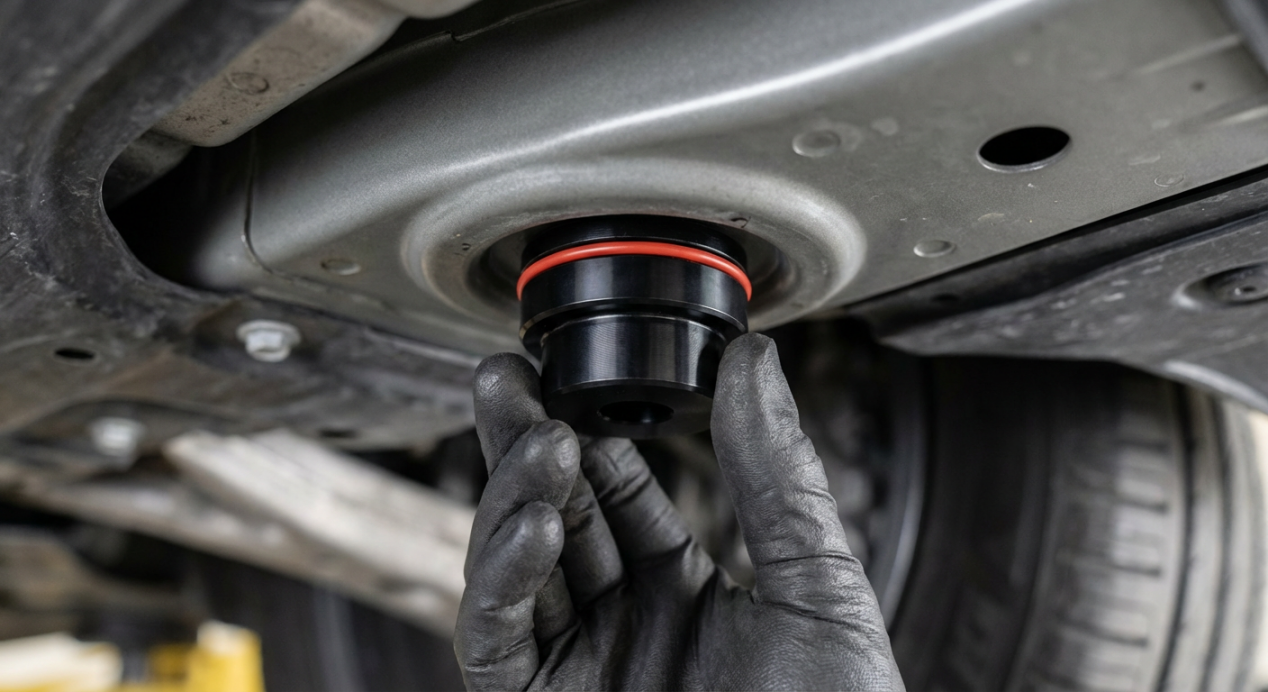
  • a. Material and Design Principles: Distributing Stress and Protecting the Battery The Puck Adapter is designed to convert the point load of a jack or Jack Stand into a surface load. It typically has a raised, cylindrical section that precisely inserts into the pre-drilled lifting hole in the electric vehicle’s chassis, while its flat bottom provides a wide and stable contact surface for the jack or Jack Stand. This special design ensures that the lifting force is evenly transmitted to the vehicle’s reinforced structure, avoiding direct compression and damage to the battery pack or weak areas of the vehicle body. The high-strength rubber material also provides sufficient cushioning and friction to prevent the vehicle from slipping during lifting.
  • b. Compatibility with Different Models: Tesla Model 3/Y/S/X and Other EV Brands Although the principle is similar, the shape, size, and depth of the chassis lifting holes may differ between different brands and models of electric vehicles. For example, the Tesla Model 3/Y/S/X series typically requires a specific size Puck adapter. Before purchasing, always ensure the adapter is fully compatible with your vehicle. An incorrect adapter may not provide adequate protection or could even get stuck in the liftgate.
Hand installing a jack pad adapter for safe car lifting with jack stands.

2. How to use a Puck Adapter correctly: Installation and Inspection

When using a Puck Adapter, first ensure the lift hole is clean and free of obstructions. Securely insert the adapter into the lift hole, ensuring it is fully seated and without any wobbling. When placing the jack or Jack Stand, center it on the adapter to ensure even weight distribution. This seemingly simple detail is crucial; any tilting or misalignment can cause the adapter to malfunction or even cause the vehicle to slip.

B. Choosing the right Jack Stands : a dual consideration of load-bearing capacity and stability

Even with the Puck Adapter, the choice of the Jack Stands themselves is crucial.

1. Why do EVs need higher load-bearing capacity Jack Stands?

a. Vehicle Gross Weight vs. Single-Point Load Capacity: Safety Margin Calculations
We already know that electric vehicles are heavier. The load-bearing capacity of a Jack Stand usually refers to the maximum safe load capacity of a “pair” or “single”. However, in practice, we need to consider more than just the theoretical weight of the vehicle. When lifting a vehicle, the weight is not evenly distributed. Add to that tool wear, minor unevenness of the ground, and even slight shifts in the vehicle’s center of gravity during maintenance, all of which can generate instantaneous loads exceeding theoretical calculations. Therefore, I always emphasize that the load-bearing capacity of the Jack Stands must far exceed the weight you actually lift to provide sufficient safety margin. It is generally recommended that the rated load capacity of a single pair of Jack Stands should be at least 1.5 times the vehicle’s curb weight.

2. Recommended Load Capacity: 2 Tons, 3 Tons, 6 Tons – How to Choose?

For most compact and mid-size gasoline vehicles, a pair of 2-ton (4000 lbs) Jack Stands might be “sufficient.” However, for electric vehicles, this “sufficient” mentality is extremely dangerous.

Example EV ModelApproximate Curb WeightRecommended Minimum Pair CapacityOptimal Safety Margin Suggestion
Tesla Model 3/YApprox. 1.8 – 2.2 tons3 tons (6,000 lbs)6 tons (12,000 lbs)
Tesla Model S/XApprox. 2.0 – 2.5 tons3 tons (6,000 lbs)6 tons (12,000 lbs)
Other mid-size EVs (such as the Volkswagen ID.4)Approximately 2.0 – 2.3 tons3 tons (6,000 lbs)6 tons (12,000 lbs)
Heavy-duty EV pickups/SUVs (such as the Rivian R1T)Over 3 tons6 tons (12,000 lbs)12 tons (24,000 lbs) or more

My recommendation is to prioritize Jack Stands with a load-bearing capacity of 6 tons (12,000 pounds) or higher for any electric vehicle. These not only offer greater safety margins but also typically have a wider base and a more robust structure, which is crucial when dealing with the high weight and potential shifts in the center of gravity of an electric vehicle.

3. The structure and safety of the Jack Stands: wide base and double locking mechanism.

In addition to load-bearing capacity, the physical structure of the Jack Stand is also directly related to safety.

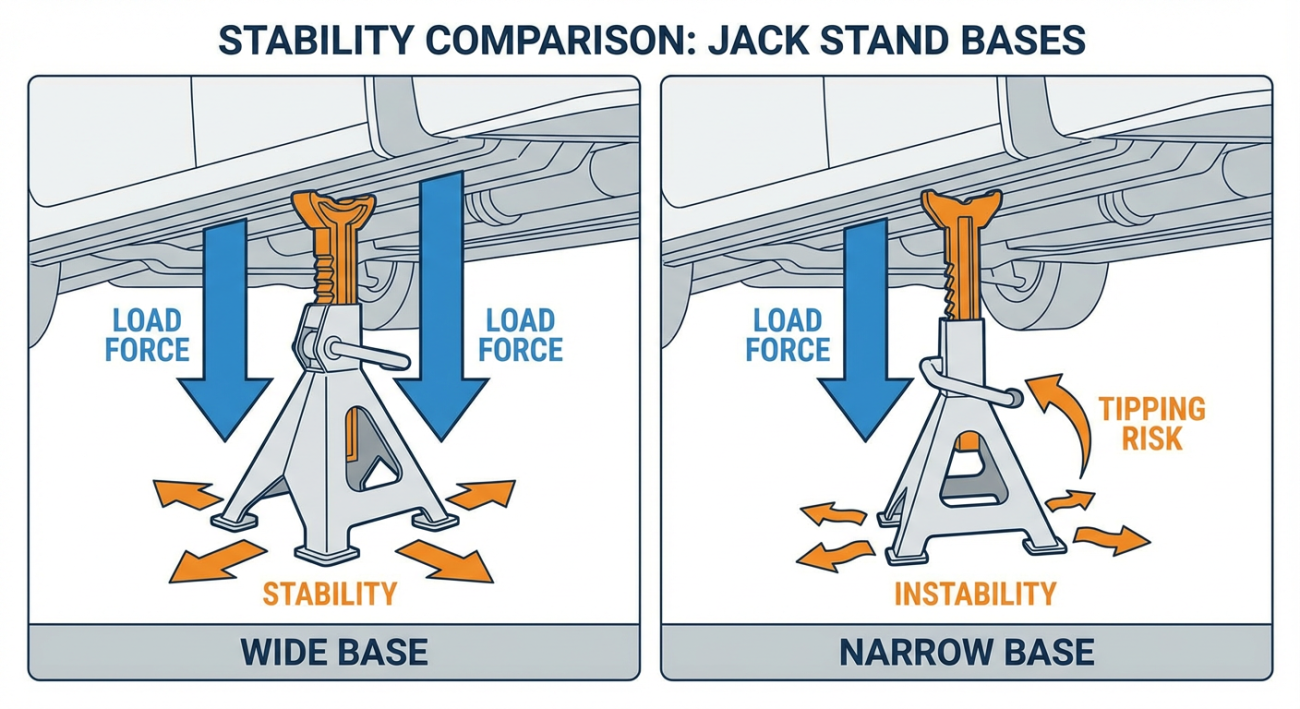
  • 1. Wide base: A wide base provides a larger contact area, effectively distributing ground pressure and preventing the Jack Stand from sinking on soft surfaces (such as asphalt heated in summer), while also significantly improving resistance to lateral overturning. This is based on a fundamental principle of mechanics: the wider the base, the better the stability.
  • 2. Dual locking mechanism: Most Jack Stands use a ratchet locking system, but safer models add an extra pin locking mechanism. This means that even if the ratchet mechanism fails unexpectedly due to vibration or wear, the pin acts as a second line of defense to prevent the Jack Stand from suddenly collapsing. Based on my years of experience in garage safety, this redundant design is a critical guarantee of life safety and should never be omitted.
Diagram comparing stability of wide versus narrow base automotive jack stands.

C. The “Golden Three Steps” Before Lifting: Site Selection, Inspection, and Redundancy

Before you begin, please be sure to perform these three key steps:

  1. Flat, firm surface: To prevent the Jack Stand from sinking or slipping, always operate on a flat, firm, dry surface. Concrete is the best choice. Avoid lifting vehicles on grass, dirt, gravel, or sloping surfaces. These surfaces may cause the Jack Stand to sink, slip, or the vehicle to roll uncontrollably during lifting. Even asphalt surfaces can soften at high temperatures; it is recommended to place a sturdy wooden board or steel plate under the Jack Stand to distribute pressure.
  2. Inspect Your Tools: Wear, Deformation, and Recall Risks. Before each use, carefully inspect your jack and Jack Stands. Look for cracks, deformation, weld cracks, rust, or any malfunctions. Pay particular attention to the Jack Stand’s ratchet mechanism and locking pins; ensure they operate smoothly and lock reliably. I’ve seen far too many near-misses where minor Jack Stand deformation went undetected, leading to sudden tilting while lifting heavy vehicles. Additionally, check for brand recalls. For example, Harbor Freight recalled certain batches of Pittsburgh Automotive 3-ton and 6-ton Jack Stands in 2020 due to a risk of sudden collapse. Tool reliability is the first line of defense for your safety.
  3. Redundancy safety: spare jacks and wheel stops Never rely solely on the Jack Stands! After lifting the vehicle onto the Jack Stands and confirming its stability, I strongly recommend leaving the jack under the vehicle and slightly raising it as an extra safety margin. It doesn’t bear the main weight, but it provides valuable buffer time in case the Jack Stand fails. Wheel locks are also essential. Lock the rear wheels when lifting the front of the vehicle; lock the front wheels when lifting the rear. This effectively prevents the vehicle from rolling accidentally during support.

III. Lifting Operation Procedures and Common Misconceptions for New Energy Vehicles

By following the correct operating procedures and being vigilant against common mistakes, risks can be minimized.

A. Detailed Explanation of Safe Lifting Procedures

  1. Preparation: Park, brake, and place wheel chocks. Park the vehicle on a flat, firm surface of your choice. Engage the handbrake (or electronic parking brake) and shift the transmission into Park (P). Place reliable wheel chocks in front of and behind the tires that will not be lifted.
  2. Locating and confirming the lift points: Refer to the owner’s manual. This is the most crucial step. Please be sure to consult your electric vehicle’s owner’s manual to confirm the manufacturer-specified lift point locations. These points are usually reinforced metal areas under the chassis, and some will have specific grooves or markings. For Teslas, these points are typically four ring-shaped holes, requiring the Puck Adapter. Never guess or randomly select lift points based on experience.
  3. Place the Puck Adapter and Jack: Securely insert the Puck Adapter into the lift point with precision and smoothness. Then, push your hydraulic jack (Note: Never use the simple scissor jack provided with your vehicle for repair work) under the adapter. Ensure the center of the jack’s lifting plate is precisely aligned with the center of the adapter. Slowly and smoothly lift the vehicle, observing its posture to ensure there is no tilting or abnormality.
  4. Slowly lift and position the Jack Stand: After the vehicle has been jacked up to a sufficient height, place the Jack Stand next to the jacking point, in the manufacturer-specified support point location (usually adjacent to or coinciding with the jacking point). Ensure the top of the Jack Stand makes firm contact with the Puck Adapter. Adjust the height of the Jack Stand to ensure it is in close contact with the vehicle chassis.
  5. Vehicle “Settling” and Stability Test: Let the Facts Speak for Themselves. This is a step many DIY enthusiasts easily overlook, yet it can be life-saving. Slowly and smoothly lower the jack, allowing the vehicle’s weight to rest entirely on the Jack Stands. At this point, the jack can have a slight gap, but should remain under the vehicle as a backup. Then, gently rock the vehicle with both hands, applying moderate force from the front, back, left, and right, to confirm that the vehicle is absolutely stable on the Jack Stands without any wobbling or movement. This step verifies your safety assumptions with facts. If you notice any signs of instability, immediately jack the vehicle back up and readjust the Jack Stands until the vehicle is completely stable.

B. Warning! A list of common fatal mistakes when lifting new energy vehicles.

Here are some of the most common mistakes I’ve made over the years that can have serious consequences:

  • Incorrect use of lift points: Placing jacks or Jack Stands under the battery pack, plastic skid plates, exhaust pipes, suspension components, or any unreinforced chassis sheet metal. This almost always results in troublesome repair costs or personal injury.
  • Insufficient Jack Stands: The idea that “good enough” is sufficient, ignoring the EV’s additional weight and safety margins. When it comes to safety, never settle for “just enough.”
  • Ignoring ground conditions: Operating on uneven, soft, or sloping surfaces is one of the main causes of Jack Stand slippage or sinking.
  • Using only a jack for support: Thinking “it only takes a few minutes to fix, it won’t matter,” puts lives at risk. A jack is a lifting tool, but a Jack Stand is the safety guarantee. I have seen people, trying to save time, use only a jack for support, resulting in the jack’s hydraulic seal failing and causing the vehicle to slip and fall—a terrifying scene. Fortunately, the people escaped in time.
  • Forgotten Puck Adapter: Directly pressing the jack or Jack Stand onto the EV chassis’s lifting point can cause unnecessary damage. This small adapter is a lifesaver for the battery pack.
  • No stability test performed: After lifting the vehicle, the vehicle was not gently rocked to confirm its stability before blindly entering underneath it. Your life is more important than any repair task.

IV. Long-term support and storage considerations

Sometimes, we may need to keep electric vehicles elevated for extended periods, such as for deep repairs or seasonal storage. This also requires special consideration.

A. The unique characteristics of long-term development of new energy vehicles: battery management and tires

Prolonged storage of electric vehicles with the wheels raised requires special attention beyond standard vehicle storage practices such as preventing tire flattening (it’s recommended to inflate tires to their maximum capacity, rotate them periodically, or even use additional support racks to completely lift the wheels off the ground). Battery management is also crucial. Electric vehicle batteries can be affected by extreme low or high temperatures, as well as prolonged full charging or over-discharging. It’s recommended to maintain the battery level within the manufacturer’s recommended long-term storage range (typically 50%-80%), according to your vehicle’s manual, and use a battery maintainer when necessary.

B. When to choose an alternative: ramps, wheel cribs, or a professional lift

  • Ramps: For simple undercarriage checks or oil changes (if needed in EVs), ramps provide a wide and stable support surface and are relatively easy to operate. However, the downsides are that the wheels cannot be removed, and there is a risk of scraping the bumper for EVs with low chassis.
  • Wheel Cribs: These support blocks, typically made of high-density foam or wood, provide very stable support, making them particularly suitable for displays or detailed work. They have a larger contact surface than traditional Jack Stands, but are usually highly fixed.
  • Professional Car Lifts: If you’re a serious DIY enthusiast or own a dedicated garage, investing in a professional car lift is the ultimate safety and convenience solution. It provides complete undercarriage access and typically features multiple safety locking mechanisms. Of course, this requires more space and a higher investment. My opinion is that a professional car lift is the best option if conditions permit. If not, then high-quality Jack Stands with Puck Adapters, coupled with strict operating procedures, are the bottom line for ensuring safety.

V. Security is the best “upgrade”.

In the world of automotive repair, technology is constantly advancing, but safety remains the core principle. The emergence of new energy vehicles has not changed this principle; it simply requires us to approach new challenges with a more rigorous and professional attitude. As a garage safety consultant, I hope that after reading this article, you will have a deeper understanding of the lifting safety of new energy vehicles and make the right choice.

If you want to minimize this risk and get the most reliable support for your electric vehicle, we recommend you take a closer look at our Jack Stands Ultimate Guide, or browse our other helpful tips on Jack Stands.


FAQ

Q: I have a 3-ton conventional Jack Stand. Can I use it for my Tesla Model 3?
While the Model 3’s single-axle weight is theoretically around 1 ton, and a pair of 3-ton (6000 lb) Jack Stands might seem sufficient, electric vehicles (EVs) have higher curb weights and different weight distributions than gas cars.
Safety Recommendation: I strongly recommend using 6-ton (12000 lb) or higher load-bearing capacity Jack Stands, always combined with a dedicated Puck Adapter. For safety, a greater margin is always the better choice.
Q: Is the Puck Adapter really that important? Can I use wood instead?
The Puck Adapter is an indispensable tool for lifting new energy vehicles. Its design ensures that the lifting force is distributed evenly across the vehicle’s reinforced frame, specifically protecting the fragile battery pack.

Blocks of wood or other improvised materials cannot provide the same stress distribution or friction. They are highly likely to cause catastrophic damage to the battery pack or cause the vehicle to slip. Their use as substitutes is absolutely not recommended.
Q: Any additional safety precautions for lifting electric vehicles?
In addition to standard ground and tool checks, EV owners should follow these specific protocols:
  • Service Mode: Ensure the vehicle is in “Service Mode” or fully powered off to prevent the air suspension or motors from engaging unexpectedly.
  • Cable Awareness: Avoid any contact with high-voltage orange cables located under the chassis.
  • Professional Consultation: Always consult a professional if your repair involves components near the battery housing.
Safety should always be the top priority.
author-avatar

About Gavin Reid

Gavin Reid has been obsessively analyzing garage safety protocols and vehicle support systems for over a decade. After transitioning from a professional service bay to independent safety consulting in 2020, Gavin realized the market was flooded with confusing weight ratings and compromised designs that offered a false sense of security. His Mission: To help DIY mechanics—especially home hobbyists—identify critical failure points in vehicle lifting and ensure every project ends safely. Why Trust Gavin: Engineering Obsessive: He dissects load paths and weld integrity. From metallurgy to geometric stability, he understands the physics that keep two tons of steel from crushing a human chest. Data-Driven Testing: Gavin has stress-tested 40+ models, evaluating lateral stability and locking redundancy rather than just "marketing tonnage." In the Garage: He’s a fixture in local DIY communities, frequently inspecting frame rails for pinch weld placement and documenting metal fatigue on aging gear. Gavin believes that "a lapse in physics is a permanent mistake." He is dedicated to teaching mechanics how to maintain a "zero-trust" relationship with their equipment. Would you like me to provide Gavin’s specific checklist for identifying structural fatigue in used jack stands?